Editor’s Note
This article reports on the tabling of a CAG audit in the Delhi Assembly, which alleges significant financial losses due to irregularities in the previous excise policy. The findings are presented as claims from the official report.
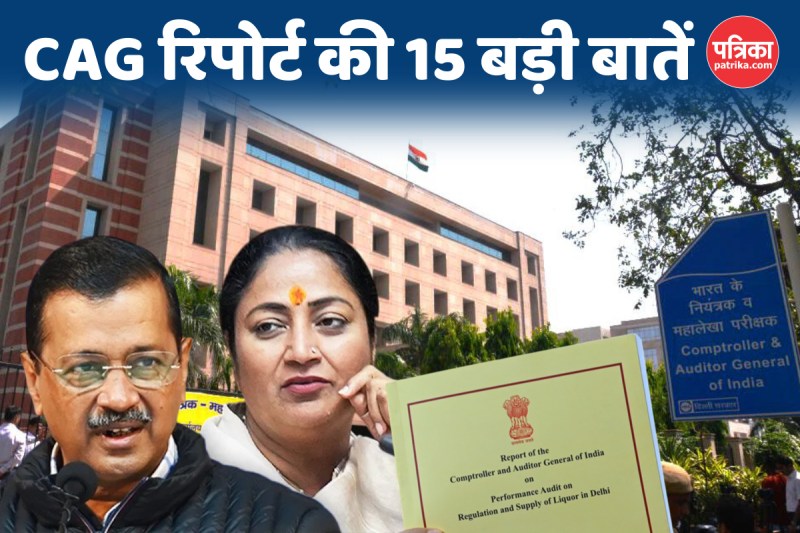
The Comptroller and Auditor General (CAG) report on the Delhi excise policy was presented by Chief Minister Rekha Gupta on the second day of the Delhi Legislative Assembly’s special session. According to the report tabled in the Assembly, the then Aam Aadmi Party (AAP) government committed various irregularities in the new excise policy, resulting in a loss of approximately Rs 2,002.68 crore to the Delhi government.
Following the release of the CAG report, troubles may increase for former Delhi CM Arvind Kejriwal, Manish Sisodia, and several other AAP leaders. In the Delhi liquor scam case, Arvind Kejriwal, Sisodia, and others have been named as accused. Both leaders have spent several months in Delhi’s Tihar Jail. Currently, the case is being investigated by the CBI and the Enforcement Directorate (ED).
Meanwhile, Speaker Vijendra Gupta suspended 21 AAP MLAs for three days for creating a ruckus over the tabling of the CAG report. The Delhi Assembly’s special session has also been extended for three days. This means opposition MLAs will not be able to participate in the House proceedings until Monday. Notably, AAP MLA Amanatullah Khan was not present in the Assembly on Tuesday, so he was not suspended.
1. Revenue Loss of Rs 2,002.68 Crore:
– Loss of Rs 941.53 crore due to not opening liquor shops in non-compliant areas.
– Loss of Rs 890 crore due to not re-auctioning surrendered licenses.
– Despite department opposition, a rebate of Rs 144 crore was given in fees to zonal licensees.
– Loss of Rs 27 crore due to not taking security deposits properly.
2. Violation of Licensing Rules:
– Rule 35 of the Delhi Excise Rules, 2010 was not implemented.
– Licenses were given to wholesale vendors who were stakeholders in manufacturing and retail trade, leading to conflict of interest.
– Control of the entire liquor supply chain was in the hands of a select few businessmen.
3. Huge Increase in Wholesalers’ Profits:
4. Weak Scrutiny of Licensees:
– No verification of assets, financial status, or criminal records before granting retail licenses.
– An investment of over Rs 100 crore was required to operate a zone, but no financial eligibility criteria were set.
– Many licensees had zero or very low income in the previous three years, raising suspicions of political patronage and proxy ownership.
5. Ignoring Expert Recommendations:
– The AAP government ignored the recommendations of its own expert committee while formulating the new excise policy for 2021-22, and no proper reason was given.
6. Creation of a Liquor Cartel:
– Previously, one person was only allowed to operate two shops, but the new policy allowed operation of up to 54 stores.
– This led to the liquor trade being concentrated in the hands of a few big businessmen. Licenses for 849 liquor shops were given to only 22 private entities, creating a monopoly in the market.
7. Promotion of Monopoly and Brand Promotion:
– Under the new policy, manufacturers were forced to associate with only one wholesaler, reducing competition.
– Just three wholesalers (Indospirit, Mahadev Liquor, and Brindco) controlled 71% of liquor supply. These three wholesalers held exclusive supply rights for 192 brands, leading to increased prices.
8. Violation of Cabinet Procedure:
– Major discounts and concessions were given without cabinet approval. No consultation was held with the Lieutenant Governor (LG), violating legal procedure.
9. Illegal Opening of Liquor Shops:
– Liquor shops were opened in residential and mixed-use areas without approval from MCD and DDA.
– In Zone-23, 4 liquor shops were wrongly declared as commercial areas, leading to their sealing by MCD in 2022.
10. Manipulation of Liquor Prices:
– The Excise Department allowed L1 licensees to set ex-distillery prices (EDP), artificially inflating liquor prices.
11. Irregularities in Quality Checks:
– Permission to sell liquor was given without quality test reports. Some test reports were taken from non-NABL certified labs, violating FSSAI standards.
– In 51% of foreign liquor cases, reports were either outdated, missing, or had no date.
– Proper testing for harmful substances like heavy metals and methyl alcohol was not done, increasing health risks.
12. Lax Action on Smuggling:
– The Excise Intelligence Bureau (EIB) took no proactive steps to prevent liquor smuggling.
– 65% of seized liquor was domestic, but no concrete action was taken.
– FIRs revealed repeated smuggling cases in some areas, but the government took no strict action.
13. Poor Data Management Leading to Illicit Trade:
– The Excise Department had disorganized records, making it impossible to track revenue loss and smuggling patterns.
– Lack of brand options and restrictions on bottle sizes led to an increase in illicit liquor trade.
14. No Action for Policy Violations:
– The AAP government imposed no penalties on licensees who violated excise laws.