Editor’s Note
Recent volatility in gold prices has prompted questions about the metal’s long-term trajectory. While sharp corrections can unsettle markets, analysts broadly view this as a consolidation within a sustained bullish trend, pointing to strong fundamentals and recent performance as indicators of enduring potential.
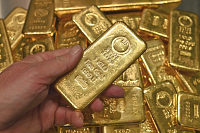
(BFM Bourse) – The precious metal has experienced sharp sell-offs over several trading sessions. Does this correction call into question the potential of the precious metal? In unison, market experts believe it does not.
For nearly two years now, the rise of gold in the market has seemed to withstand all tests. The price of the “barbarous relic,” as the illustrious economist John Maynard Keynes nicknamed it, has gained 64.6% in 2025 and secured a 13% gain in January alone. Since mid-2024, the price of an ounce of gold has almost doubled.
We have already written multiple times about the various factors that have contributed to the commodity’s surge.
The political and geopolitical uncertainties caused by Donald Trump’s erratic economic policy, particularly regarding tariffs, have reinforced gold’s role as a safe-haven asset. Especially as other traditional safe havens, such as the dollar and US bonds, have seen their status weakened this year. The increase in US deficits has also played a role.
More structurally, significant purchases by central banks, particularly China and emerging countries, have been a tailwind for nearly two years now.
Threats to the independence of the US Federal Reserve (Fed) by Donald Trump may also have pushed investors to seek refuge in gold.
Other more mechanical effects have played a role, namely the decline of the dollar and the return of Fed rate cuts. The first factor makes gold, whose prices are denominated in dollars, more attractive to investors who do not have the greenback as their reference currency.
The second also supports gold because the commodity does not generate income (unlike coupon-bearing bonds or dividend-paying stocks). Consequently, its price is aided by a decline in interest rates, as it becomes increasingly interesting to invest in gold rather than placing funds elsewhere.
However, like other precious metals (silver, even palladium), gold recently experienced an impressive episode of volatility.
The ounce surpassed $5,000 at the beginning of last week before nearing $5,600 two days later.
Was this movement too rapid?
The precious metal then fluctuated sharply several times. On January 29, gold suddenly lost 8% in a few minutes before climbing back to end with a slight decline.
Above all, the commodity then plunged violently in the following two sessions. On January 30, gold lost 8.95%, its largest single-session drop since 2013. On Monday, the “barbarous relic” followed with a new decline of nearly 5%, before rebounding and then more or less stabilizing in subsequent sessions. At the European close on Friday, an ounce of gold was trading around $4,960.
One element has been identified as the major trigger for this correction: Donald Trump’s nomination of Kevin Warsh to head the Fed.
Economists differ somewhat on Kevin Warsh’s exact views on monetary policy. But the central banker has a reputation for being a “hawk” (“restrictive”) regarding the Fed’s balance sheet. This means he is less inclined than other central bankers to conduct operations (such as security purchases in the market) aimed at supporting the economy by injecting liquidity.
This idea somewhat undermined investors’ bet of anticipating a pronounced depreciation of the dollar by taking refuge in gold, a bet that would have been justified by a very accommodative monetary policy.
Warsh’s nomination primarily provided the ideal pretext for investors to take profits on the commodity.
Alexandre Baradez explains that gold, like silver, was among the “most crowded trades,” meaning investment bets that everyone rushed into.
