Editor’s Note
The pioneering work of Dr. Edward J. Gübelin established the modern scientific foundation for gemology. His vast personal collection, now housed at GIA, serves as an enduring resource for research and education.
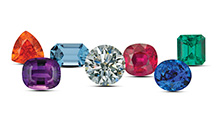
Dr. Edward J. Gübelin’s research on gems and their inclusions, conducted over more than 60 years, revolutionized the science of gemology. From his home laboratory in Lucerne, Switzerland, he visited gem-producing regions across five continents to collect samples, leaving behind meticulous, detailed records. His comprehensive collection was acquired by GIA after his passing in March 2005. The collection consists of approximately 2,800 gemstones representing 225 mineral species. It now serves as part of the GIA Gem Collection for research, education, and exhibition purposes.
Since its founding, GIA has acquired gemstone specimens to fulfill its educational and research mission. While most of these specimens were useful for identification purposes, they often lacked detailed origin information, and some were not particularly attractive.
This situation changed in 2005 with the purchase of the collection of the late Dr. Edward J. Gübelin from Lucerne, Switzerland. This collection comprises over 2,800 specimens representing 225 mineral and gemstone species gathered from major sources worldwide. Many of these gems are unique specimens in terms of color, weight, and optical phenomena, significantly expanding the educational and exhibition potential of the GIA Gem Collection.
As one of the world’s foremost gemologists, Dr. Gübelin spent over 60 years assembling this important collection. His lifelong study of inclusions within gemstones revolutionized the science of gemology, and his contributions helped establish the foundation for identifying all types of gemstones using a microscope. Details about Dr. Gübelin are published in the Winter 2005 issue of Gems & Gemology.
Since 2007, GIA has undertaken a project to characterize the gemstones in the Edward J. Gübelin Collection. This project has two main objectives: to systematically document these gems using various techniques, and to make the results available on GIA’s website as a valuable resource for students, gemologists, researchers, and anyone interested in gem materials. Using standard data collection methods, the characteristics of each gemstone were demonstrated through various techniques. Since the resulting data was collected from individual gemstones, this database allows interested researchers to examine, for example, potential variations in gemological properties among different origins for a specific gem species. This information was not available in previous publications that compiled gemological information into representative characteristic values.
Therefore, the project’s database will provide the following information for individual gemstones:
1. Photographs of the gemstone.
2. GIA Gem Collection number.
3. Gem species name, and where applicable, group name and variety name.
4. Geographic origin information (country, prefecture, state, district, county, town, mine name, etc.) as recorded in the collection records obtained from Dr. Gübelin.
5. Basic information about the gemstone. For example: facet cut (reported as a standardized shape name); carat weight (to two decimal places, 1 ct = 0.2 g); dimensions (in millimeters to three decimal places); transparency (transparent, translucent, opaque); color description (according to GIA’s terminology for colored stones).
6. Diagrams illustrating the shape and facet arrangement of the gemstone from the top, side, and bottom views. These diagrams are based on proportion measurement data obtained using the Sarin DiaVision system. They are not created for gems shaped as cabochons or other non-faceted forms.
7. Summary of standard gemological properties including optical character (uniaxial positive or negative), refractive index values (maximum/minimum RI values obtained from the gem’s table using a refractometer), calculated birefringence, calculated specific gravity, pleochroism, luster, long-wave and short-wave ultraviolet fluorescence (and phosphorescence) reactions, absorption spectra, and descriptions of all optical phenomena (such as color change or asterism). Facet arrangement diagrams indicate the approximate position of the optic axis when it could be determined by observing a glass sphere (acting as a condenser lens) placed above the gemstone under a microscope. In this setup, the gem is rotated using crossed polarizing filters until the centered optic axis interference figure is seen through the glass sphere. Even using this method, the optic axis of some gems could not be visually located.
8. General description of internal and external characteristics observable at standard magnifications (10x to 100x). Many internal features are photographed under a microscope, and the photomicrographs include brief explanatory text. Photomicrographs are not taken for gems where internal features are not prominently visible.
9. For most gems, multiple spectra are presented, including infrared, visible light, Raman, and photoluminescence. X-ray fluorescence spectra are also shown where major and trace elements were detected.
The initial data collection focused on corundum, spinel, garnet, beryl, and tourmaline, with results obtained for over 1,000 gemstones. The current project aims to provide fundamental characteristics. Two important types of scientific information—quantitative chemical analysis showing concentrations of major and trace elements present in the gem, and unit cell dimensions obtained by X-ray diffraction analysis—are not included in this project’s data. There are significant technical challenges in collecting such information for large faceted gemstones, but we hope to add it in the future.
Information for the first group of 50 stones (including corundum, spinel, beryl, garnet, tourmaline, and other gem minerals) is currently available in PDF format. In the future, an online database will make it easy to view and investigate the significant gemstones in the Edward J. Gübelin Collection. Furthermore, GIA plans to expand the database to include other gems in the GIA Collection and, potentially, historically important gems from other collections.
Museum:
Terri Ottaway, Collection Curator
Laboratory:
Mike Breeding, Research Scientist
Karen Chadwick, Staff Gemologist
Emily Dubinsky, Analytical Specialist
John Hall, Supervisor, Weights and Dimensions
Dylan Hand, Identification Technician
John Innis, Identification Technician
John Koivula, Analytical Microscopist
David Nelson, Metrologist
Nathan Renfro, Analytical Specialist
Andy Shen, Research Scientist
Education:
Andy Lucas, Manager, Field Gemology
Library:
Sharon Bohannon, Visual Resources Cataloger
Caroline Nelms, Library Research Analyst & Coordinator
Robert Weldon (Photography & Visual Communications Manager)
Research:
Al Gilbertson, Cut Research Project Manager
Brooke Goedert, Senior Research Data Specialist
Scott Hemphill, Researcher
James Shigley, Distinguished Research Fellow
