Editor’s Note
This article discusses adjustments to buyback policies by major gold retailers in response to market volatility, highlighting how industry practices adapt to external trading conditions.

Amidst sustained and severe fluctuations in gold prices, major gold retailers are taking action.
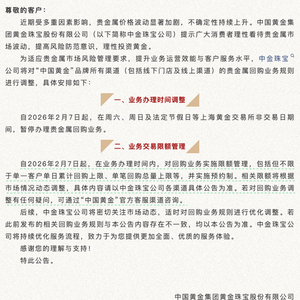
On the late night of February 6, China Gold Group Gold Jewelry Co., Ltd. (hereinafter referred to as “China Gold”) announced via its official WeChat account that starting from February 7, 2026, the company will suspend its precious metals buyback service on Saturdays, Sundays, and statutory holidays—days when the Shanghai Gold Exchange is closed.
According to a report by China National Radio, Liu Zhigeng, a renowned expert in finance, taxation, and auditing, analyzed that the recent intensified volatility in precious metal prices has brought significant operational risks and pricing challenges to gold buyback businesses. The core objectives of China Gold’s adjustment to limit buyback operations to trading days are threefold:

Liu Zhigeng stated that this rule adjustment is not intended to restrict consumer rights but is a prudent operational decision made by the company in light of the current market situation, and also an improvement to business standardization. Such practices already have precedents in the banking industry and among large gold retailers and are common risk management measures within the industry.
In addition to China Gold, leading retailer Caibai Co., Ltd. has also announced adjustments to its precious metals buyback business.
According to Caibai’s official WeChat account, starting from February 6, 2026, the company will suspend its precious metals buyback service on Saturdays, Sundays, and statutory holidays when the Shanghai Gold Exchange is closed. During business hours, the company will implement quota management for buyback operations, including daily buyback limits for the entire business or single clients, single-transaction volume limits, etc., which will be dynamically set.
Recently, the gold market has experienced severe volatility.
Spot gold rebounded strongly from a low near $4,400 per ounce after a significant sell-off on Monday, with a weekly swing of 14%. As of the close on February 6, it was reported at $4,966.61 per ounce, marking a year-to-date increase of 15.01%. In the domestic futures market, the latest price for the main Shanghai gold futures contract is 1,114.5 yuan per gram, representing an 11.46% drop from the recent high of 1,258.72 yuan per gram.
Furthermore, Wind data shows that the gold concept index has surged over 14% year-to-date. As of the close on February 6, China Gold’s A-share rose over 2%, with a year-to-date increase exceeding 40%; Caibai Co., Ltd. has risen over 70% year-to-date.