Editor’s Note
This article highlights 3D Systems’ participation in a major Tokyo manufacturing exhibition, where the company focused on promoting “Indirect Manufacturing”—the integration of 3D printing into established production workflows.
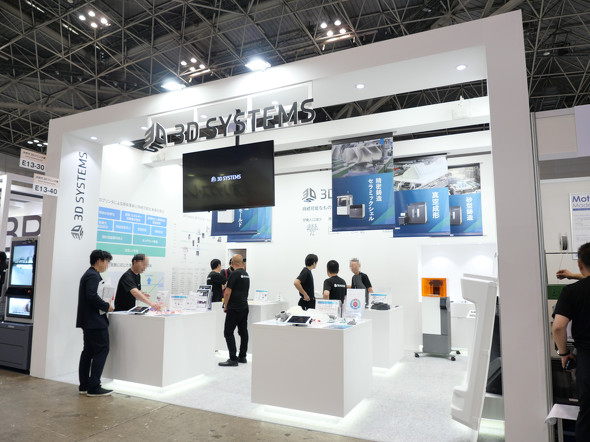
3D Systems exhibited at the “7th 3D Printing Pavilion” at “Monozukuri World [Tokyo] 2024” and promoted “Indirect Manufacturing,” which utilizes 3D printing in traditional manufacturing processes.
Indirect Manufacturing refers to a method where 3D printing is incorporated into a part of a traditional manufacturing process to achieve advantages such as improved quality and cost reduction.
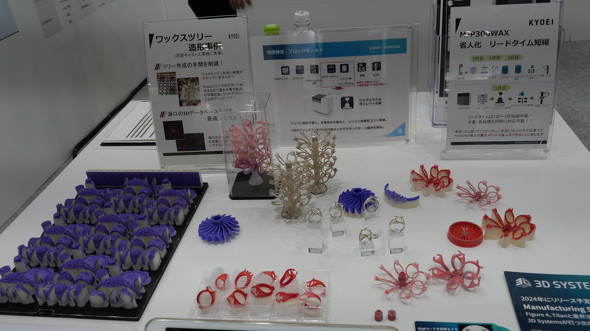
Specifically, it is an explanation of the wax pattern (investment casting) process used in jewelry manufacturing. Traditionally, a master model is created using a modeling 3D printer, a silicone mold is made from it, wax patterns are injection molded using that mold, and then jewelry is manufactured through investment casting. Based on this, the company uses a 3D printer capable of directly outputting wax (example models: ProJet MJP 2500W Plus, MJP 300W) to propose a method for creating wax patterns for indirect manufacturing.
Regarding investment casting, the company also explains that indirect manufacturing using 3D printing can bring significant benefits. Traditionally, a master model is created, a silicone mold is made from it, wax is injected into the mold, and after removing the wax, an investment mold is created and casting is performed. The challenge here lies in the time and cost associated with master model creation/prototyping, as well as the difficulty in reproducing complex shapes. In response to this challenge, the company proposes two methods.
One method is to use a 3D printer capable of directly outputting wax (example model: ProJet MJP 2500 IC) to produce wax patterns for indirect manufacturing. With this, the master model for creating wax patterns becomes unnecessary, reducing both time and cost, and it is possible to reproduce complex shapes.
The other method is a method using a modeling 3D printer (example model: SLA 750) and a dedicated investment casting material. It is an innovative technology where the material that becomes the core of the wax pattern is modeled with a modeling 3D printer. By ensuring high dimensional accuracy and making the material itself a disposable casting mold, it achieves both ease of removal and strength.
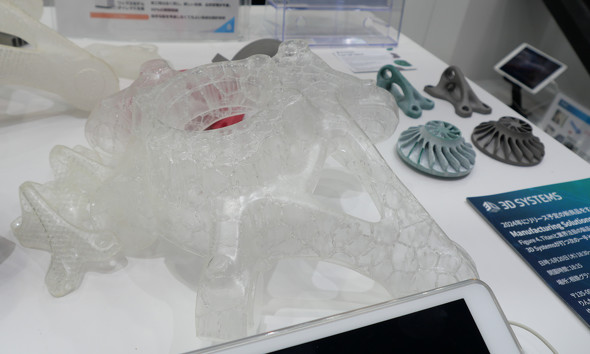
Regarding casting, there is also the idea of indirect manufacturing of final products using metal 3D printing, but the spokesperson emphasizes, “If it is indirect manufacturing that utilizes 3D printing in a part of the traditional manufacturing process, the basic process is no different from tradition, so you can manufacture products with the same post-processing as before. This core concept is significant.”
Another example that was particularly noteworthy in the explanation of indirect manufacturing is the method of repair/manufacturing using gypsum bonding. For example, in cases like repairing a broken antique, where you want to restore or manufacture a part using the same materials and techniques as the original. Gypsum bonding is a method that responds to such needs. Specifically, the 3D data of the product (e.g., antique) is used as a base, and its shape characteristics are captured with a precision scanner like a human fingerprint. Then, adhesive and filler are applied digitally to that point, and modeled with a 3D printer (example model: ProJet MJP 2500Plus). Adhesive and filler are injected from the injection port, and on the outer surface of the gypsum, the gypsum is applied like a human fingerprint, and the core is extracted (gypsum product fabrication).