Editor’s Note
As the global luxury market rebounds toward a projected €380 billion by 2025, 3D printing is emerging as a key enabler of innovation—from bespoke accessories to high-end automotive components. This article explores how additive manufacturing is reshaping craftsmanship and customization in the luxury sector.
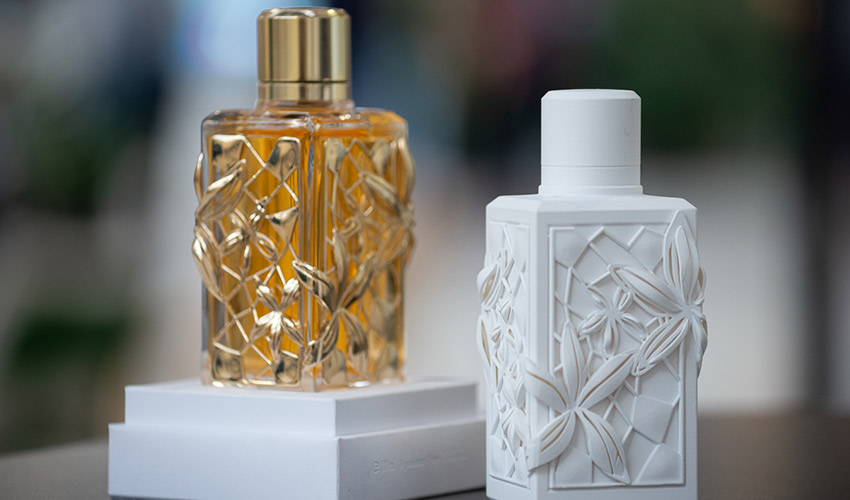
According to a report published by the Italian luxury goods manufacturers’ foundation, Fondazione Altagamma, and the strategic consulting firm Bain & Company, the global luxury goods market is experiencing a rapid post-pandemic recovery and could reach €380 billion by 2025. In this growing market, 3D printing has a role to play. From accessories and eyewear to haute couture pieces and car components, additive manufacturing has much to offer luxury brands.
Companies such as Dior, Louis Vuitton, Bentley, and Porsche have already taken the step, attracted by the many advantages of 3D technologies. But why haven’t some brands adopted additive manufacturing yet? How can they integrate it? Today we will examine three fundamental pillars of the luxury industry: cars, jewelry, and haute couture, to learn more about how luxury companies implement new technologies and the added value they obtain.
Many luxury and sports car manufacturers tend to demand very high standards. This category of automakers needs parts that are both visually remarkable and extremely durable. Additive manufacturing is the ideal choice to meet this challenge. It facilitates the manufacturing of complex shapes and allows weight to be minimized by applying material only where it is truly needed. Furthermore, 3D printing offers a cost-effective way to produce small volumes.
Among the applications of 3D printing in the automotive sector is the ability to print much more customized components directly from the factory, giving the car unique performance characteristics. Bentley is one of those who have already implemented this. Consumers spend thousands of euros each year customizing their vehicles, and manufacturers can leverage additive manufacturing in this regard. Another application of 3D printing is the creation of hard-to-find or obsolete parts. Collectors of vintage cars are increasing, and manufacturers are striving to restore and preserve certain models considered gems.
It is also evident that additive manufacturing facilitates the creation of car components. One of the best examples is likely the case of Divergent, a California-based high-end sports car company that manufactures ultra-lightweight chassis and whose ambitious goal is to design all parts of its cars using 3D technologies. But Divergent is not alone: 1016 Industries has also made 3D printing available to luxury brands such as McLaren, offering optimized final parts.
Furthermore, 3D technologies enable the provision of fully functional prototypes for rigorous testing and simulations, tooling for limited-edition components, and customized low-volume production parts for final use in vehicles.

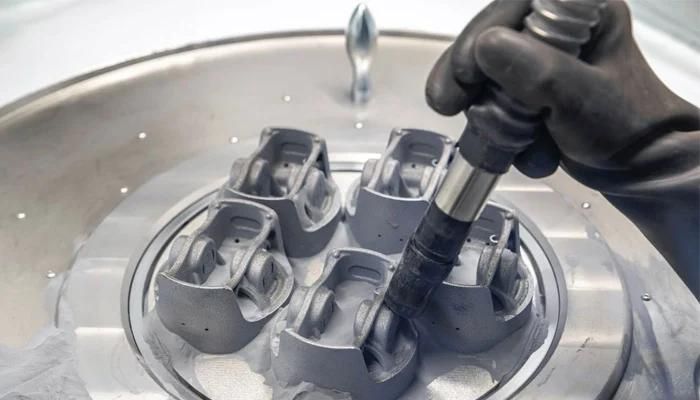
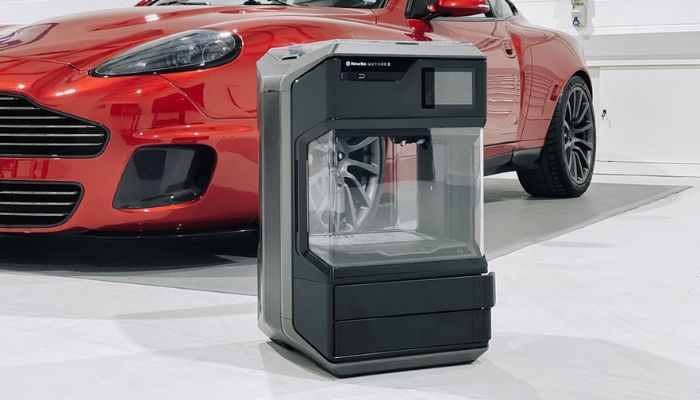
There are several 3D printing technologies used to produce automotive parts, depending of course on the final application. For example, Porsche uses laser powder bed fusion to create pistons for the 911 GT2 RS from metal powder. The British luxury car design company Vital Auto uses SLA technology, also known as stereolithography, to produce other automotive parts such as air vents or door seals. Another of the most used technologies in this field is FDM technology, which is mainly used in the prototyping phase, as it is a fast and effective way to physically have components before final production.
3D printing significantly shortens lead times: any part can be available in just a few days or even hours, even the scale model of a complete car, and at a lower cost. Moreover, 3D printing allows working with thinner sections, more customized and tailored designs, and testing different versions quickly and at lower cost. This is the case with Bugatti, which 3D printed its monolithic eight-piston titanium brake caliper, allowing it to achieve savings and improve performance by reducing the part’s weight and making it more resistant.
(Note: The article appears to be truncated here. The section on haute couture and jewelry, hinted at in the introduction and by the search keyword “fabrication joaillerie imprimée 3D”, is missing from the provided content.)