Editor’s Note
This article highlights a unique approach to luxury tourism, where a multi-generational pearl company is transforming its working farm into a resort. The project aims to offer authentic experiences deeply connected to the local environment and community, seeking to revitalize the coastal “Satoumi” ecosystem.
Kakuda Pearl, a pearl production and sales company spanning three generations in Ise City, Mie Prefecture, will open a luxury resort facility in April 2023. The company is revitalizing a pearl farm it owns in a cove of Ago Bay in Shima City into a resort offering authentic local experiences. By involving local agriculture, forestry, and fisheries that coexist with community life, the resort aims to reconstruct a “Satoumi” (coastal sea where humans and nature coexist) through its operations. This reconstructed environment will be offered to guests as an experience and returned to the region through cultural inheritance and economic benefits. The goal is to create a world-class luxury resort based on a circular tourism model.
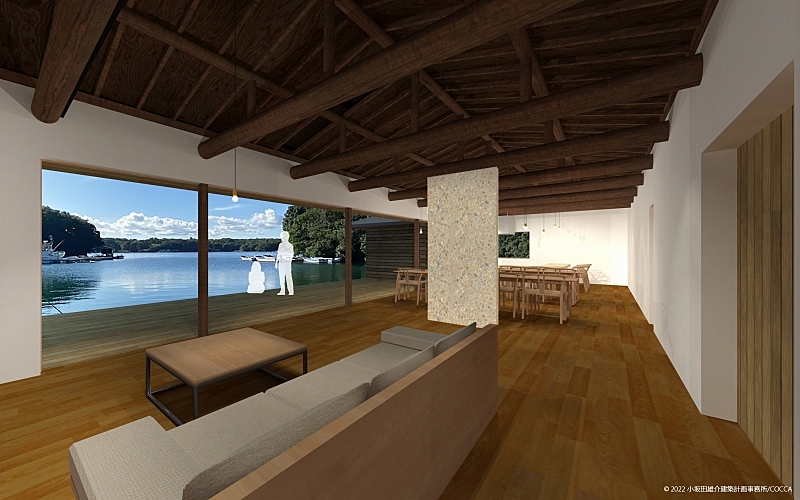
Founded in 1931, Kakuda Pearl has been involved in pearl cultivation, processing, and sales in Ago Bay for three generations. The planned accommodation facility, “COVA,” will regenerate an area of a cove that was used for pearl cultivation and production up until half a century ago. Buildings such as the processing plant for harvested Akoya oysters will be renovated, with guest rooms, dining areas, sauna & spa facilities, etc., each housed in separate buildings (some are newly constructed). The resort’s name was decided based on how former employees used to call the area “Kakuda’s Factory (Kouba).”
The resort will be developed on a 40,000-square-meter site within Ise-Shima National Park, featuring only four rooms. The grounds will include orchards and vegetable fields. Meals will center on Shima’s seafood, offering fusion cuisine that incorporates local ingredients.
The resort will also focus on activities that allow for authentic experiences of Ago Bay’s nature and Satoumi life. In addition to popular marine activities like kayaking, SUP, and cruising, it plans to revive pearl cultivation, offering experiences like shell cleaning and cage changing, as well as workshops on local cuisine. These will be provided in cooperation with local agriculture, forestry, and fishery businesses and residents. The accommodation rate, including stay, meals, and activities, is set at 110,000 yen per person per night for two people sharing one room, and 90,000 yen per person per night for four people sharing one room at full capacity.
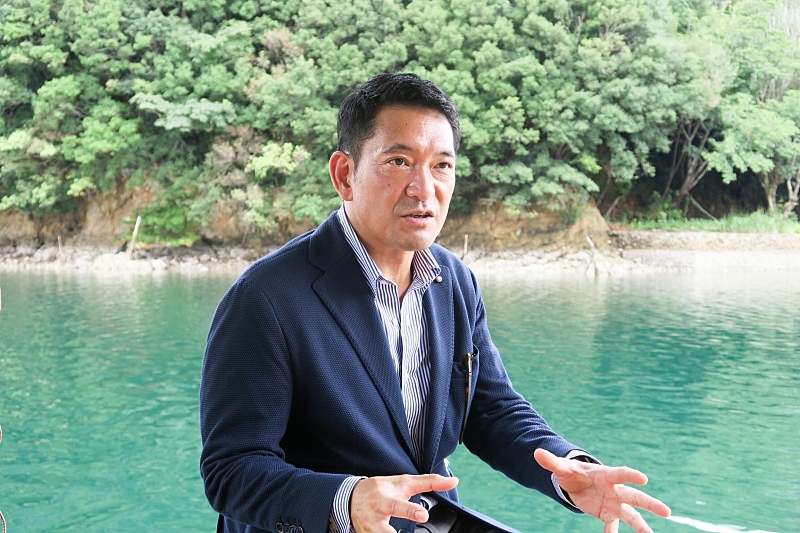
Joji Kakuda, the company’s representative director, explains COVA’s core value: “Experiencing the nature and culture of Satoumi, the fisheries and agriculture, and the unique activities of Ago Bay in an adult way, applying a pleasant load to the mind and body. By swinging between load and rest, bustle and silence, childlike and adult minds, the sense of relaxation deepens, allowing for physical and mental revitalization. We want our guests to take this feeling home with them.”
The cove facing COVA is a public sea. Therefore, guests can see local fishermen’s scallop farms right in front of them, and some fishermen set out from this cove morning and evening. Guests will spend their holidays not in a resort isolated from reality, but in the extraordinary (for them) daily life of Satoumi, where people and the sea coexist.
The target image is “myself” (Mr. Kakuda): active generations with high experience but still strong curiosity, who value communication with locals and seek adult pleasures. They are economically comfortable and understand the value of authentic experiences. “At the end of the trip, I want to provide a stay that feels like a retreat where guests feel COVA is a place to return to, yet ideas for the next day’s work start bubbling up,” Mr. Kakuda says.
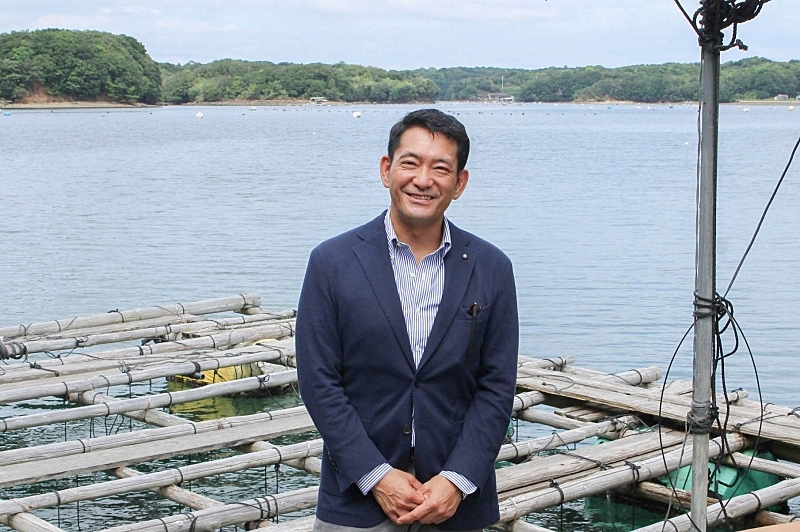
Why did Kakuda Pearl decide to open “COVA” with such a concept? There are two backgrounds.
One is effective utilization of assets. The other is a sharp decline in sales due to the impact of COVID-19. Although exports have turned favorable recently due to the weak yen, Mr. Kakuda strongly desired, “By the time COVID-19 subsides, I want to start other profitable businesses, not relying solely on pearls.”
This situation is not unique to the company; local pearl cultivators are in the same position. Moreover, cultivators have long needed side jobs for a living, and many older operators intended to end the business with their generation. “If there is another stable business, pearl cultivation can survive. Starting a new business will also benefit the pearl industry,” Mr. Kakuda thought.
Why choose the accommodation business for the new venture in this location? There are also two triggers.
One is the confidence that the charm of Satoumi could be a weapon in the accommodation business. For Mr. Kakuda, it’s a place he has been familiar with since childhood and still visits occasionally as an adult to swim, fish, or have barbecues. While he felt “the enjoyment here is universal,” he wasn’t confident it could be “sold.”
However, when a local accommodation operator encouraged him, saying, “If you utilize the tranquility, what exists here, and what can be done here, there is potential,” his mindset moved forward.
The other trigger is that “sustainable” and “responsible” have become increasingly important even in his main battlefield, the jewelry industry. For gemstones, not only beauty but also appropriate production processes are now evaluated. “Jewelry also requires spiritual comfort. Let’s do the same thing in the accommodation business,” Mr. Kakuda’s resolve solidified.
When jewelers from Hong Kong visited for inspection, many were breathless at the scenery and tranquility, expressing their admiration. The belief that “the nature and human activities of Satoumi resonate with visitors” turned into conviction.
In many regions, a “division” has existed between tourism and local businesses. Ise-Shima is no exception. Issues like speedboats tearing cultivation nets or creating large waves that interfere with fishing have made tourism unwelcome by some fishermen.
However, cooperation from local businesses is essential for the accommodation venture COVA envisions. When Mr. Kakuda first spoke to cultivators in the cove, the reaction was positive: “That’s fine.” A local charcoal burner told him, “Actually, I’ve been wanting to try something like that.” After detailed explanations, they gained support for the concept of “reconstructing the future Satoumi by offering its experiences to visitors.”
Mr. Kakuda notes that the smooth progress is largely due to “being a local company rooted in the region.” During the 2016 Ise-Shima Summit, Mr. Kakuda proposed a project to have national leaders wear pearl lapel pins as substitutes for participation certificates to promote Ise-Shima’s pearls. He negotiated with relevant ministries and realized the project. This resulted in a sales effect of 200 million yen for the local pearl industry after the summit. “I think being recognized as an operator with a track record of working to give back to the region made it easier to gain trust,” he speculates.
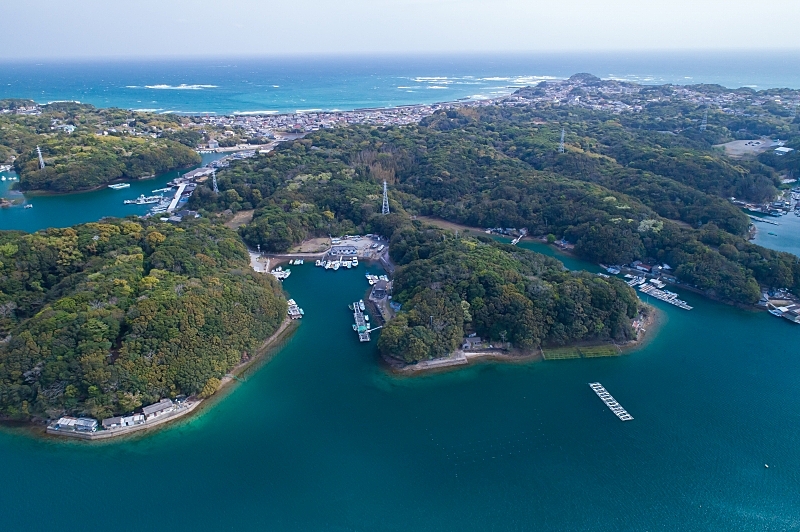
The calm cove of Tomoda-ura facing COVA has a sea color deeper than the surrounding forest’s green, further accentuating the region’s tranquility. According to Mr. Kakuda, this green is the color of chlorophyll, a symbol of Tomoda-ura’s richness.
However, Mr. Kakuda says, “Recently, the richness of Satoumi has been weakening.” The once rich sea had nutrients discharged from human activities circulating in nature, but recently the population in Satoumi areas has decreased. The virtuous cycle balance of the past has collapsed, reducing seawater nutrients. That is precisely why, through COVA’s operation, he is eager to “reconstruct a new Satoumi landscape and environment for the future.”
In the orchards and fields created on COVA’s grounds, olives and citrus fruits once aimed for production in Shima will be planted. For charcoal making, the native Ubame oak in the surrounding forest will be systematically cut for material, helping maintain a balance for the healthy survival of the Satoumi forest. The heat source and charcoal produced in this process will be used for the sauna’s stone bath.
In the sea, they plan to revive Aosa nori (green laver) cultivation and pearl cultivation, which once thrived in the region. Even on a small scale, they aim to pass on that scenery and culture to the next generation. For local businesses, new initiatives should provide opportunities to overcome environmental changes, implement economic measures, and create employment opportunities for young people.
The circular resort management COVA undertakes on the stage of Shima’s Satoumi. It will be interesting to see what whirlwind it stirs in regional tourism after its opening in spring 2023.