Editor’s Note
**Editor’s Note:**
This piece explores how vacanza, an affordable accessories brand with items averaging under NT$500, achieved remarkable success in Taiwan’s competitive retail market. From a humble stall to 28 stores and nearly NT$500 million in annual revenue, founder Xu Yizhi’s strategy of high-volume, low-margin sales has proven effective, even outperforming luxury counters in per-ping revenue.
Walking into Shin Kong Mitsukoshi’s Nanxi store, alongside common international brands, you might spot an accessories brand appearing in shopping districts across Taiwan: vacanza. Its small counter displays over 3,000 types of earrings, bracelets, necklaces, and other accessories. Unlike other higher-priced accessory counters in the department store, vacanza’s average item price is under NT$500. Despite being affordable, founder Xu Yizhi revealed that their per-ping (unit area) sales once reached NT$600,000, placing them in the top tier among department stores that prioritize sales per unit area.
Starting from an unknown small stall, vacanza has transformed into a brand with 28 stores across Taiwan. With an annual revenue of nearly NT$500 million, it firmly holds the top market share in Taiwan’s affordable accessories sector. Xu noted that in the past, accessories were seen by most as just an accessory accounting for 1-2% of clothing sales. Consumers either bought expensive international brands or cheap, low-quality items. Sellers, due to low sales volumes, couldn’t demand quality from suppliers.
Identifying pain points on both sides, Xu launched the vacanza brand in 2012. “For accessories, they are not necessities. People don’t specifically go to browse an accessory store; they usually visit a shopping district and happen to see accessories,” Xu said. His strategy focuses on making accessories visible during consumers’ shopping trips and enhancing their desire to purchase.
During the COVID-19 pandemic in 2021, daily revenue at some stores dropped to just 5%. While many chose to close unprofitable stores, vacanza expanded against the trend. “The pandemic will eventually end,” Xu said. vacanza, meaning “holiday” in Italian, originally focused on consumers wearing accessories on vacation. But the pandemic halted all travel, and with consumers staying home, demand for accessories nearly vanished. Xu had to rethink the meaning of “holiday.”
Xu believes a holiday is about enjoying the present moment, a feeling that can also be experienced during shopping—pleasant and worry-free. He redefined the purpose of a holiday as making consumers feel joy while shopping, ultimately driving purchases. “If accessories aren’t necessities, what should our strategy be?—Find better, everyday necessities to complement people’s impulsive desires.”
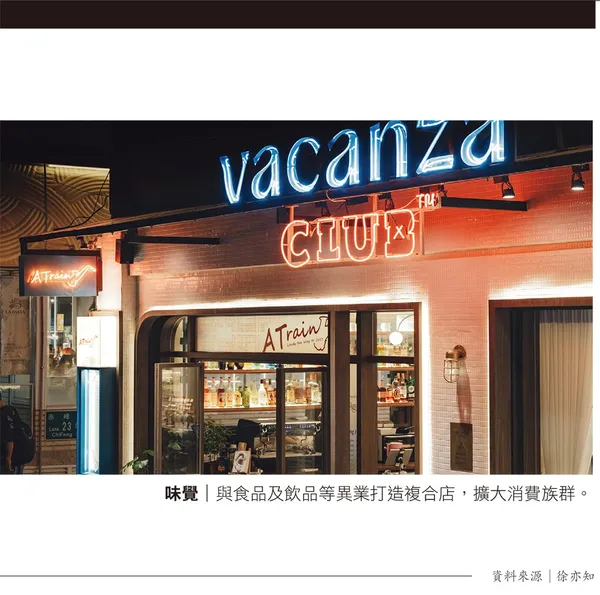
Thus, vacanza collaborated with a well-known bakery and a bar, creating a hybrid store “vacanza club” with “A-Train.” This not only increased customer dwell time from over 20 minutes to 35 minutes but also attracted non-target customers like local residents due to the inclusion of necessities like bread and beverages.
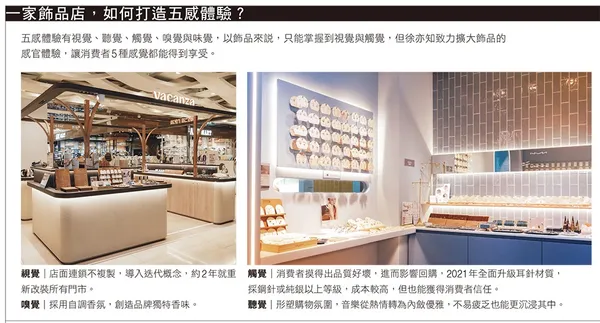
“Accessories can’t engage the sense of taste in the five senses, but a hybrid store can,” Xu explained. “We’re used to small-scale testing. If successful, we invest resources to scale up.” After success, they partnered with beverage brand “SOMA” to create different hybrid stores, boosting foot traffic and revenue by 30%, with monthly sales reaching up to NT$3 million.
Xu admitted previous store failures, making small-scale testing crucial for expansion. “Once a test succeeds, it could become your second growth curve. If you anticipate a plateau at 40 stores, can you create your first and third curves now?”
Being on the front line with consumers, Xu observed customers hesitating over products. Further inquiry revealed they didn’t have pierced ears. “About 3 out of 10 women don’t have pierced ears; among our employees, 4 out of 10 don’t. After estimation and market research, we knew about 30% of people lack pierced ears.”
In September 2022, he renovated existing stores to include the first “Ear Clip Specialty Store” for non-pierced customers, doubling foot traffic and increasing monthly revenue from NT$700,000 to NT$1.4 million.
“This needs to scale quickly,” Xu said. After the first test succeeded, three more ear clip specialty stores were added by December. He believes that once a strategy’s seeds are sown, the ear clip market should be rapidly captured. “Think two steps ahead when acting.” If successful, resources are invested, and the next step follows immediately.
Xu considers failure a stepping stone to success, allowing for the cost of failure in operations. “Experiment within budget, or it’s hard to find a second growth curve.” Minimizing failure means safe management but also makes innovation or change difficult.
Products and store designs must be continuously iterated, as freshness is immediately reflected in sales. “Every product has its lifecycle. You need to estimate its duration and have a second generation ready for iteration,” Xu said. Even if elements differ, updates keep consumers interested.
Constantly innovating in store formats and products, besides finding viable strategies through small tests, also maintains consumer freshness. “Our cross-industry collaborations should surprise consumers.” Xu doesn’t fixate on repurchase rates; his target audience is every potential consumer. He believes a successful freshness strategy naturally leads to remarketing.
Beyond trying new store formats, vacanza periodically changes visual strategies. Each store has a unique exterior, and “every generation, about every two years, all stores are renovated.” Once iteration occurs, all 28 stores are revamped to avoid consumer boredom.
Stores have now reached the fourth generation, with each designed by Xu himself, treating stores and counters as art. Results are immediate; for example, after iteration, the Kaohsiung Hanshin Arena store saw a twofold increase in sales. “Once you iterate, it comes back to life.”
Born in 1983, graduated from the evening department of Electronic Engineering at St. John’s University. Former quality inspection engineer in electronics, sold accessories in night markets, officially founded vacanza in 2012, opening the first physical store in Taipei’s East District. Entered department stores in 2016.
Founded: 2012
Revenue: Nearly NT$500 million for all business units (including cross-border), top market share in Taiwan’s accessories brand
Number of Stores: 28
Business Items: Earrings, necklaces, bracelets, rings, and accessories like hair clips and fragrances.
Search Keywords: Accessories Supplier