Editor’s Note
This article examines the complex reality behind EU sanctions on Russian diamonds, revealing a significant import spike into Belgium months after the Ukraine invasion. It highlights the challenges in enforcing trade restrictions and the ongoing debate over closing loopholes in the current sanctions regime.
Russian diamonds continue to flow freely into the European Union (EU). This reality persists despite the numerous sanctions imposed on Putin’s government since the invasion of Ukraine. How is this possible?
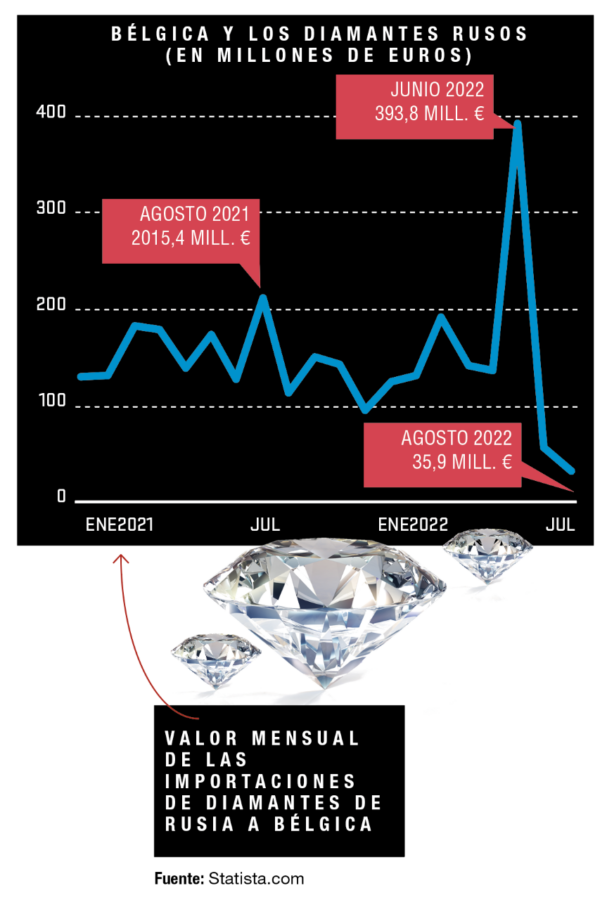
As data from the National Bank of Belgium shows, four months after the war began (in June), there was a significant spike in Belgian diamond imports from Russia, reaching a value of nearly €400 million. This striking figure has, however, drastically decreased since August 2022.
According to The Guardian, Belgium is the only EU country importing a significant volume of diamonds from Russia. While the government itself claims it would not block a ban, diamonds have so far repeatedly evaded the sanctions list, despite calls from Ukrainian President Volodymyr Zelenskyy.
Russian diamonds are still not subject to sanctions. Belgium continues to buy them, despite pressure from certain EU countries like Poland and the Baltic states, which want these precious stones included in the next round of sanctions.
Europe has stopped importing coal from Russia, aims to phase out most Russian oil, and has ceased buying many products like gold, caviar, and vodka. However, diamonds have repeatedly avoided drastic measures. The European Commission has promised to push forward with this sanction before the end of the year. Meanwhile, the United States has banned the import of non-industrial diamonds from Russia, and the United Kingdom imposed sanctions on the exporter group Alrosa in March.
Yet, no country has a diamond market as large as Belgium’s. Cessation of Russian imports could endanger 10,000 jobs—4,000 direct and 6,000 indirect. Privately, the Belgian government warns the EU of this risk, though publicly it insists it is not blocking sanctions.

However, when Russian diamond mining companies were included in the latest sanctions package, Belgium abstained. Subsequently, the sanctions were adopted unanimously.
The Belgian city of Antwerp has traded diamonds since the 15th century. According to the trade association Antwerp World Diamond Center (AWDC), some 1,700 companies and 4,500 traders buy and sell this natural precious stone.
Before the war in Ukraine, 25% of the gems passing through Antwerp came from Russia. The country imported Russian diamonds worth €1.8 billion in 2021 and €1.2 billion in the first eight months of 2022. Now the trade has become a “roller coaster,” with a sharp rise to €393.8 million in June before plummeting thereafter.
In the same month of 2021, the figure was €215.4 million, 83% lower. Faced with this situation and the highly unlikely cessation of hostilities, Belgian traders may need to consider making artificial diamonds fashionable among lovers. Although, bad luck, these are also produced in Russia.