Editor’s Note
As gold prices reach historic highs, the diamond market faces a starkly different reality. This article examines the sharp divergence between these two classic stores of value, highlighting a nearly 50% decline in diamond prices since 2022. The contrasting trends underscore shifting consumer preferences and market dynamics in the luxury goods sector.
Recently, gold prices have experienced significant volatility, triggering a wave of market investment and trading activity. Meanwhile, the previously red-hot diamond market has seen a continuous price decline. According to data from the International Diamond Exchange, the diamond price index has fallen from a peak of 158 in 2022 to around 84.01, representing a drop of over 45%. In January of this year, De Beers, the world’s largest diamond producer, once again lowered the price of rough diamonds over 0.75 carats, with market predictions suggesting a price reduction of 10% to 15%.
“When getting married, I was torn between a gold ring and a diamond ring, but ultimately chose the gold ring, mainly considering that gold might hold its value better,” said Xiao Su, a post-95s individual who got married last year.
Xiao Su’s thinking is not an isolated case. The reporter inquired with several friends who got married in the past two years, and almost none of them chose diamond rings. The situation was the same during offline market visits:
At 11 a.m. on February 5th, at the Chengdu Lihua Street Jewelry Market. Even though it was a weekday morning, many gold stores still had young people selecting gold products. In contrast, the reporter saw no customers entering some stores that exclusively sold diamonds.
In jewelry stores that sell both gold and diamonds, sales also present a stark contrast. “We are getting married soon and plan to look around more,” said a lady who was selecting items. On the other side of this jewelry store, the diamond area was deserted.

The staff showed the reporter lab-grown and natural diamonds, which were indistinguishable to the naked eye. “Even the identification machines in ordinary stores cannot tell the difference between the two. Their physical and chemical properties are the same; one is ‘wild’ and the other is synthetically produced.”
She joked with a smile that it’s a bit like free-range eggs and factory-farmed eggs; the nutrition is similar, but one is laid by chickens running outside, and the other is laid in an industrial feeding facility.
The “2024 China Jewelry Industry Development Report” released by the China Gems & Jewelry Trade Association in May last year corroborates the above situation:
Why are prices falling?
According to public information, global proven natural diamond reserves are approximately 2.5 billion carats. Furthermore, diamond mines are discovered in different countries every year.
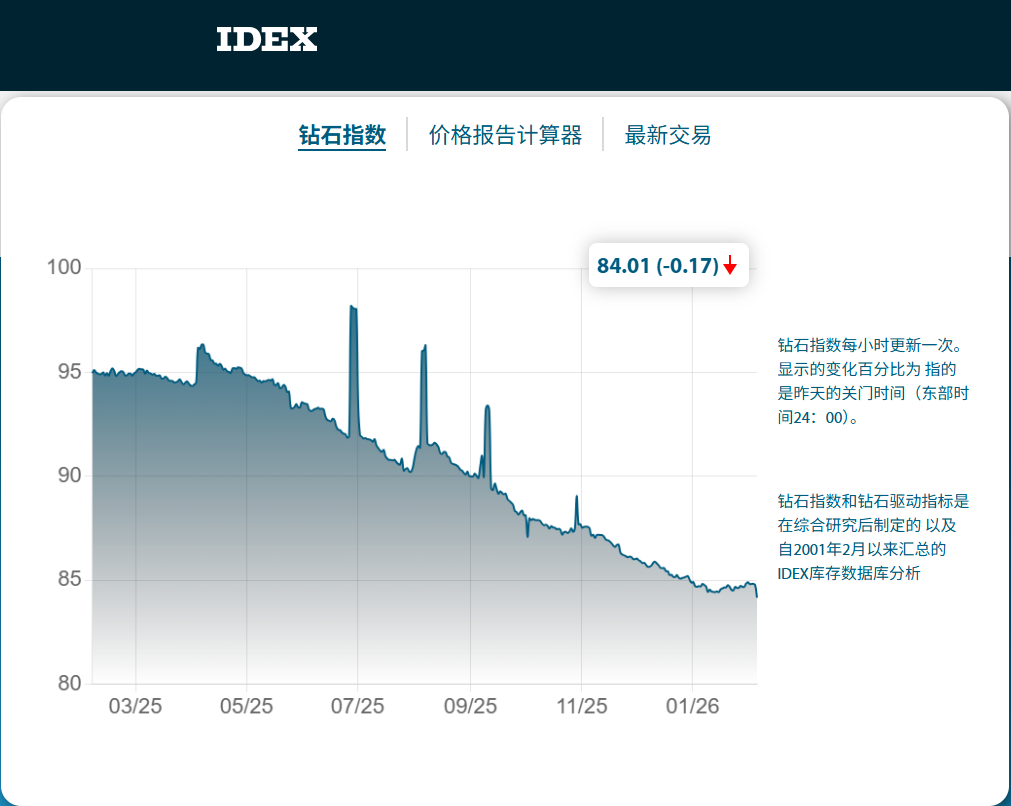
Due to declining scarcity, diamonds have low liquidity in the secondary market.
The “Natural Diamond Industry Research Report” jointly released by the De Beers Group and Nielsen Consulting last year also showed that:
Apart from the lack of scarcity and investment value,
The “Natural Diamond Industry Research Report” points out that rising consumer interest in non-diamond products (such as gold, pearls, jadeite, etc.) and intensified competition from lab-grown diamond jewelry have contributed to the price decline of natural diamonds.
What consumption trend does the hot gold sales and cold diamond sales reflect?

Zhu Feiyan believes the market is severely polarized. High-end, scarce jewelry remains relatively popular, with the core reason being its asset preservation attribute. For more mass-market products, influenced by young people’s self-pleasure consumption view, brand溢价 will weaken.