Editor’s Note
The enduring slogan “A diamond is forever” has long underpinned the gemstone’s symbolic and market value. Yet, as industry giant De Beers implements further price cuts, we examine the pressures reshaping the traditional diamond market and what this may signal for its future.
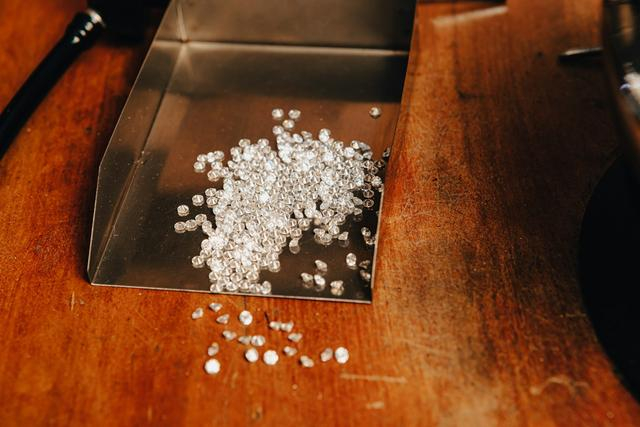
According to a report by Yicai, at this year’s first routine diamond auction, De Beers significantly lowered the prices of rough diamonds above 0.75 carats. The specific extent of this price adjustment is currently unknown. Informed sources stated that De Beers adopted a unified pricing and invoicing policy at this auction—no longer pricing each box of diamonds separately but issuing a consolidated total price invoice, making it difficult to calculate the exact price reduction. Industry insiders estimate the negotiation range to be around 10%-15%.
De Beers’ price cut stems from the price decline following a drop in global diamond demand. According to the RapNet Diamond Price Index (RAPI), in 2025, the RAPI for diamonds above 3 carats fell slightly by 0.4%. Smaller, everyday consumer-grade diamonds like 0.3-0.5 carats, impacted by lab-grown diamonds and weak demand, saw significant price drops, with 0.5-carat diamonds falling over 20% for the full year of 2025.
Against the backdrop of declining demand, De Beers has already conducted multiple rounds of price adjustments. According to CCTV Finance, De Beers played the “price reduction card” at its first rough diamond sight in January 2024, lowering prices for various types of rough diamonds. Among them, rough diamonds above 2 carats saw reductions of over 15%; those between 0.75 and 2 carats saw average reductions of 10%-15%; those below 0.75 carats were reduced by 5%-10%; the comprehensive reduction was approximately 10%. In December 2024, reports indicated that De Beers once again cut diamond prices across the board by over 10%.
However, De Beers’ situation has not improved significantly. According to Xinhua Net, De Beers lowered its full-year 2024 production guidance from the original 29-32 million carats to 26-29 million carats.
Recently, diamond industry giant De Beers once again lowered rough diamond prices, sparking widespread global discussion about the future prospects of the diamond industry. Where is the diamond market headed?
Firstly, De Beers’ price reduction is essentially a rational return of the diamond value bubble. Its expensive nature fundamentally lacks irreplaceable support. The chemical essence of a diamond is merely carbon, sharing the same origin as ordinary graphite. Its natural scarcity is more a result of artificial manipulation than absolute natural scarcity. During De Beers’ peak monopoly over global diamond sources, through strict control of supply, stockpiling, and production reduction, it deliberately created a market illusion of “rarity breeds value,” transforming an ordinary mineral into a high-value commodity.
This monopoly-based pricing system is inherently fragile. Once the monopoly structure is broken and market supply-demand dynamics are restructured, prices inevitably return to their true value range. Compared to assets like gold, which have a globally unified pricing and strong liquidity, diamonds lack both an intrinsic value anchor and a standardized valuation system. The bursting of their price bubble was only a matter of time; De Beers’ price cuts merely conform to this objective law.
Secondly, De Beers’ long-term dominance in the diamond market was key to its success in strongly associating diamonds with love. Through a series of meticulously planned marketing campaigns, De Beers successfully established the notion of “A diamond is forever” in consumers’ minds, making diamonds a symbol of love and an essential token of marriage. This marketing strategy turned diamonds into a one-time consumer product difficult to resell. When purchasing diamonds, consumers often focus more on their symbolic meaning than their actual value.
However, this marketing model now faces unprecedented challenges. With the diversification of society, people’s values are constantly changing. An increasing number of consumers are questioning the necessary link between diamonds and love, believing that love should not be measured by material possessions, let alone held hostage by a commercialized product like diamonds. Moreover, the secondary market for diamonds is not active, and their value retention and appreciation capabilities are highly debated. After purchasing a diamond, consumers often find it difficult to resell it at a reasonable price, significantly diminishing its actual value. Therefore, the diamond-love narrative constructed by De Beers is no longer as solid as before. Consumers have become more rational when buying diamonds and are no longer easily swayed by such marketing concepts.
Thirdly, technological breakthroughs in lab-grown diamonds and the awakening of consumer awareness have completely shattered the diamond love narrative and scarcity myth, stripping natural diamonds of their past core competitive advantages. With the maturation of technologies like High-Pressure High-Temperature (HPHT) and Chemical Vapor Deposition (CVD), lab-grown diamonds are indistinguishable from natural diamonds in physical and chemical properties, even to the naked eye or ordinary testing instruments, while their prices are only one-fifth or even lower. China, as a core force in global lab-grown diamond production, has further lowered market prices with its production capacity advantage, delivering a dimensional blow to natural diamonds.
More importantly, younger consumers, represented by Generation Z, are no longer buying into the “diamonds equal love” marketing rhetoric. Their rational consumption awareness has significantly increased, placing greater emphasis on cost-effectiveness and practical utility. They no longer see diamonds as a necessity for marriage but equate them with ordinary jewelry, opting for affordable lab-grown diamonds or turning to categories with better value retention like gold. This shift in consumer perception means the emotional premium of diamonds has lost its audience base. With natural diamond demand continuously shrinking, De Beers can only maintain market share through price reductions.
Fourthly, from a long-term industry trend perspective, the diamond market will completely shed its “luxury halo” and return to its essence as jewelry, presenting a stratified pattern of “high-end niche value retention, mass-market affordability.” Low-priced diamonds becoming mainstream is inevitable. Diamonds will not disappear but will bid farewell to the era of high prices pursued by all, gradually blending in with various gemstones. Their market positioning will converge with colored gemstones like rubies and sapphires, relying on design, craftsmanship, and branding for differentiated competition rather than relying solely on material scarcity premiums.
For small-carat, medium-to-low quality natural diamonds, under continued pressure from lab-grown diamonds, there is still significant room for price decline. Eventually, a stable price gap will form between them and lab-grown diamonds, meeting the needs of different consumer tiers. Large-carat, high-clarity natural diamonds, due to their natural scarcity and collectible attributes, can still maintain relatively stable prices, but market demand will be limited to niche scenarios like high-end collections and business gifts, unable to support the entire industry’s high-price system.
This process of “becoming ordinary” is undoubtedly painful for traditional giants like De Beers, signifying the end of exorbitant profits. However, for society and consumers at large, it represents a rational progression and liberation of consumption. The diamond market will eventually fall to a reasonable range that aligns with its physical value and supply-demand relationship. There, it will no longer bear the heavy emotional shackles, nor be an IQ tax exploiting love, but simply be a beautiful stone.