Editor’s Note
China has introduced new anti-money laundering regulations for the precious metals and jewelry sector, requiring businesses to enhance due diligence and reporting. This marks a significant step in expanding the country’s financial compliance framework.
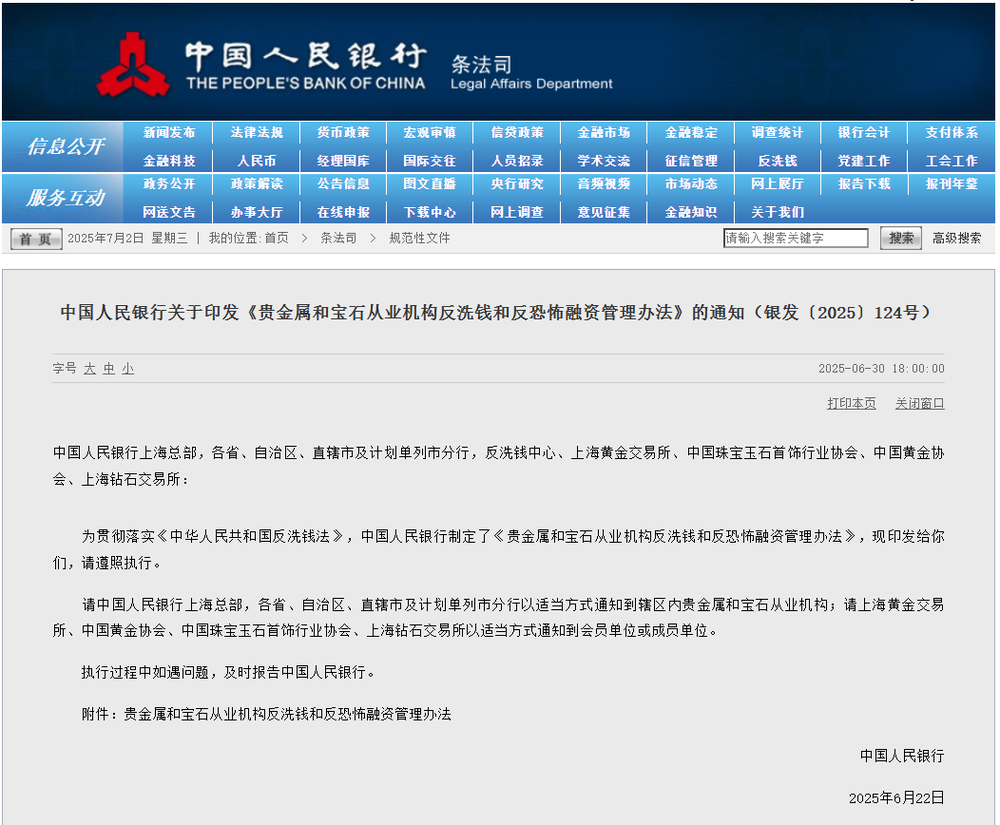
According to a report by Caixin on July 2, the People’s Bank of China (PBOC) has recently issued the “Administrative Measures for Anti-Money Laundering and Counter-Terrorist Financing for Precious Metals and Jewelry Industry Institutions” (hereinafter referred to as the “Measures”).
The Measures stipulate that for single or daily cumulative cash transactions by customers exceeding 100,000 yuan (including 100,000 yuan) or the equivalent in foreign currency, industry institutions must submit a large-value transaction report to the China Anti-Money Laundering Monitoring and Analysis Center within five working days from the date the transaction occurs.
The Measures aim to prevent money laundering and terrorist financing activities, strengthen anti-money laundering work in the precious metals and jewelry industry, and implement classified management of industry institutions based on their money laundering risk profiles.
Industry institutions refer to businesses legally engaged in cash transactions of precious metals and jewelry within the territory of the People’s Republic of China.

Industry institutions are required to conduct customer due diligence, following the “Know Your Customer” principle, based on customer characteristics and the nature of transaction activities, particularly in the following circumstances:
1. Single or daily cumulative cash transactions exceeding 100,000 yuan (including 100,000 yuan) or the equivalent in foreign currency.
2. There are reasonable grounds to suspect the customer or their transaction is involved in money laundering activities.
3. There are doubts regarding the authenticity, validity, or completeness of previously obtained customer identification data.
The PBOC and its branches will conduct anti-money laundering supervision and investigations of industry institutions according to law, guiding industry self-regulation. Supervision intensity and frequency will be reasonably determined based on the assessed money laundering risks of the industry and its institutions.
Industry institutions assessed as having higher money laundering risks will face strengthened supervision, while those with lower risks may receive simplified or exempted supervision measures.
Precious metals and jewelry trading venues and industry self-regulatory organizations are required to establish industry anti-money laundering self-regulation mechanisms, under the guidance of the PBOC. These mechanisms are responsible for duties such as coordinating anti-money laundering work, identifying and assessing industry risks, formulating industry norms, organizing training, and reporting violations or suspicious activity线索 to relevant authorities.
Industry institutions must establish sound internal anti-money laundering control systems commensurate with the money laundering risks they face and their business scale. They must appoint or authorize a manager to oversee anti-money laundering work and ensure staff possess appropriate professional competence and integrity.
Institutions must take reasonable measures to periodically assess their money laundering risks and manage or mitigate identified risks. The maximum assessment周期 is three years, but assessments must be conducted promptly when business activities or the environment undergo significant changes.
When launching new products, services, or using new technologies, institutions must assess associated money laundering risks and take appropriate measures to mitigate them.