Editor’s Note
This article explores the inherent challenge of communicating quantum concepts, a field where precision and accessibility often seem at odds. It examines how this complexity intersects with the rise of artificial intelligence.
There’s an old saying among tech journalists: you can either explain quantum accurately or make it understandable, but you can’t do both.
This is because quantum mechanics—a peculiar and partly theoretical branch of physics—is an incredibly difficult concept to grasp. It involves the bizarre behavior of tiny particles, and this strangeness opens up a whole new realm of scientific superpowers.
The breathtaking complexity of quantum mechanics might be one reason it hasn’t captured the spotlight like today’s tech star, Artificial Intelligence (AI), despite major quantum announcements from tech giants like Microsoft and Google.
Broadly, we often think of quantum technology in terms of hardware like sensors and computers, while AI leans more towards software—which needs hardware to run. Combining the two might one day yield technology more powerful than anything before.
However, Brian Hopkins, Vice President and Principal Analyst of Emerging Technology at research firm Forrester, warns that the word “might” in that prediction carries significant uncertainty.
In terms of value, both are highly attractive. Market research firm McKinsey predicts the quantum sector could be worth up to $97 billion (£74 billion) by 2025. Meanwhile, AI’s value is projected to reach trillions of dollars. Yet both are shadowed by hype and potential bubbles.
In mid-October, analysts warned that some key quantum computing stocks could fall by up to 62%, while discussions about an AI bubble also increased.
Quantum computing and AI share another commonality—errors. While we’re now familiar with the “hallucinations” of generative AI tools, quantum computing faces a different kind of error. These errors occur because particles must be in an extremely fragile state; even the slightest environmental change, including light and noise, can disrupt it.
Maintaining this state is very difficult. This week, Musk stated on X that quantum computing is best suited for “permanently shadowed craters on the moon.”
Quantum computers look completely different from traditional ones. There’s no single design blueprint yet, but they are all very large. They exist in labs, most commonly resembling jellyfish in form. They require extremely low temperatures and lasers—not something likely to appear in homes, let alone pockets.
They also have a touch of luxury—researchers have found that using synthetic diamonds to create qubits (the basic building blocks of quantum computers) can allow them to operate closer to room temperature. Element 6, a subsidiary of luxury jeweler De Beers, claims to have launched the world’s first universal quantum-grade diamond in 2020 and is collaborating with Amazon Web Services (AWS) to optimize lab-grown diamonds for future quantum computer networks.
These machines are still in their infancy, with only about 200 believed to exist worldwide (though China has not disclosed its numbers)—but that hasn’t stopped quantum experts from making bold predictions about their potential.
So, what life-changing transformations can these machines bring once they are ready? Like AI, a significant amount of quantum research is dedicated to improving healthcare. Future quantum computers might easily process countless molecular combinations to develop new drugs—a process that currently takes years with traditional computers.
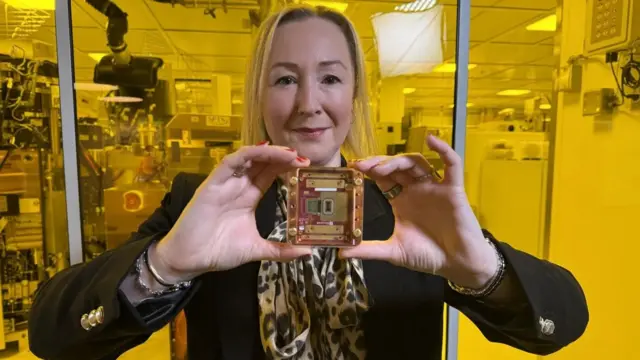
To illustrate the scale, Google released a new quantum chip named Willow in December 2024. Google claims the chip can solve in five minutes a problem that would take the world’s fastest supercomputer “10 to the power of 25” years (i.e., 10,000,000,000,000,000,000,000,000,000 years).
Hazra said this could pave the way for personalized medicine, where patients receive drugs tailored to their individual body chemistry, most likely to be effective, rather than standard prescriptions.
This also applies to broader chemical processes, such as new methods for producing chemical fertilizers more efficiently, which could greatly benefit global farmers. Quantum sensors, which use the principles of quantum mechanics for extremely precise measurements, already exist and are used in atomic clocks.
In 2019, scientists at the University of Nottingham integrated a quantum sensor into a prototype device the size of a bicycle helmet for a new system of non-invasive brain scans for children with conditions like epilepsy.
Last year, scientists at Imperial College London trialed an alternative to GPS satellite navigation called a “quantum compass” on the London Underground network. GPS doesn’t work in the subway, but this system can—the idea is to track and locate objects worldwide more precisely, whether above or below ground, as GPS signals are susceptible to blockage, interference, and weather.
National Grid is investing in quantum technology research to explore whether it can help solve the so-called “load shedding” problem—how to maximize the output of thousands of generators from different energy sources based on real-time demand fluctuations to avoid blackouts.
Additionally, Airbus is collaborating with UK quantum technology company IonQ to test quantum-based algorithms aimed at loading cargo onto aircraft more efficiently. A slight shift in an aircraft’s center of gravity can cause it to consume thousands of kilograms of extra fuel.
So far, so good—but we also need to talk about secrets. It is widely believed that existing encryption—how we store personal data and state secrets—will eventually be broken by quantum technology, which can cycle through all possible combinations in an extremely short time until the data is decrypted. It is known that countries have already begun stealing each other’s encrypted data, hoping to decode it one day.
The moment such computers arrive is sometimes called “Q-Day.” Estimates vary on when quantum encryption-breaking might arrive, but Forrester’s Brian Hopkins suggests it could be soon—around 2030.
Companies like Apple and the secure messaging platform Signal have already released what they believe are post-quantum encryption keys, but these keys cannot be retroactively applied to existing data encrypted in traditional ways. And this is already a problem. In October last year, Daniel Shiu, former head of cipher design at GCHQ, the UK’s intelligence, security, and cyber agency, told The Sunday Times that “almost all UK citizens’ data may have been compromised in Chinese state-sponsored cyber attacks,” and this data has been collected, awaiting the day it can be decrypted and studied.