Editor’s Note
This article details a significant step for European semiconductor innovation, as French deeptech firm Diamfab inaugurates its first pilot line for synthetic diamond-based chips—a European first. This €4 million investment marks a crucial transition from research to industrialization for the Grenoble-based startup.
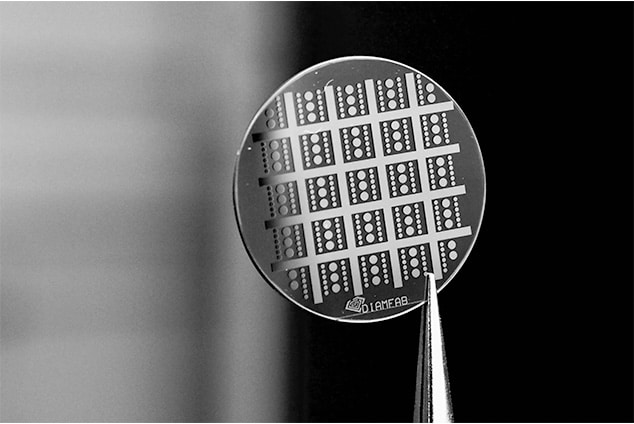
The Grenoble-based deeptech company Diamfab has reached a major milestone in its development by inaugurating, on Friday, January 16, 2026, its first pilot production line for synthetic diamond-based semiconductors. Located in Fontaine, near Grenoble, this new industrial base is a first in Europe and marks the transition from research to industrialization for this CNRS spin-off startup.
Resulting from a €4 million investment, the site is based on an existing 750 m² building, entirely reconfigured to house a pilot line integrating 150 m² of cleanroom. The fitting-out work took place between February and October 2025. Ultimately, the cleanroom area is expected to at least double by 2028 to support the industrial ramp-up.
The stated goal: to produce several tens of thousands of four-inch diamond semiconductor wafers per year, an unprecedented volume at this stage on the European continent.
Unlike traditional materials like silicon carbide (SiC), a diamond semiconductor wafer can contain between four and fifty times more components. Diamfab masters the entire value chain, from the synthesis of diamond wafers to the design of electronic components.
Thanks to its exceptional physical properties: high thermal conductivity, wide bandgap, strong radiation resistance, diamond is seen as a key material for future power electronic devices, which will be more compact and higher-performing.
According to Gauthier Chicot, CEO and co-founder of Diamfab, this site is a first step in a three-phase market entry strategy.
If a larger-scale industrial site will be needed for these volumes, the Fontaine base will retain a central role in research and development.
Founded in 2019 by Gauthier Chicot and Khaled Driche, both PhDs in nanoelectronics, Diamfab currently employs 26 people and continues to hire. The company relies on a strong local ecosystem, close to the CNRS’s Néel Institute, and collaborates with several major industrial partners like Schneider Electric, STMicroelectronics, Soitec, and Murata.
Since its creation, the startup has raised €8.7 million to fund the development of its breakthrough technology, protected by several patents. With this pilot line inaugurated in Isère, Diamfab now positions itself as a strategic European player in diamond semiconductors.