Editor’s Note
Finance Minister Nirmala Sitharaman is set to present the Union Budget for 2026-27 on February 1, marking her ninth consecutive budget. As the third full budget of the current government’s term, it is anticipated to address key areas such as tax relief, customs duties, and export incentives. This article outlines the budget schedule and its expected economic focus.
Finance Minister Nirmala Sitharaman will present the Union Budget 2026 on February 1, 2026. This will be her ninth consecutive budget and the third full budget of the Modi-led NDA 3.0 government. The budget session of Parliament will run from January 28 to April 2, with a recess from February 13 to March 9. This year’s budget is expected to provide tax relief, changes in customs duties, and relief for exports.
The Union Budget outlines the government’s assessment of economic growth and details how government expenditure will be allocated among ministries and schemes. It elaborates on how the government plans to generate revenue from taxes such as income and corporate tax, as well as non-tax sources like PSU dividends and asset monetization. It also specifies the borrowing required to bridge the gap between expenditure and revenue, known as the fiscal deficit.
This central budget comes at a crucial juncture as a new global order takes shape. While India is one of the world’s fastest-growing economies, challenges are also evident. The government must strike a fine balance between maintaining fiscal discipline and promoting growth and investment to keep borrowing costs under control. Both steps are essential to realize India’s dream of becoming a $5 trillion economy and the world’s third-largest power.
The Indian housing market is now moving beyond the luxury phase towards affordable and mid-income segments, which will be the main axis of future growth. The 2026 Union Budget is expected to focus on enhancing the affordability of mid-income homebuyers. Steps could include more tax exemptions, an increase in the deduction limit for home loan interest, and continued investment in urban infrastructure.
Suthram further stated that clear and consistent policies on land availability and grid connectivity will help accelerate this sector and promote long-term investment.
As the announcement of the 2026-27 Union Budget approaches, it is time for India to move beyond just boosting the AI engine to building the entire system. If last year’s budget was an ‘adrenaline shot’ that sparked the AI ecosystem, the upcoming budget should be the structural steel that transforms India’s AI-first dream into a lasting global reality.
Finance Minister Nirmala Sitharaman will set a new record by presenting her ninth consecutive budget on February 1. Amid global uncertainty, this budget is expected to contain reformist measures aimed at accelerating economic growth. With this, Sitharaman will come close to the record of 10 budgets presented by former Prime Minister Morarji Desai over different time periods. Desai presented a total of six budgets as Finance Minister during 1959-1964 and four budgets between 1967-1969.
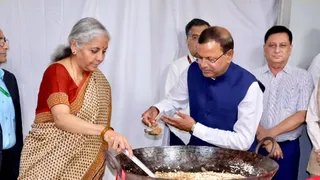
Finance Minister Nirmala Sitharaman participated in the traditional ‘Halwa’ ceremony, marking the commencement of the final lock-in period for officials involved in the budget preparation process.