Editor’s Note
The Reserve Bank of India will auction government securities worth ₹32,000 crore on October 31. This article details the auction schedule and explains the nature of these sovereign-guaranteed debt instruments.
The Reserve Bank of India (RBI) is set to auction (re-issue) four government securities (bonds) with a total value of ₹32,000 crore. The auction will be held on October 31 (Friday), with settlement on November 3 (Monday).
Government securities are tradable debt instruments issued by the central or state governments to raise funds for public expenditure.
These are considered the safest investments due to the sovereign guarantee of the Government of India.
G-Secs are fixed-income investments that provide investors with regular interest income and return the principal amount upon maturity.
The funds raised from these bonds are used by the government for infrastructure projects, development programs, or other public expenditures.
Investors receive fixed interest until maturity, making G-Secs a preferred option for risk-averse investors seeking stable and secure returns.
The government is keeping an extra subscription reserve of ₹2000 crore so that the total amount can be increased if market demand rises. This auction will be conducted at the RBI office in Mumbai using the ‘Multiple Price Method’. This means that different bidders will receive bonds at the price they bid.
Primary Dealers can submit bids for Additional Competitive Underwriting (ACU) from 9:00 AM to 9:30 AM on the auction day. Additionally, the RBI stated that these securities will be available for “When Issued” trading from October 28 to October 31, 2025. This allows investors to trade the securities before the actual issue, providing early price discovery.
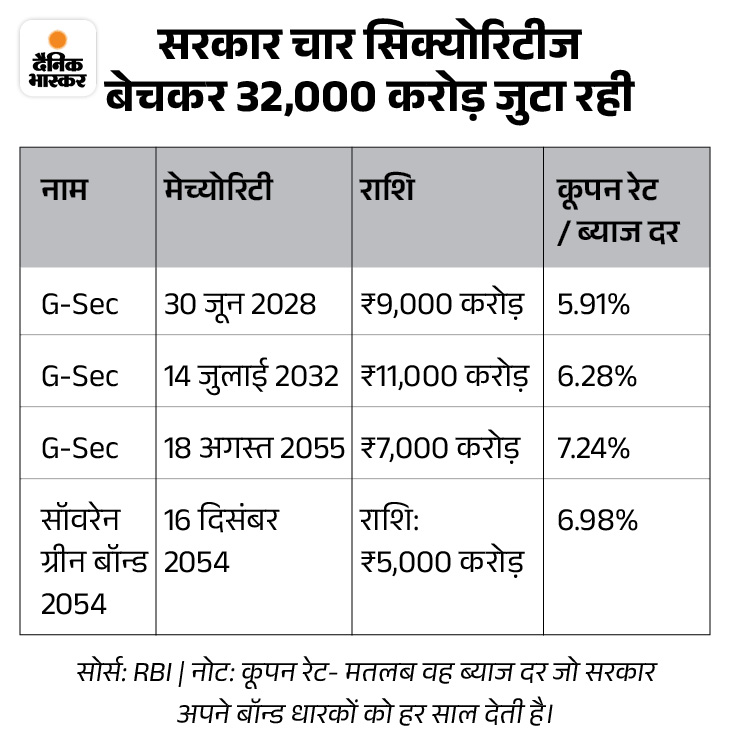
Competitive and non-competitive bids must be submitted electronically through the RBI’s Core Banking Solution (e-Kuber system). The RBI said the auction results will be announced on the same day, and successful bidders must make payment by November 3, 2025.
These are typically submitted by large financial institutions, specifying the yield or price at which they wish to purchase the securities. Their allocation depends on the cut-off yield determined in the auction.
These are for small investors and eligible institutions. They do not need to specify a yield or price; they receive securities at the weighted average price determined in the auction.