Editor’s Note
This article examines the diverging fortunes of two classic luxury assets. While diamond inventories swell to crisis-era levels, gold continues its record-breaking ascent—a stark reminder of how consumer trends and economic forces can reshape even the most established markets.
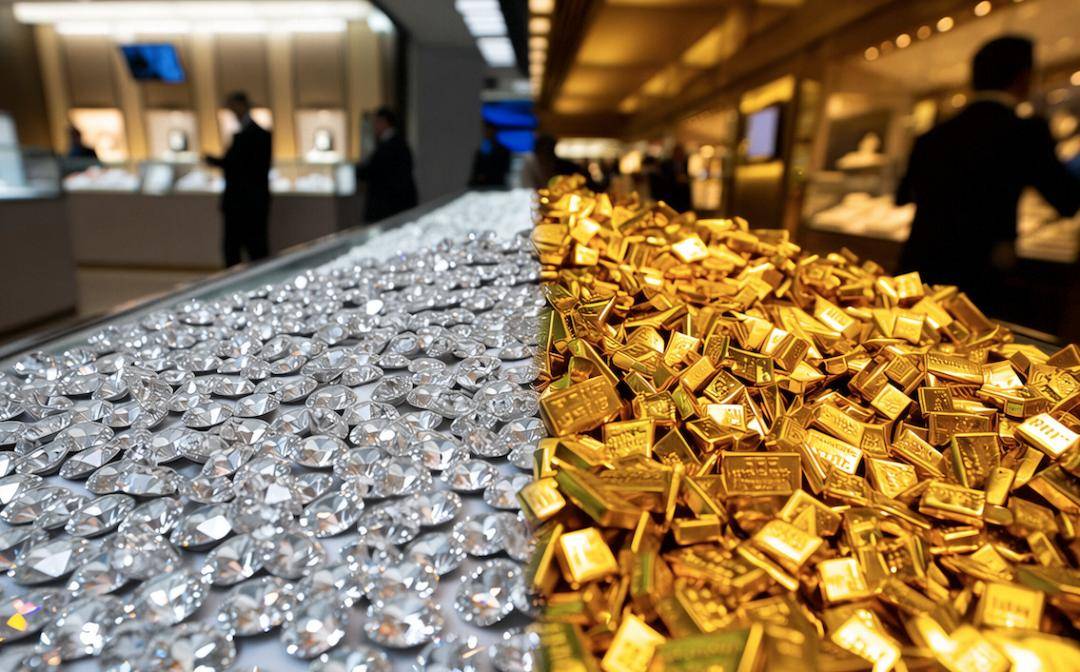
As a crucial raw material for jewelry, the market conditions for diamonds and gold can be described as a tale of two extremes.
According to recent reports from the UK’s *Financial Times*, De Beers, the world’s largest supplier of natural diamonds, has accumulated a diamond inventory worth approximately $20 billion (about 145.4 billion yuan), reaching its highest level since the 2008 financial crisis.
To reduce this massive inventory, De Beers cut diamond production in 2024 and announced multiple rounds of price reductions. The most recent one was at the end of 2024, announcing a 10%-15% price cut for rough diamonds. This is the first price reduction in recent years and one of the largest in history.
Earlier last year, he remained optimistic about the rough diamond inventory, stating,
However, this consumer demand has clearly not materialized.
In contrast, the gold market has performed quite differently.
In 2024, international gold prices surged “vigorously,” maintaining a strong upward trend throughout the year and hitting new highs 40 times. As of January 24, spot gold prices had broken through $2,773 per ounce.
According to a report from the World Gold Council, as of July 2024, about 77% of sales from Chinese jewelry retailers came from gold investment products and gold jewelry, 7% higher than in 2022. During the same period, the share of diamond sales dropped from 16% to 9%, highlighting the stark contrast in consumer market performance between the two.
Founded in 1888, De Beers is not only the world’s largest diamond mining company but also the world’s largest diamond retailer. It once dominated the global diamond market across mining, processing, and sales.
In the 1950s, De Beers used the classic advertising slogan “A diamond is forever” to market the transparent, hard diamond as a symbol of love. For over 70 years since, whenever discussing the market significance of natural diamonds, this analogy has been frequently mentioned.
However, today’s consumers, especially Generation Z (born after 1995), are growing weary of the marketing tactics for natural diamonds. Data shows that as of late November 2024, sales of natural diamond jewelry in the U.S. fell by 4.7% year-on-year, while sales of lab-grown diamonds surged by 46%.
A recent report titled “The diamond industry is at an inflection point” by consulting firm Bain & Company points out that the price gap between lab-grown and natural diamonds will further widen. With advantages like a traceable supply chain and a more environmentally friendly production process, lab-grown diamonds are becoming the first choice for younger consumers. Natural diamonds may move away from the mass market and toward a niche, high-end luxury market.
Key data related to diamond trading clearly shows that the natural diamond market is experiencing a downturn.
According to data from U.S. investment bank Piper Sandler, global diamond wholesale prices have fallen by about 40% over the past two years. As the second-largest diamond-consuming country, China’s diamond imports have declined year-on-year for three consecutive years, exceeding 30%. The total diamond trading volume at the Shanghai Diamond Exchange, the world’s second-largest diamond trading center, in 2023 was less than half of that in 2021.
Market feedback is also reflected in financial data. In the first half of 2024, De Beers’ diamond sales volume fell 28% year-on-year to 11.94 million carats, sales revenue decreased 26% to $2.247 billion, and underlying EBITDA profit dropped 16% to $300 million. Its parent company, Anglo American, announced earlier plans to divest its diamond business through a sale or initial public offering.
*Jiemian Finance* believes that while the symbol of love crafted by De Beers has not lost its effectiveness, consumers are becoming more rational when it comes to diamond purchases. Public commentary on social media and the visual impact of short-form videos are also encouraging them to shift their spending toward lab-grown diamonds.
Lab-grown diamonds have the same chemical composition as natural diamonds, and the difference is almost indistinguishable to the naked eye, but their prices are 80%-90% lower. According to analysis by German data platform Statista, the value created in 2023 was about $27 billion and is projected to reach nearly $59 billion by 2032, a growth rate of 118%.
Searching for diamond products on mainstream e-commerce platforms like Tmall and JD.com reveals that a 1-carat, gem-quality natural diamond from a jewelry brand currently sells for 60,000 to 110,000 yuan, while a 1-carat lab-grown diamond sells for only 6,000 to 8,000 yuan—a staggering price difference.
In China, lab-grown diamond production accounts for about 50% of global output, with 80% of the products coming from Zhenping County, Nanyang City, Henan Province, known as the “Capital of Man-Made Diamonds.” Lab-grown diamond brands originating from Zhenping County have become the biggest beneficiaries of this wave. Performance in the secondary market is also evident, with lab-grown diamond sector stocks showing significant gains. Since late September 2024, the cumulative highest increase for this sector has exceeded 50%.
Typically, only diamonds with large carat weights and high purity possess value retention properties. Low-carat diamonds circulating in the mass consumer market not only have poor liquidity but also depreciate quickly. Many diamond brands have announced policies of “not supporting diamond buyback,” and the value of diamonds is far from matching gold, which serves as a quantitative indicator.
With the rising popularity of lab-grown diamonds, luxury groups like LVMH and Kering, as well as jewelry brands such as Pandora and Swarovski, have entered this emerging market. LVMH announced the use of lab-grown diamonds in watches under brands like Fred and TAG Heuer, while Pandora and Swarovski have replaced the small-carat natural diamonds in their original products with lab-grown diamonds.
*Jiemian Finance* believes that the value of diamonds is being reshaped, driven by systematic changes in market positioning, consumer perception, and industry ecology. From the buyer’s perspective, diamonds are no longer a luxury item with high value and high scarcity but a consumer product with multiple meanings.
When purchasing diamonds, consumers now place greater emphasis on multiple considerations such as product design, brand philosophy, and cost-effectiveness.