Editor’s Note
As gold prices reach unprecedented highs, traditional spending habits are being reshaped. This article explores how Indian consumers are adapting their age-old wedding customs to navigate today’s economic realities, finding innovative solutions to maintain tradition amid inflation.
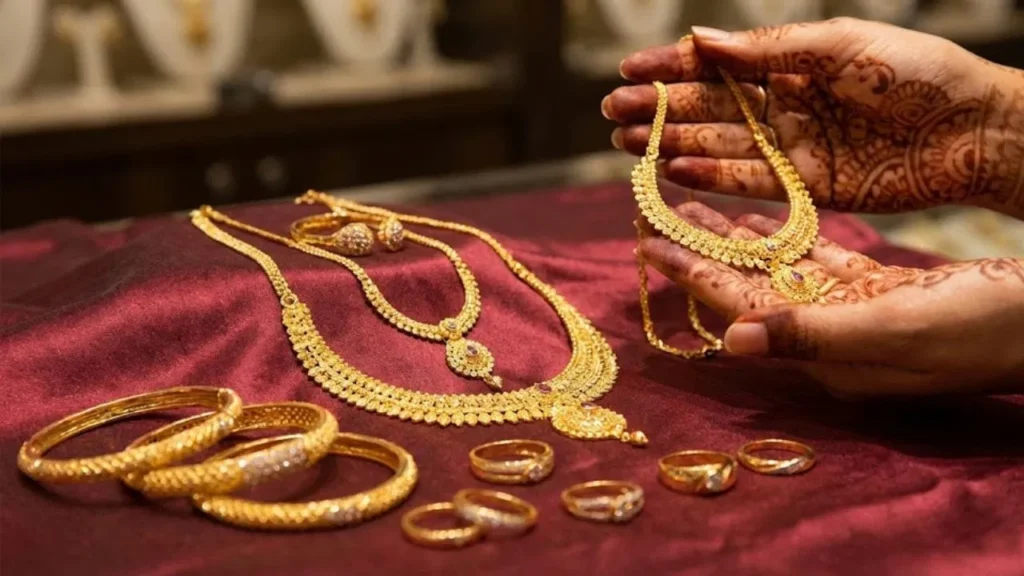
These days, gold prices are touching the sky. It has been a tradition in Indian families to buy gold lavishly during weddings, but this year’s story is a bit different. Gold prices are continuously setting new records, which has disrupted the common man’s budget. However, Indian buyers are no less resourceful; they have found a new and smart way to deal with inflation.
According to a CNBC report, even though gold prices are at an all-time high, there is no lull in the bullion markets. Purchases are continuing, just the method has changed. People are now preferring 14 and 18-carat jewelry over 22-carat pure gold. This change is initiating a new trend in the jewelry market.

For decades, it was believed that 14 or 18-carat gold was used only for making diamond jewelry because it required strength. But now, rising prices have forced people to choose these options even in plain gold jewelry. A new segment has emerged in the market where lower-carat jewelry is being proudly sold and purchased.
To understand this change, the example of a customer named Parul is quite apt. She recently explained how inflation changed her decisions.
This is not just the story of one family; the same calculation is being made in thousands of homes across the country to manage the budget.
According to the Ahmedabad Jewelers Association, at the beginning of 2025, the price of gold was around ₹80,000 per 10 grams. By the end of the year, this figure had nearly doubled, reaching around ₹1.42 lakh. Such a massive increase has broken the backs of buyers.
Market experts say that until two years ago, the share of 22-carat jewelry made for weddings was 75% of total purchases. But now it has dwindled to just 50%. Gold expert Manoj Soni explains that Indian weddings seem dull without gold, so people cannot stop buying. In such a scenario, the use of 14 to 18-carat gold for rings, bracelets, and even as the base metal for diamond jewelry is rapidly increasing.
It is natural for the common man to wonder why gold is becoming so expensive. Commodity experts attribute several international reasons to this. Geopolitical tensions are at their peak worldwide. The war between Russia and Ukraine shows no signs of stopping, while the US ban on crude oil shipments from Venezuela and military strikes against ISIS in Nigeria have added fuel to the fire.
Whenever tensions rise in the world, investors rush towards gold as a safe investment, driving up prices. Additionally, the inflation rate in the US is decreasing, and softness is being observed in its labor market. The market expects the US Fed to cut interest rates next year. When interest rates fall, investment in gold becomes even more attractive, providing further support to its prices.