Editor’s Note
This article highlights a notable shift in investor behavior amid volatile gold prices, with a focus on risk aversion and increased cash-out activity. The details are based on a report from the China Securities Journal.
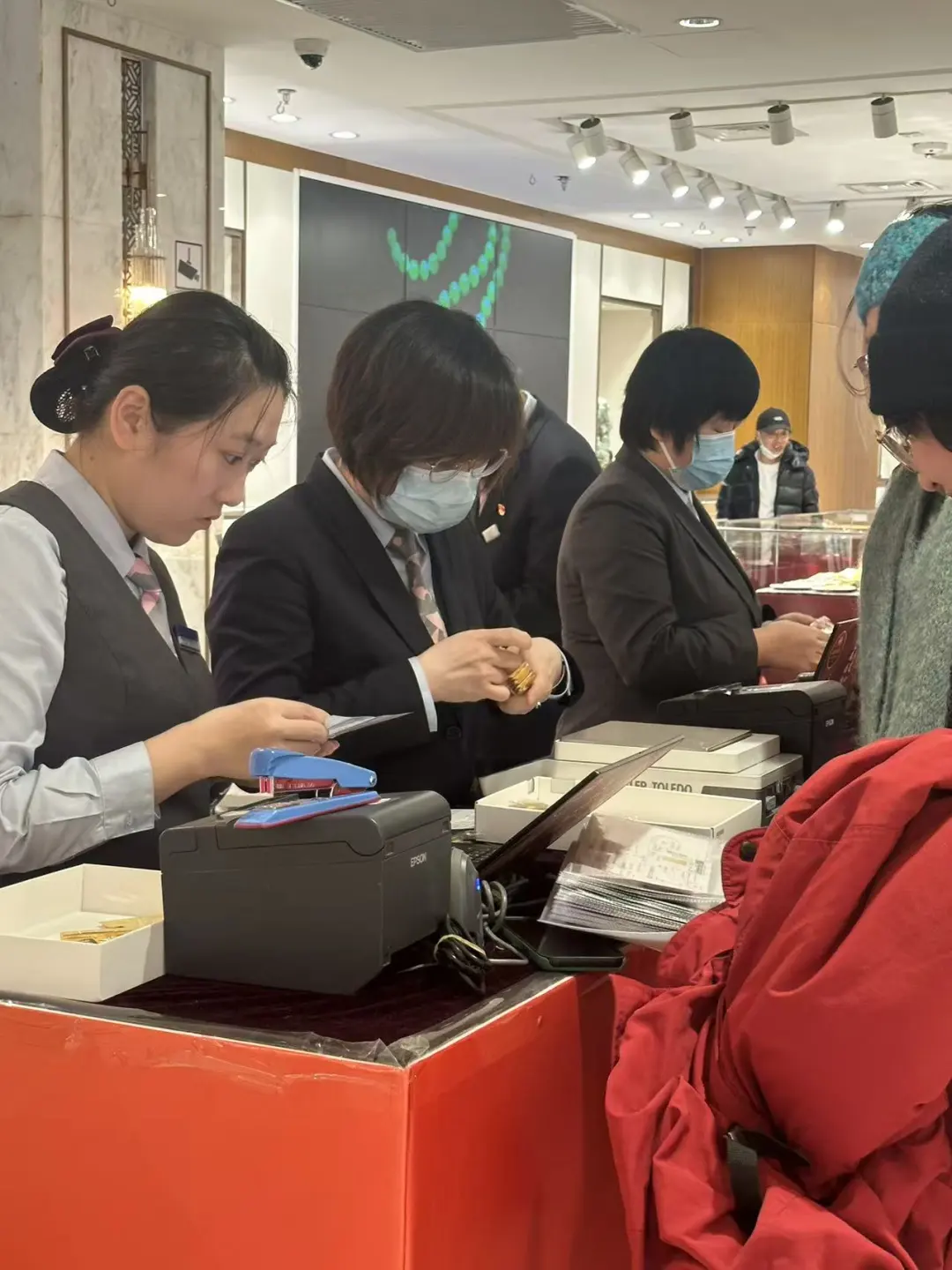
Following sharp fluctuations in gold prices, investor sentiment is quietly shifting. While the market is seeing active buying and selling, the main investment theme has turned to ‘risk prevention’.
According to a report by the China Securities Journal on the evening of February 10th, despite being a weekday, the main store of Caibai Jewelry in Beijing was bustling with activity on February 10th. Amid high and volatile gold prices, large-scale cash-outs are frequent. A woman who sold 8 kilograms of gold bars in one go attracted much attention.
Ms. Wang pointed to the gold bars on the table while flipping through her deposit book, which neatly contained the purchase vouchers, invoices, and certificates for every gold bar she had bought over the years, all clearly organized. However, as dozens of gold bars had to be individually unwrapped, weighed, and tested, the staff spent over an hour completing this transaction.
said a staff member at Caibai Jewelry.
An elderly man waiting in line told reporters that he buys some gold bars every year, ranging from 100 grams to 500 grams, accumulating over ten kilograms over time. Although he remains optimistic about the long-term trend of gold prices, to control risk, he chose to sell a portion first.
Apart from investors making large one-time cash-outs, there are also many investors buying several kilograms of gold bars at once. However, to control risk, making multiple small purchases has become the mainstream. In recent days, as gold prices entered a phase of high volatility, many investors have started actively buying gold again. But to manage risk, investors are showing a preference for smaller-weight gold bars.
on-site staff repeatedly reminded queuing buyers.
Along with the sharp fluctuations in gold prices, gold shops are adjusting their business strategies accordingly.
According to the 21st Century Business Herald, China Gold announced that starting February 7, 2026, it will adjust its precious metals buyback business arrangements. Buyback services will be suspended on Saturdays, Sundays, and statutory holidays—days when the Shanghai Gold Exchange (SGE) is closed.
China Gold explained the reason for this adjustment, citing that recent multiple factors have led to significantly increased volatility and sustained uncertainty in precious metals prices. To meet precious metals market risk management requirements and enhance operational efficiency and customer service levels, the company will adjust the buyback business rules for all channels (including offline stores and online platforms) of the “China Gold” brand.
This adjustment not only limits buyback times but also strengthens quota management. Even on normal SGE trading days, related buyback services will implement quota controls, including daily cumulative buyback limits per single client and per transaction limits, requiring advance appointments. These quotas are not fixed but will be dynamically adjusted based on market conditions.
Beijing Caishikou Department Store Co., Ltd. has also updated its buyback arrangements simultaneously. It stated that starting February 6th, it adjusted its precious metals buyback rules, suspending buyback services on Saturdays, Sundays, and statutory holidays when the SGE is closed. Additionally, the daily gold recycling上限 has been adjusted from 200 kilograms to 100 kilograms.
As the Lunar Horse Year Spring Festival approaches, bringing a 9-day holiday, the Shanghai Gold Exchange issued a notice on February 9th regarding market risk control during the 2026 Spring Festival holiday to guard against risks from international market price fluctuations. According to the arrangement, the SGE will be closed from February 14th to February 23rd, with no night trading on February 13th, and normal trading will resume on February 24th. Starting from the close and settlement on February 11th, margin ratios and price limit ranges for related contracts will be simultaneously increased.
Meanwhile, multiple banks are proactively clearing out inactive precious metals clients with “three no’s” (no positions, no inventory, no outstanding payments).
For instance, on February 3rd, Industrial Bank’s “Announcement on Adjusting Trading Channels for Agency Shanghai Gold Exchange Individual Precious Metals Trading Business” indicated that, according to business development needs, the bank will close the personal online banking trading channel for its agency SGE individual precious metals trading business after February 14, 2026. Counter and mobile banking channels will remain open normally.
Industrial Bank is not an isolated case. Since September 2025, at least 11 banks have successively issued announcements adjusting their agency SGE individual precious metals businesses, mainly involving the suspension or cessation of new position openings or buy transactions for related products.
In December 2025, Industrial and Commercial Bank of China (ICBC) strengthened the management of its agency individual precious metals trading. For clients with no positions, no inventory, and no outstanding payments but with remaining balances in their margin accounts, ICBC began batch transferring the margin account balances to the settlement accounts linked to the business and closing the related business functions starting December 19th.
In the same month, China Construction Bank (CCB) also prompted similar clients to transfer their margin balances and terminate agreements as soon as possible.
China CITIC Bank started cleaning up long-dormant accounts (with only available funds, no positions) for its agency SGE individual trading from November 7, 2025.
Furthermore, multiple banks including Postal Savings Bank of China (PSBC) and Bank of Ningbo have announced the discontinuation of their agency SGE individual precious metals businesses. On December 30, 2025, PSBC announced that its agency SGE individual precious metals business would be discontinued starting January 12, 2026. On September 30 of the same year, Bank of Ningbo stated that it would stop accepting agency individual client SGE spot physical buy transactions starting October 13th, with sell transactions unaffected.