Editor’s Note
This article highlights how Carleton University’s acquisition of advanced robotic arms is pushing the boundaries of architectural practice and heritage conservation, merging traditional design with cutting-edge technology.
Although the tools they use have evolved over the years, architects have always designed and built physical structures and objects.
A pair of jointed-arm industrial robots recently acquired by the Carleton Immersive Media Studio (CIMS) represent the latest leap forward.
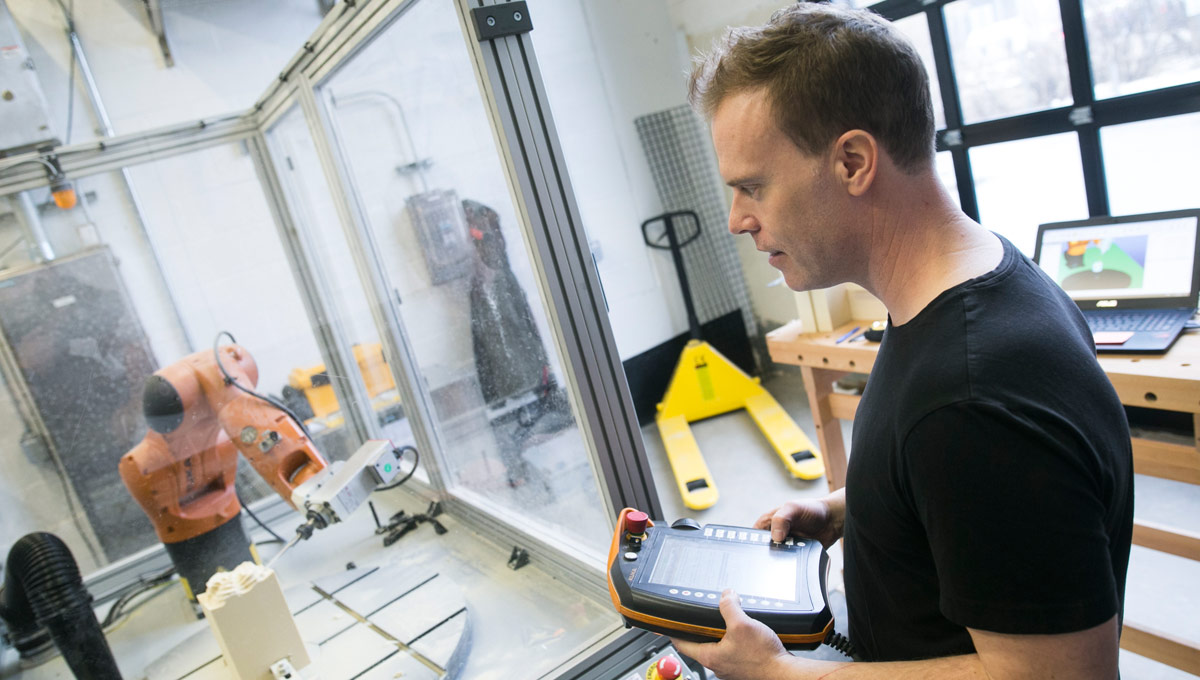
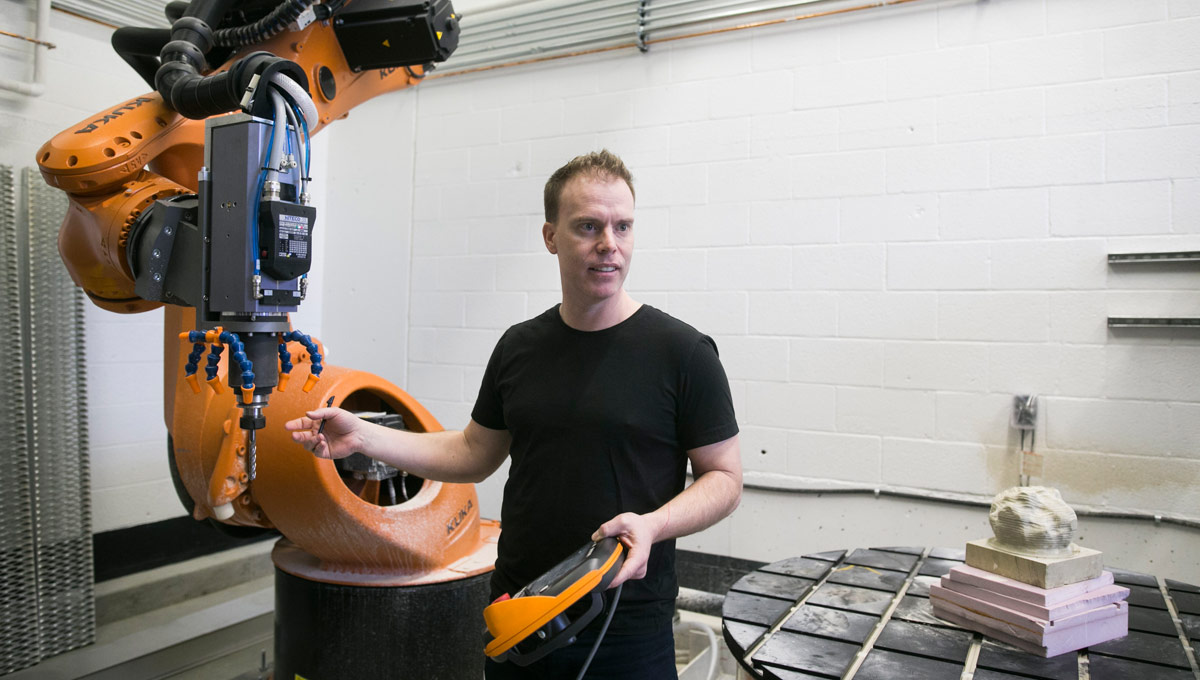
Roughly three metres high when fully extended, the Kuka KR 360 and a desk-sized KR 6 are housed in a customized room in Carleton’s Architecture Building. Kuka is the manufacturer and the numbers refer to the payload (in kilograms) each machine is capable of handling.
Purchased with support from Public Services and Procurement Canada (PSPC) and the Social Sciences and Humanities Research Council (SSHRC), the robots will help CIMS and its collaborators in the federal government continue their cutting-edge work in the rapidly advancing world of digitally-assisted fabrication.
The CIMS team will use the robots to assist in creating sculptures and other architectural ornaments in a variety of materials — including stone and wood — from digital models obtained by laser scanning and photogrammetry, the science of using photographs to make precise measurements.
This technology has already been of use on Parliament Hill, where centuries-old sculptures are being replaced or restored as part of the renovations, and new decorative features are being crafted for the Government Conference Centre, which will serve as a temporary home for the Senate when the decade-long Centre Block restoration begins next year.
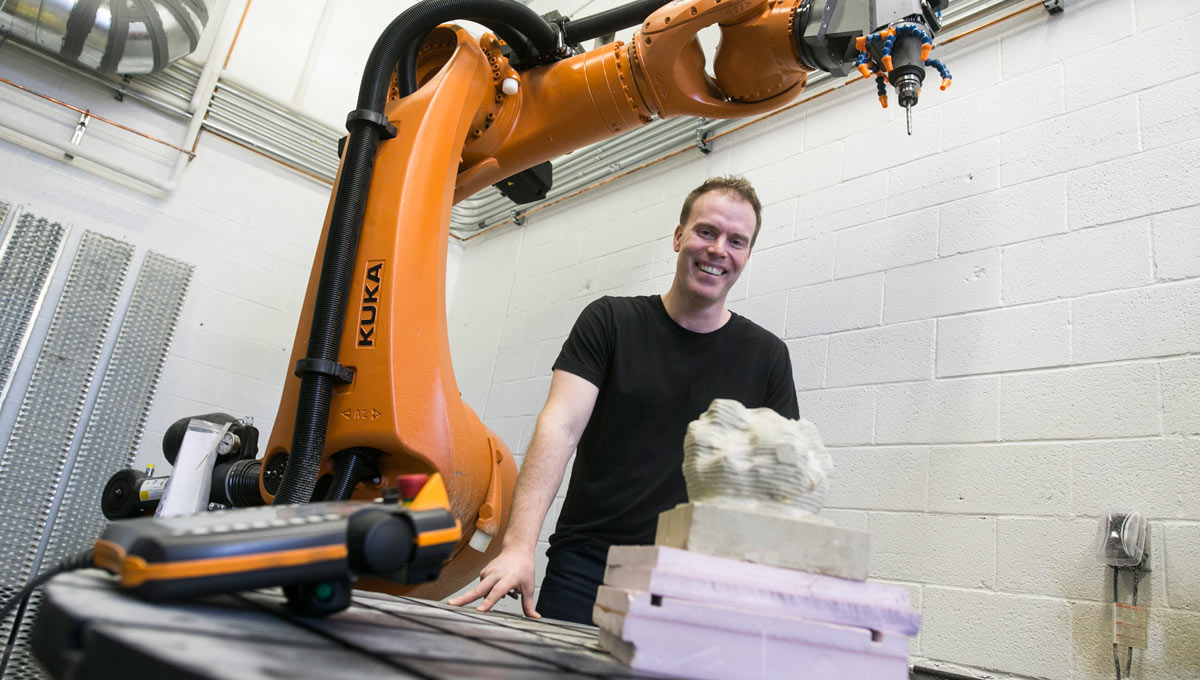
And because human hands will continue to play a role in this process, from operating the robots to the fine-detail finishing work on a sculpture before installation, some people in traditional fields such as stone masonry don’t see the robots as a threat to their employment.
Laser scanning something as a step toward making a 3D object is an idea that developed at the National Research Council (NRC) in Ottawa in the 1990s, says White, who was working at the Museum of Civilization at the time and worked with the NRC to create a replica sphinx for an Egypt exhibition.
Two decades later, the technology has matured and is being used to restore historical objects, such as a badly deteriorated owl sculpture perched on the northeast corner of the East Block that White worked with CIMS to digitize and reproduce.
And it is being used to help create new ornamentation, “which seems to have been forgotten for decades,” says White, who is also working with CIMS on a collection of 10 decorative maple leaves that will be milled into wooden panels, cast in glass and carved out of stone for the Government Conference Centre.
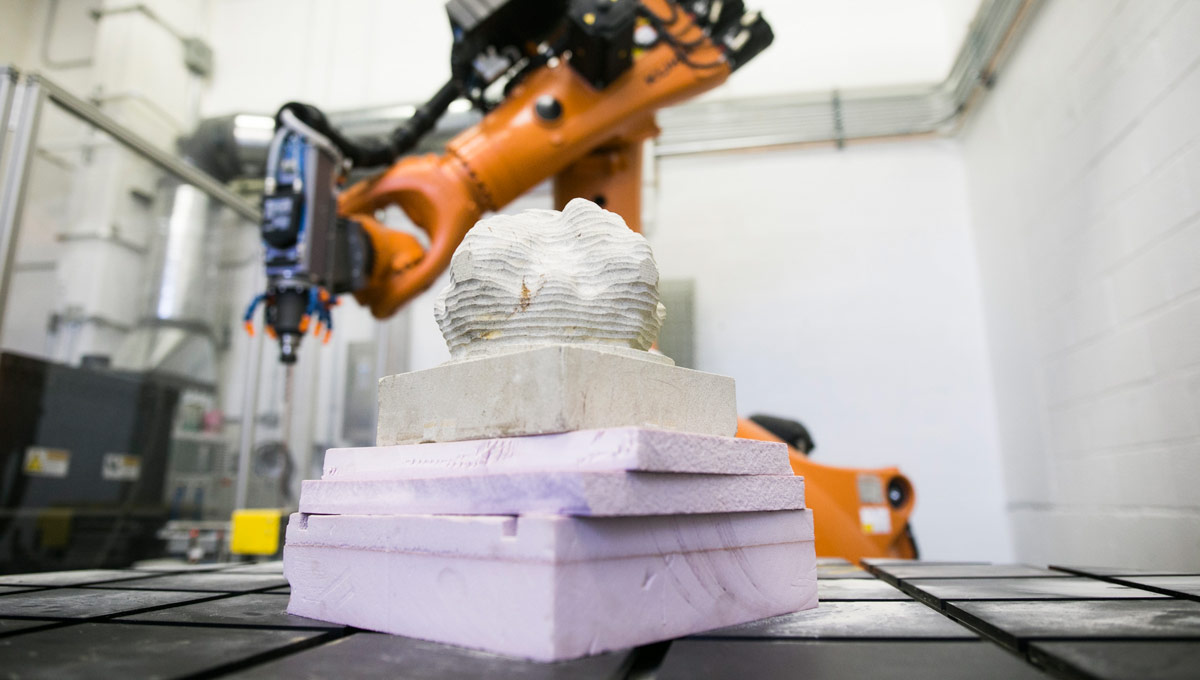
Stone and metal sculptures are expensive and time-consuming to produce, and aren’t regular features on the modernist buildings — boxy structures with clean, straight lines — that have become the norm in our cities.
By reducing costs and the amount of time required, digitally-assisted fabrication could herald a return to the type of ornamentation that was common when the Parliament Buildings were constructed.
Edgar, who came to Canada from the United Kingdom to work on Parliament Hill and has been involved since the first scaffolds went up, says this technology could be perceived as a threat to traditional stone carving. But he prefers to see this shift as a new set of tools that could help revitalize the relationship between his craft and modern architecture.