Editor’s Note
This article explores the rise of moissanite, a lab-created gemstone, in the Japanese market. It highlights the pioneering work of jeweler “Brillar” and Kyoto University in developing a patented manufacturing process, offering insight into a growing segment of the jewelry industry.

The market for artificial gemstones is expanding daily alongside technological advancements. Recently, Japan’s first moissanite jeweler, “Brillar,” developed a manufacturing method for moissanite through joint development with Professor Tsunenobu Kimoto of Kyoto University’s Graduate School of Engineering and obtained a patent in Japan. This article explores the overview of moissanite and the development technology, which is still unknown to many readers in Japan, through an interview with Mr. Isatoshi Ohara, President and CEO of Brillar Co., Ltd.
Moissanite is a natural material discovered in a meteorite in 1893. It possesses the world’s highest brilliance, said to be 2.5 times that of diamond, along with high durability. It shares many similarities with diamond and is characterized by superior properties in areas such as impact resistance (toughness) and resistance to clouding (low lipophilicity).
Natural moissanite is highly scarce and did not circulate in the market, but a U.S. company succeeded in manufacturing it, and sales of artificial moissanite began in 1998. The manufacturing patent obtained at that time expired in the U.S. in 2015, and subsequently expired in countries worldwide. As a result, high-quality artificial moissanite is now being manufactured in various countries, including the U.S. and China. Because it is manufactured artificially with stable quality, it offers excellent cost-performance regarding quality. It is already widely accepted by consumers in the U.S. and is also supported as one of the options for engagement rings.
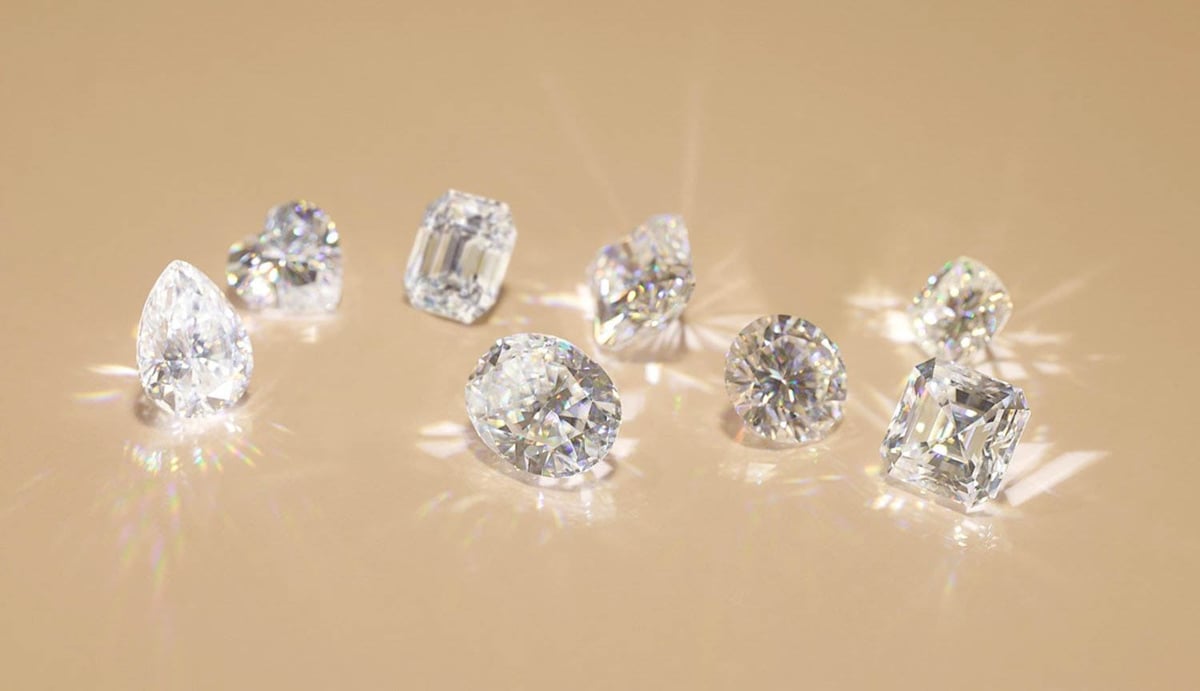
In Japan, attention is increasing year by year due to its ethical aspects (free from issues related to mining), the superior quality of the material itself, and its high cost-performance. This has led to an increase in consumers and new domestic brands handling it. According to Mr. Ohara, the ethical aspect, particularly being free from issues such as conflict financing and forced labor caused by natural rare gemstones like diamonds, is a major attraction of moissanite.
Originally, Brillar Co., Ltd. was a company that imported carefully selected loose stones from overseas and manufactured jewelry. While exploring in-house development, they met Professor Tsunenobu Kimoto of Kyoto University, an authority in semiconductor research, leading to joint research and patent acquisition.
The patented method involves manufacturing artificial moissanite by processing silicon carbide crystals originally used in semiconductor devices. Single crystals of silicon carbide for semiconductor devices are typically amber-colored, making them unsuitable for use as gemstones in their raw state.

The reason why silicon carbide crystals for semiconductor devices are colored is that they contain impurities to achieve low resistance as semiconductors. Therefore, the patented technique involves irradiating these single crystals with an electron beam to eliminate light absorption caused by impurities and decolorize the crystals.
Furthermore, artificial gemstones often require significant energy and time for manufacturing. However, according to Professor Kimoto, the energy consumption per carat for manufacturing artificial diamonds is considered to be less than half that of natural diamond mining, and moissanite is thought to be less than one-hundredth of that, indicating that moissanite is a very sustainable gemstone.
Additionally, Professor Kimoto’s view is that this research achievement enables the reuse of materials that would otherwise become waste, such as silicon carbide crystals unsuitable for semiconductors, into gemstones. This is expected to contribute further to SDGs through reduced manufacturing energy and time, as well as waste reduction.

According to Mr. Ohara, Brillar hopes that through this manufacturing method, moissanite will become more widespread in Japan, and changing consumer values will lead to its acceptance as “one of the options,” similar to overseas markets. Finally, Mr. Ohara shared the following comment: