Editor’s Note
The global success of series like “Shtisel” and “Unorthodox” reveals a growing audience fascination with the cloistered world of ultra-Orthodox Judaism. This article explores how these shows bridge cultural divides, offering both intimate drama and a window into a rarely seen community.
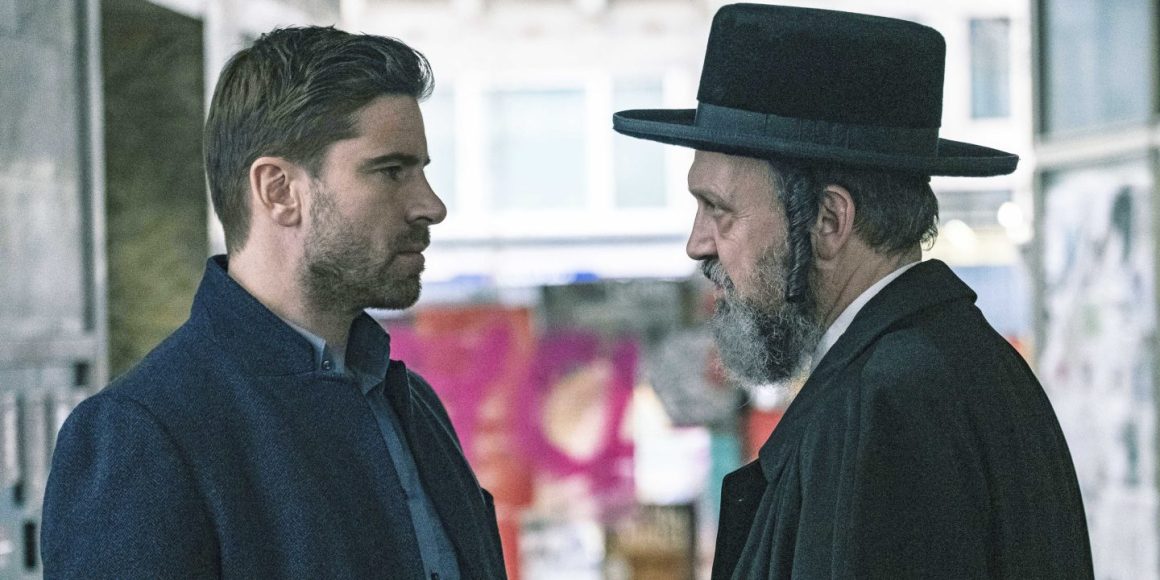
Kevin Janssens (left) as Noah and Robby Cleiren as Eli
Photo: De Mensen / Netflix
“Shtisel” and “Unorthodox” found a large global audience on Netflix. With the series “Rough Diamonds,” an ultra-Orthodox family is once again at the center.
by Christiane Laudage
Antwerp has been the diamond capital of the world since 1447 – that’s what the city advertises. Here, rough diamonds are traded and polished. For a long time, the diamond trade was heavily dominated by the ultra-Orthodox Jewish community. Yiddish was spoken, and the diamond exchange was closed on the Sabbath. Meanwhile, Indian companies have captured a large share of the business.
The diamond trade in Antwerp now forms the backdrop for the Netflix series “Rough Diamonds,” which has already achieved high viewership numbers in a short time. The center of the Israeli-Belgian series is the strictly Orthodox Wolfson family, proud to be among the founding families of the Antwerp diamond trade. However, their company, Wolfson Diamonds, has suffered greatly under globalization.
On one hand, the eight-part crime series delves into the criminal underworld of the diamond city. On the other hand, it portrays the life of an ultra-Orthodox family living in a closed community. When it comes to series about Orthodox Jewish families, Netflix can be sure of success.
“Rough Diamonds” begins with the funeral of the youngest son Yanki, who committed suicide due to gambling debts and had apparently gotten involved with people he should have avoided. The brother Noah, who left the family and the ultra-Orthodox community 15 years ago, also attends the funeral. In the meantime, he has built a new life in London and become the father of a son, Tommy. Noah feels obligated to protect the family’s honor and save the family business from ruin.
The series is the work of the two Israeli directors Rotem Shamir and Yuval Yefet, who previously collaborated on the very popular series “Fauda.” For “Rough Diamonds,” they sought contact with the ultra-Orthodox community in Antwerp, hiring a Yiddish coach and a cultural advisor to portray the community as authentically and accurately as possible.
Indeed, some from this community participated in small roles. Several main actors are Jewish, such as Dudu Fisher as family patriarch Ezra Wolfson or Yona Elian as his wife Sarah.
Netflix offers viewers various languages – however, describing the original as Flemish is insufficient. As befits an ultra-Orthodox family, everyone speaks Yiddish with each other. Noah and his siblings Eli and Adina also switch to Flemish, not only when in contact with other people. They speak French because Belgium is bilingual, and of course English – so the series is actually quadrilingual. This reflects the multilingualism of Antwerp’s Orthodox community.
Why is the ultra-Orthodox community so fascinating? It is a closed community, unknown to most people, with clear rules. As depicted in the series, women wear their *scheitel* (a wig) and modest clothing, men wear sidelocks (*payot*), a kippah, and a hat over it, along with their black suit and white shirt. “Rough Diamonds” shows how they celebrate Shabbat and high Jewish holidays together or celebrate weddings in separate rooms for men and women.
In series about ultra-Orthodox families, the big questions of life are addressed – family, love, freedom. How does one position oneself regarding the prescribed rules? How much freedom is possible or necessary?