Editor’s Note
This article explains the Mohs hardness scale, a fundamental geological tool developed in 1812 to rank minerals by scratch resistance. It details the scale’s practical use and its ten reference minerals, from talc to diamond.
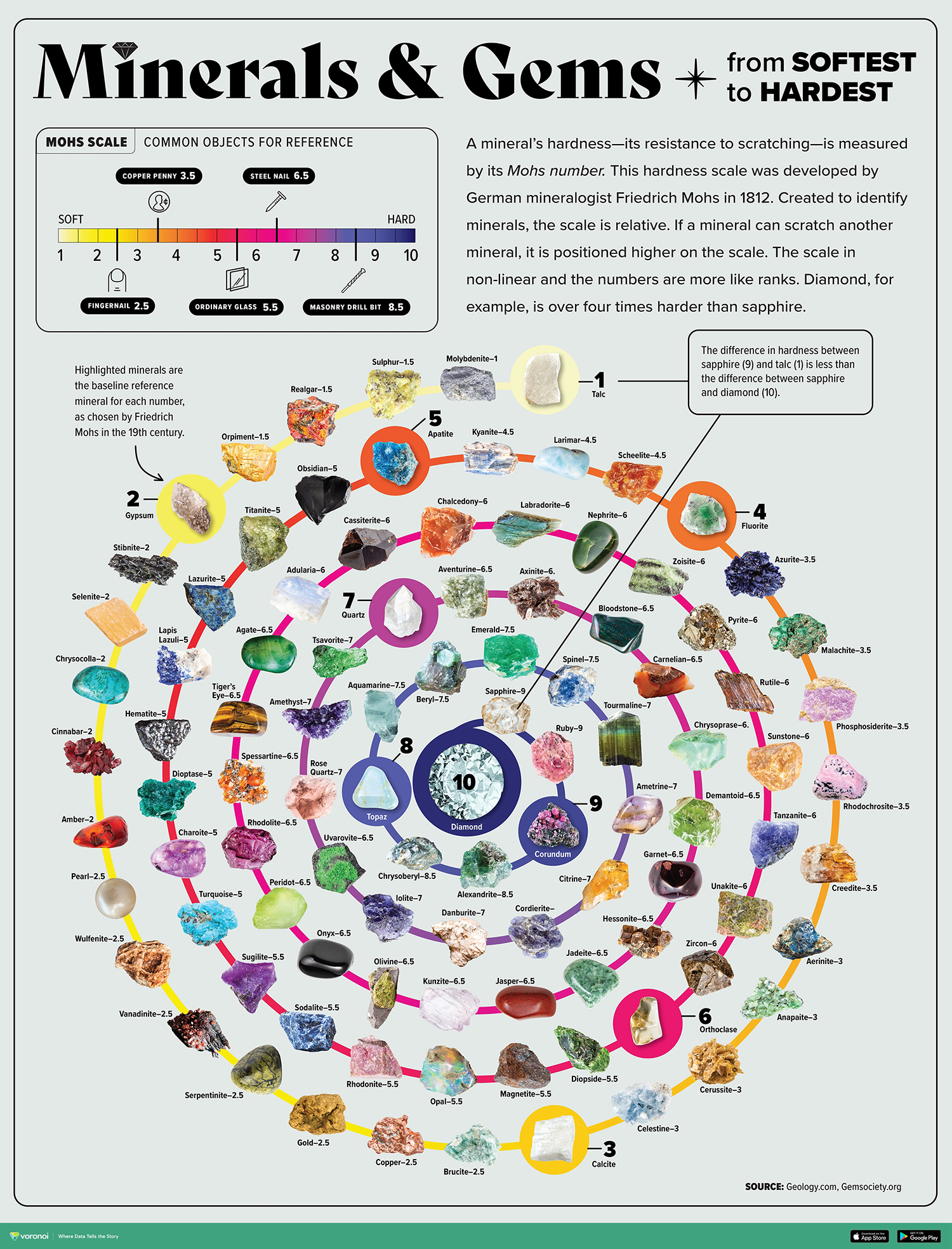
The Mohs hardness scale is one of geology’s most practical and enduring tools.
Developed by German mineralogist Friedrich Mohs in 1812, it ranks minerals by their ability to resist scratching—a proxy for their relative durability. Each level on the scale is associated with a “reference” mineral and is increasingly resistant to scratching by the minerals below it.
Mohs selected 10 minerals to define this scale, ranging from soft talc (1) to hard diamond (10). As outlined by Geology.com and the Mineralogical Society of America, this system is still widely used by geologists, gemologists, and industrial designers to quickly compare material strength in the field.
The visualization above, by Julie Peasley, maps out more than 100 different minerals and gemstones according to their Mohs hardness:
Gem/Mineral | Mohs Hardness
— | —
Molybdenite | 1
Talc | 1
Orpiment | 1.5
Realgar | 1.5
Sulphur | 1.5
Amber | 2
Chrysocolla | 2
Cinnabar | 2
Gypsum | 2
Selenite | 2
Stibnite | 2
Brucite | 2.5
Copper | 2.5
Gold | 2.5
Pearl | 2.5
Serpentinite | 2.5
Vanadinite | 2.5
Wulfenite | 2.5
Aerinite | 3
Anapaite | 3
Calcite | 3
Celestine | 3
Cerussite | 3
Azurite | 3.5
Creedite | 3.5
Malachite | 3.5
Phosphosiderite | 3.5
Rhodochrosite | 3.5
Fluorite | 4
Kyanite | 4.5
Larimar | 4.5
Scheelite | 4.5
Apatite | 5
Charoite | 5
Dioptase | 5
Hematite | 5
Lapis Lazuli | 5
Lazurite | 5
Obsidian | 5
Titanite | 5
Turquoise | 5
Diopside | 5.5
Magnetite | 5.5
Opal | 5.5
Rhodonite | 5.5
Sodalite | 5.5
Sugilite | 5.5
Adularia | 6
Cassiterite | 6
Chalcedony | 6
Labradorite | 6
Nephrite | 6
Orthoclase | 6
Pyrite | 6
Rutile | 6
Sunstone | 6
Tanzanite | 6
Unakite | 6
Zircon | 6
Zoisite | 6
Agate | 6.5
Aventurine | 6.5
Axinite | 6.5
Bloodstone | 6.5
Carnelian | 6.5
Chrysoprase | 6.5
Demantoid | 6.5
Garnet | 6.5
Hessonite | 6.5
Jadeite | 6.5
Jasper | 6.5
Kunzite | 6.5
Olivine | 6.5
Onyx | 6.5
Peridot | 6.5
Rhodolite | 6.5
Spessartine | 6.5
Tiger’s Eye | 6.5
Uvarovite | 6.5
Amethyst | 7
Ametrine | 7
Citrine | 7
Cordierite | 7
Danburite | 7
Iolite | 7
Quartz | 7
Rose Quartz | 7
Tourmaline | 7
Tsavorite | 7
Aquamarine | 7.5
Beryl | 7.5
Emerald | 7.5
Spinel | 7.5
Topaz | 8
Alexandrite | 8.5
Chrysoberyl | 8.5
Corundum | 9
Ruby | 9
Sapphire | 9
Diamond | 10
The data shows a wide variety of hardness across different gems and minerals. At the softest end are talc (1) and molybdenite (1), both so delicate they can be scratched with a fingernail. At the extreme other end is diamond (10), the only mineral that can scratch all others. Interestingly, while corundum (which includes ruby and sapphire) is rated 9, diamond is more than four times harder—a reminder that the Mohs scale is not linear.
Understanding the hardness of a mineral isn’t just academic—it’s highly practical. For example:
Diamond is not just the hardest mineral, it is a critical component in industrial cutting tools due to this property.
Some gems prized for their beauty—like opal (5.5) or turquoise (5–6)—are relatively soft, meaning they’re more prone to scratching or wear over time if used in jewelry.
Meanwhile, harder stones like sapphire (9) and spinel (7.5–8) offer both brilliance and durability, making them ideal alternatives to diamonds.
Quartz (7) sits in a sweet spot: it’s harder than most household objects, which explains its longevity in nature and popularity in jewelry.
Talc (1) and gypsum (2) are so soft that they can be powdered by hand, yet they are still used in everything from cosmetics to drywall.
Interestingly, some visually similar minerals like fluorite (4) and apatite (5) can have markedly different hardness ratings, which can help in their identification.