Editor’s Note
This article discusses the growing prominence of lab-grown diamonds, highlighting recent coverage in international media on industry shifts from established players like De Beers to new ventures leveraging technology such as blockchain.

Interesting articles have appeared in both Newsweek and the Japanese edition of Forbes. They introduce De Beers’ ‘synthetic diamond business’, which has dominated the global diamond market since its inception in 1871, named after the owner of the farm where diamonds were discovered, and Japan’s Pure Diamond Research Institute, linked with the Davidoff diamond mine, and the ‘Pure Diamond Blockchain’.
The common theme of the two articles is ‘lab-grown diamonds’. According to the materials, lab-grown diamonds are distinctly different from previous artificial diamonds in that they are composed purely of carbon, just like natural diamonds, and possess the same scientific, physical, and optical properties as natural diamonds mined from the earth. The only difference lies in the environment—whether they were formed over long periods in mines or created in a laboratory.
The history of synthetic gemstones dates back a long time, driven by humanity’s thirst for beauty, the temptation of enormous profitability, and the aspirations of artisans. The romance with gemstones even formed a category of alchemists and incidentally led to various developments in alloying methods.
Natural diamond, as carbon (C) like graphite, is the only pure elemental crystal among gemstones, mainly forming in the cubic system as octahedrons, dodecahedrons, 48-hedrons, and 64-hedrons, with some being twins. As known, it has a hardness of 10, making it the strongest mineral, and its refractive index is 2.439, the highest among Earth’s minerals except for rutile. It emits light due to heat or sunlight and fluorescent light under ultraviolet rays; its transparency to X-rays is used to authenticate stones.
Colors include white, red, green, blue, pink, purple, orange, yellow, brown, and black. The exact causes of these colors are still not definitively known. Occasionally, there are inclusions like bubbles containing liquid or gas, which is why diamond mines prohibit moving stones immediately after mining to places near fire or high temperatures.
Synthetic diamond technology, also called ‘Synthetic diamond, Lab-grown diamond, Lab-created diamond, Cultured diamond’, has a history of over 60 years since 1955. However, until recently, synthetic diamonds were used for making tools like cutting machines that require high hardness. They were not suitable for gemstone use in terms of quality, and it was difficult to grow them to large sizes, so societal interest in synthetic diamonds was not significant.
However, in recent years, synthetic diamond growth technology has rapidly advanced, producing high-quality synthetic diamonds that can rival gem-quality natural diamonds in terms of colorlessness and transparency. As quality improved, the jewelry industry naturally began showing interest in synthetic diamonds.
According to data released by Zimnisky, in 2018, synthetic diamonds were estimated to be about 5 million carats, roughly 10% of the total diamond market.
Although the market share of synthetic diamonds is still small, the reason for its growth rate exceeding 100% annually is that synthetic diamond technology is combining with global companies to achieve economies of scale, securing competitiveness by improving quality and gradually lowering manufacturing costs.
Over the past decade, natural diamond production has decreased. The natural diamond industry is still plagued by connections to blood diamonds used for conflict funding, and the significant time and cost involved in finding new mines are giving the synthetic diamond industry room to penetrate the market by promoting itself as ‘conflict-free’ and ‘ethically distributed’.
Regarding the market outlook for synthetic diamonds, Lee Hoi-doo, CEO of GOC, stated:

He projected that if lab-grown diamond products, which can be seen as a form of natural diamond cultivation unlike previous zirconium-based synthetic diamonds, reflect the demand of the younger generation who value beauty and ‘my own value’ that I like, the market size could expand rapidly.
The outlook for the synthetic diamond market appears quite bright when observing the actual consumer base. The younger generation born in the 80s and 90s, who can be considered 21st-century consumers, actively participate in social communities, are highly concerned about environmental destruction and labor issues, yet have limited economic means. Therefore, they are showing interest in synthetic diamonds, which are free from environmental and labor problems and, above all, more affordable, rather than expensive natural diamonds associated with environmental destruction and labor issues.
Regarding the market outlook for synthetic diamonds, Lee Hoi-doo, CEO of GOC, stated:
Along with this answer, he projected that if lab-grown diamond products, which can be seen as a form of natural diamond cultivation unlike previous zirconium-based synthetic diamonds, reflect the demand of the younger generation who value beauty and ‘my own value’ that I like, the market size could expand rapidly.
Global synthetic diamond producers and traders are also utilizing marketing that aligns with the new generation’s mindset, stating that synthetic diamonds are eco-friendly and genuine diamonds that do not destroy humans or the environment. The natural diamond side argues that synthetic diamond marketing is lying to and deceiving the younger generation. Thus, natural and synthetic diamonds are clashing with opposing stances regarding defending market share and new expansion.
Amid this situation, De Beers, which maintains over 40% of the global natural diamond market share and is the largest natural rough diamond business, recently announced that it will launch a gem-quality synthetic diamond business under a new brand, Lightbox Jewelry, both online and offline this September. The natural diamond industry is shockingly receiving this launch, wondering if it will create a new storm by emphasizing reasonable and environmental beauty. Indeed, De Beers, which once monopolized global diamond supply, has a precedent of skyrocketing diamond popularity thanks to creating demand for diamond engagement rings through thorough marketing campaigns under the slogan ‘A Diamond is Forever.’
Although there have been controversies over synthetic diamonds before, the reason lab-grown diamonds are particularly noteworthy lies in their creation process. Until now, synthetic stones have been mainly produced through two methods: HPHT and CVD, but they were not threatening to the market in terms of economics or scale.
HPHT method, developed by General Electric in 1954, creates the high temperature and pressure that crystallizes carbon into natural diamond over millions of years and installs a growth chamber inside a press where HPHT stones grow from carbon molecules within a metal solvent catalyst (mainly iron, nickel, or a mixture of the two).
Most HPHT stones are Type Ib with about 0.05% dispersed nitrogen. The growth chamber is small, allowing only a few stones to be grown at a time, and they have the disadvantage of having an intrinsically different form from natural stones even under a microscope.
The CVD method is completely different from HPHT. It uses microwaves or other energy sources inside a vacuum chamber to decompose hydrocarbon gases like methane, growing synthetic diamond. Carbon atoms accumulate in thin layers on a flat diamond substrate, like snowflakes piling on snow, generating about 0.1mm or 100 microns of diamond per hour. The CVD method has slow stone growth speed and limitations in thickness; growing a CVD stone over 3mm is an extremely difficult task.
Due to its unique growth method, CVD stones are Type IIa, containing only trace amounts of nitrogen, have high thermal conductivity, and have a unique shape. Growing CVD stones over 3mm is tricky and costly, so most CVD stones are manufactured under 1 carat.
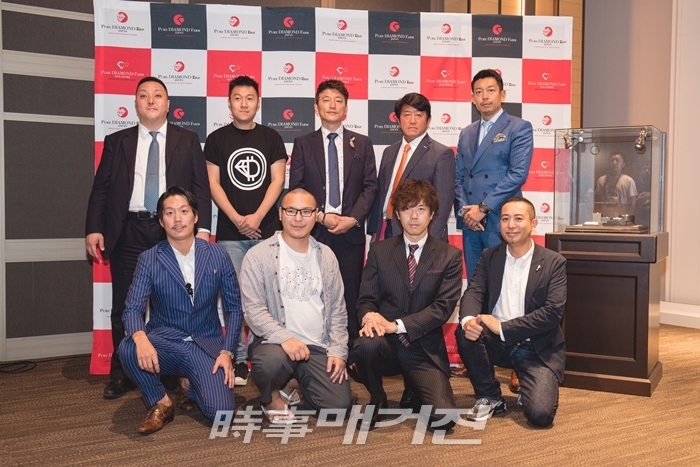
The Japanese lab-grown diamond announced at this conference is said to be scientifically, gemologically, and optically completely identical to natural diamond in composition, which is surprising. Therefore, they express confidence in using terms like diamond cultivation or diamond growth rather than diamond synthesis.
In recent years, with leading global diamond market companies like Diamond Foundry (invested by Leonardo DiCaprio) and De Beers participating in lab-grown diamonds, significant market growth is expected. In Japan, PURE DIAMOND FARM applies the first ‘Made in Japan’ lab-grown diamond manufacturing and research technology, making it possible to produce colored diamonds like ‘Red Diamond’ and ‘Blue Diamond’ and rainbow diamonds, which are truly rare or non-existent in the natural diamond industry.
Hideyuki Abe, representative of Pure Diamond, defined lab-grown diamonds by stating:
The most unique aspect of this conference can be said to be the combination of lab-grown diamond technology and blockchain technology. Shige Ishida, who founded Pure Diamond Co., announced that he developed an independent distribution system called the Pure Diamond Blockchain.
Hideyuki Abe, representative of the Pure Diamond Research Institute, stated:
In other words, the ID engraved on each individual is linked with various data managed on the blockchain, such as production date and location, allowing tracking of history from shipment to sale. This highlights the differentiation from natural diamonds.