Editor’s Note
This article details the upcoming auction of an 18th-century pink diamond with a storied royal provenance. Its history, from the court of Marie Antoinette to its modern resetting by jeweler JAR, encapsulates centuries of art, heritage, and craftsmanship.
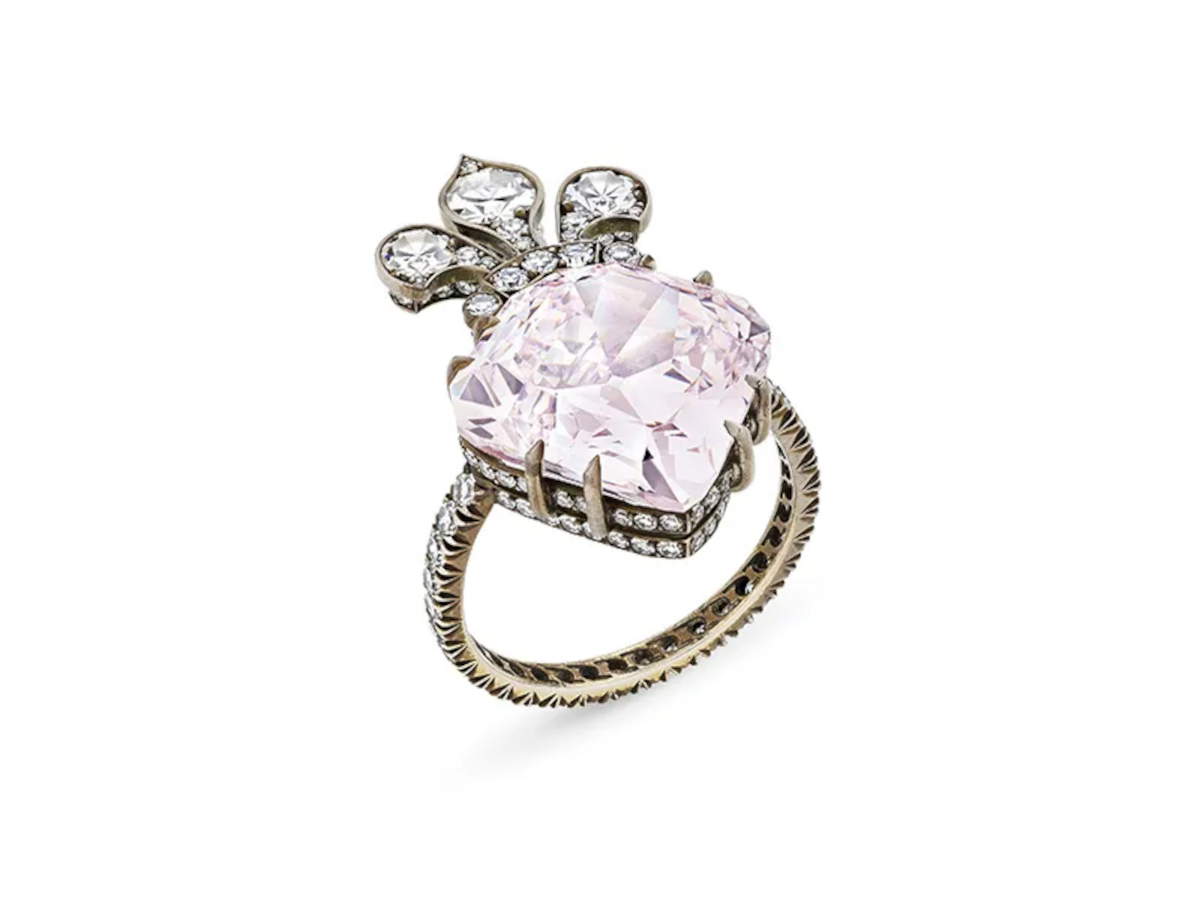
An 18th-century rare pink diamond that once belonged to the daughter of Marie Antoinette will be auctioned on June 17 at Christie’s headquarters in New York. The ring, reset by jeweler JAR, tells a story intertwined with monarchy, dynastic heritage, and contemporary craftsmanship.
Christie’s auction house will auction a pink diamond dating back to the 18th century and linked to the French royal dynasty on June 17 at Rockefeller Center in New York. Known as the “Marie-Thérèse Diamond,” it is named after Marie-Thérèse of Angoulême, the only surviving daughter of Queen Marie Antoinette and Louis XVI. This diamond is the star lot of the upcoming Magnificent Jewels auction, where other historical treasures will also be presented, and it is one of the highlights of the 2025 auction season. The diamond is cut in a kite shape, exhibits a purplish-pink hue, and weighs 10.38 carats. According to Christie’s estimate, its value is between $3 million and $5 million.
The diamond’s provenance traces back to the mid-18th century, its history intertwined with the turmoil of the French monarchy, originating from the failed royal flight from Paris in 1791. It is reported that Queen Marie Antoinette entrusted her most precious jewels to her trusted hairdresser the night before the attempted escape. The aim was to preserve the jewels and retrieve them once they were safe. After her execution in 1793, her daughter Marie-Thérèse was sent to Austria, her mother’s country of origin. There, some of her mother’s jewels, hidden for years, were returned to her.
It cannot be confirmed whether the diamond now up for auction belonged to the specific collection entrusted to the hairdresser. However, historical research confirms that the diamond did belong to Marie-Thérèse of Angoulême. After her, the stone was inherited by her niece, the Duchess Marie-Thérèse de Chambord, and later acquired by Queen Marie-Thérèse of Bavaria. In a will, the Bavarian queen referred to it as “a unique pink diamond from Aunt Chambord.” The diamond passed through generations of European nobility until it was sold in 1996. The current owner then commissioned Joel Arthur Rosenthal (known in the industry as JAR) to create a new setting. Rosenthal is considered one of the most influential figures in contemporary jewelry, renowned for his sculptural designs and use of unconventional color palettes. He produces only a limited number of pieces each year, and his name is associated with clients like Elizabeth Taylor and Diane von Furstenberg. In 2014, the Metropolitan Museum of Art in New York held a retrospective for him, unprecedented for a living jeweler. His ring design for the Marie-Thérèse diamond features a double pavé band set with diamonds, and the ornament above the central stone, composed of 17 diamonds, resembles a crown.
The image of Marie Antoinette has long been a symbol of fashion and luxury. During her life at Versailles, Queen Marie Antoinette had a passion for jewelry. Necklaces, bracelets, tiaras, and hair ornaments were part of an extraordinary collection of precious and rare gems like pearls, rubies, sapphires, and diamonds. Some of the most important pieces were commissioned from court jewelers like Boehmer and Bassenge, or even financed through loans from her husband Louis XVI, such as a pair of diamond bracelets. After the Revolution, some of these jewels were stolen, hidden, or sold. Some have been rediscovered and are now in museum collections. A pair of pear-shaped diamond earrings is currently housed at the Smithsonian Institution in Washington. In 2021, Christie’s auctioned a pair of diamond bracelets that belonged to the queen.