Editor’s Note
**Editor’s Note:**
This exhibition at Palazzo Morando offers a compelling look at how men’s jewelry and style have shaped identity across centuries—proving that ornament is far from marginal.
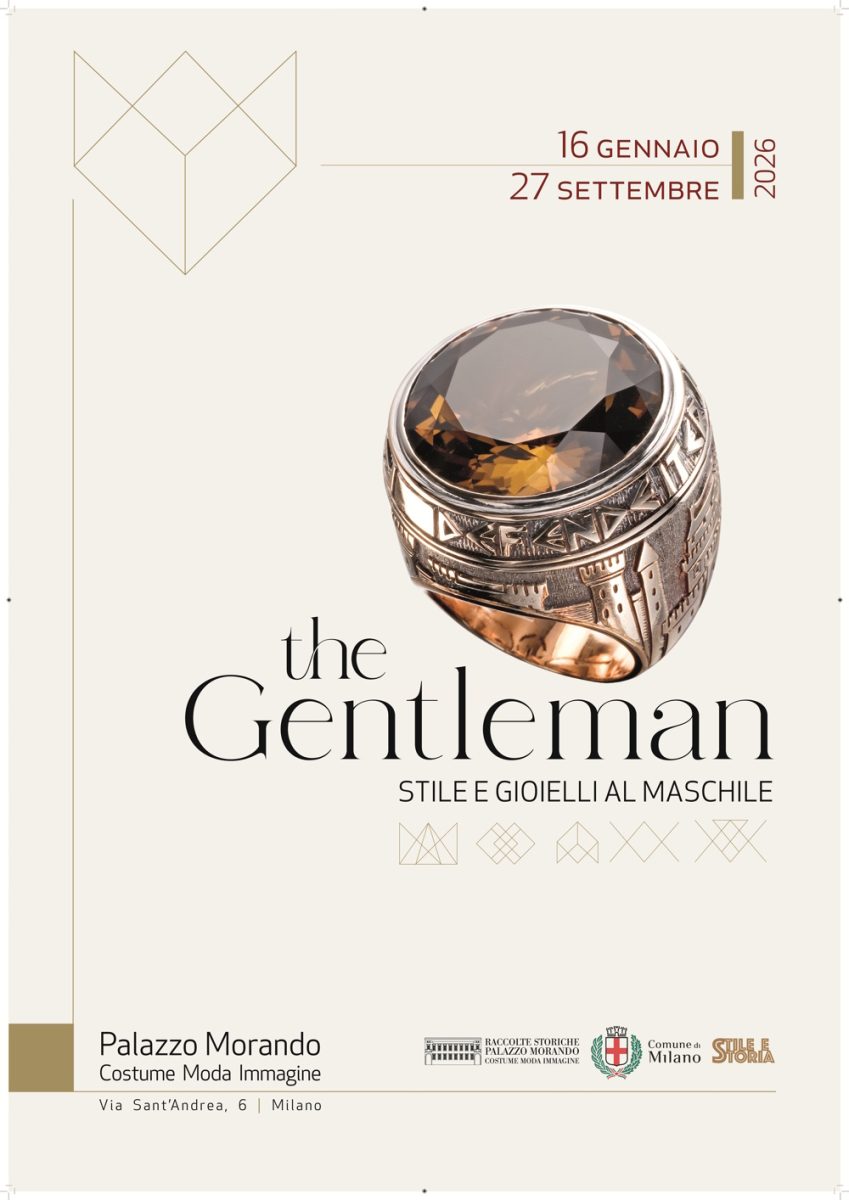
At Palazzo Morando, the exhibition ‘The Gentleman – Style and Jewelry for Men’ traces the relationship between ornament, attire, and identity from the 18th century to the present day.
There is a long, layered, and surprisingly relevant story that runs through clothing, rings, brooches, chains, and details that only appear marginal. This is the story of male ornamentation, told with rigor and sensitivity by the exhibition The Gentleman – Style and Jewelry for Men, open until September 27 at Palazzo Morando | Costume Moda Immagine in Milan.
The exhibition path invites us to reconsider men’s jewelry not as an exception or concession, but as a structural element of male identity. It plays a fundamental role in defining roles, status, affiliations, and desires. This is a continuous dialogue between attire and ornament that spans over two centuries, from the 18th century to the present day, restoring cultural dignity to an area often left on the margins of fashion discourse.
Through original jewelry, clothing, documents, and archival materials, The Gentleman constructs a cross-sectional narrative on the symbolic meaning of male ornamentation. Each object on display is chosen for its ability to tell a story about a context, an era, a way of being in the world. Jewelry, especially in the male sphere, is often functional as well as deeply narrative: it declares family, political, military, and cultural affiliations.
The exhibition, which opens concurrently with Milan Fashion Week Men’s 2026, addresses a still little-explored theme, restoring its “historical, symbolic, and cultural complexity.” It also strengthens Milan’s image as an international capital of fashion and design.
The narrative is enriched by a dialogue with contemporaneity thanks to the presence of iconic jewelry by Buccellati, Bulgari, Cartier, and Damiani, alongside artisanal and creative realities such as Cusi, Grimoldi, Margherita Burgener, Milano Jewels, and Lucilla Giovanninetti. This reveals an open perspective, showing how men’s jewelry is today a field of research, experimentation, and innovation.
The exhibition path follows a clear chronological sequence. It starts in the 18th century, when men of the European elite naturally wore elaborate jewelry and sumptuous clothing. In that historical period, ornament was a social language, a sign of power and representation. Then, with the bourgeois 19th century, a turning point arrived: male aesthetics became more sober and measured. However, it did not completely renounce jewelry, which survived in discreet and functional forms such as cufflinks, brooches, and chains.
The 20th century introduced tensions and contradictions: alongside the simplification of modern attire, charismatic figures emerged – artists, musicians, intellectuals – who brought ornament back to the center of individual expression. It is in these shifts that jewelry once again becomes a symbol of identity, belonging, and personal affirmation.
The exhibition concludes with contemporaneity, where men rediscover the freedom to adorn themselves without rigid codes. Designers and artisans today redefine the boundaries between function and decoration, proposing bold, conceptual jewelry capable of speaking a personal and inclusive language.
Produced by the Municipality of Milan and Palazzo Morando in collaboration with the Cultural Association Stile e Storia, the exhibition enjoys the patronage of important institutions with video contributions from Rai Teche. It is a choral project that intertwines fashion, social history, and excellence in craftsmanship.
The Gentleman – Style and Jewelry for Men
Palazzo Morando – until September 27, 2026
Hours: Tuesday to Sunday 10 AM – 5:30 PM (last entry at 5 PM). Closed on Mondays
Free admission