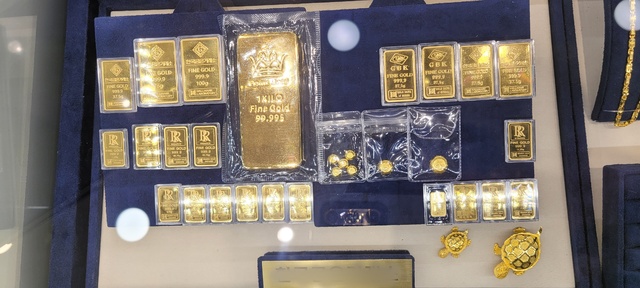
Editor’s Note
The recent sharp decline in gold and silver prices has sent shockwaves through markets, shifting dynamics for investors, retailers, and manufacturers alike. This article examines the immediate fallout and the contrasting impacts across different sectors of the economy.
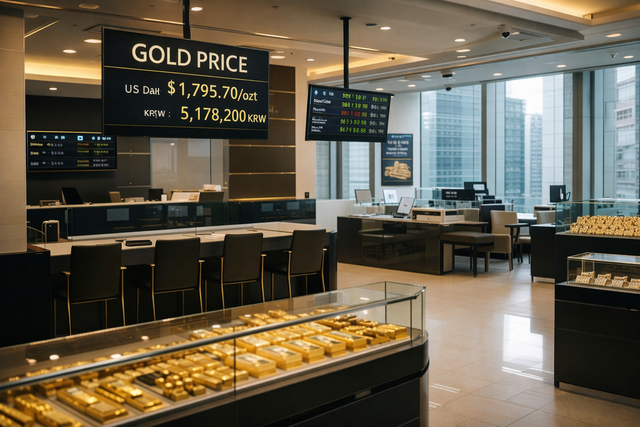
International gold and silver prices have plummeted by 10% and 30% respectively, leading to a ‘trading cliff’ in retail markets such as the Gyodong Jewelry Street. Manufacturers, however, anticipate a relief in cost burdens.
International gold and silver prices, which had recently hit consecutive all-time highs, have plummeted in just one day, delivering a significant shock not only to global financial markets but also to domestic physical and investment markets. Funds that had flocked to safe-haven assets are withdrawing en masse, causing volatility to expand dramatically, and the ripple effects are extending to local commercial districts and industrial sites.
According to Reuters and other sources, on the 31st of last month (local time), the international gold price traded at $4,883.62 per ounce, a sharp drop of 9.5% from the previous session. This represents a major correction just one day after it had soared to $5,594.82, breaking through the $5,500 per ounce level for the first time in history.
Domestic gold prices also fell under the influence of the international decline. As of the 31st of last month, the selling price per ‘don’ (3.75g) was 836,000 won, and the buying price was 995,000 won, down 52,000 won (5.0%) and 28,000 won (3.2%) respectively from the previous day.
International silver prices, which had been on a rally for several months, fell even more sharply. Silver, which had soared to over $120 per ounce, traded at $83.99 on that day, a plunge of 27.7% from the previous session, dropping 17-30% in a single day and falling below the $100 level. Market assessments indicate a ‘panic selling’ phenomenon, where sell-offs poured in all at once following the short-term surge. In some trading intervals, gaps in quotes were observed, leading to scenes of prices plummeting vertically.
The direct trigger for this sharp decline is cited as uncertainty surrounding US monetary policy. News that President Donald Trump nominated the hawkish Kevin Warsh as the next Federal Reserve (Fed) Chairman caused the interest rate cut expectations that had been supporting the market to plummet sharply.
As prospects spread that benchmark interest rates could remain higher for longer than expected, the dollar turned strong, and the investment appeal of non-interest-bearing assets like gold and silver relatively weakened. Additionally, the massive release of profit-taking sell orders following the excessive price rise in a short period also fueled the sharp decline. Gold and silver had maintained a steep upward trend in recent months, driven by a combination of global geopolitical risks, inflation concerns, and expectations of a weak dollar.
As the perception that prices had peaked spread, large-scale sell orders poured in simultaneously, leading to a result that further amplified volatility.
Expectations of easing geopolitical risks also acted as a factor lowering demand for safe-haven assets. With the possibility of a peace agreement between Russia and Ukraine being discussed, the ‘hedge’ demand for holding gold and silver in preparation for uncertainty partially weakened. As complex factors intertwined, the gold and silver markets shifted from an ‘overheated’ to a ‘sharp cooling’ phase in a short period.
The sharp plunge in international gold and silver prices is having mixed effects on the overall regional economy. While jewelry retail districts directly facing consumers are complaining of a deep recession, manufacturers with a high proportion of industrial demand and investment-focused gold exchanges show a different expression.
The Gyodong Jewelry Street in Jung-gu, Daegu, shows little sign of vitality despite the news of falling gold and silver prices. Although gold prices have undergone some adjustment, traditional consumption demand for items like ‘dolbanji’ (first birthday rings), couple rings, and wedding gifts has virtually ceased as the high price range of around 1 million won per ‘don’ is maintained. Among merchants, the perceived economic climate is so cold that comments like “There are fewer customers than during the IMF foreign exchange crisis or the COVID-19 pandemic” are being made.
On the other hand, regional manufacturers using gold and silver as industrial materials are relatively positive about the price decline. Silver, with its excellent conductivity, is a key material for advanced industries such as electronic components, circuits, and solar panels. Electronic component and parts companies in the Seongseo Industrial Complex, which had been burdened by high costs due to the recent surge in silver prices, expect the burden of raw material procurement costs to ease somewhat with this price adjustment.
Industry officials said, “While price volatility has not completely dissipated, we expect cost pressures to decrease for the time being.”
Meanwhile, expert views on the future outlook for gold and silver prices are divided. Some warn, “This is an adjustment process where bubbles are bursting from an overheated market,” and “Given the increased volatility, the possibility of further declines cannot be ruled out.” On the other hand, there is also analysis stating, “U.S. fiscal instability, structural distrust in the dollar, and medium- to long-term inflation concerns are still valid,” and “This sharp decline could be an opportunity for medium- to long-term investors.”
In the market, cautious views are gaining strength, suggesting that as the fluctuation range of gold and silver prices is likely to remain significantly expanded for the time being, it is necessary to watch for the market to calm down rather than engaging in chase buying or panic selling. In a volatile market alternating between sharp rises and falls, both investors and actual demand users are required to make cool-headed judgments.