Editor’s Note
The Economic Survey 2024-25 highlights the resilience of India’s external sector, with total exports showing steady growth despite global uncertainties.
India’s external sector continues to display resilience amidst global headwinds of economic and trade policy uncertainties, states the Economic Survey 2024-25 tabled in the Parliament today by the Union Minister for Finance and Corporate Affairs, Smt. Nirmala Sitharaman.
The Economic Survey notes that the total exports (merchandise and services) registered a steady growth of 6 percent in the first nine months of Financial Year 2024-25. Growth in services and goods exports, excluding petroleum and gems and jewellery, was 10.4 per cent. This indicates that Indian manufacturing, agriculture and services exports were able to compete with global competition. Total imports during the same period registered a growth of 6.9 per cent.
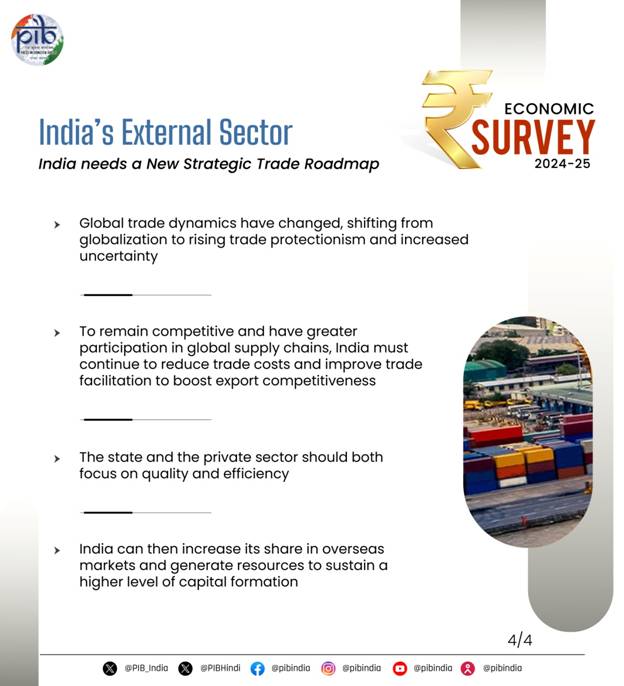
Disruptions in global trade due to Red Sea crisis, Ukraine war and recent drought in the Panama Canal, allied with increased protectionist tendencies shown by many countries, have created uncertainties. The number of Non-Tariff Measures (NTMs) that restrict international trade have also increased over the last few years. The Technical Barriers to Trade (TBT) affect 31.6 per cent of the product lines, covering 67.1 per cent of the global trade as of December 2024. This is followed by export-related measures, affecting 19.3 per cent of the product lines and covering 31.2 per cent of the global trade. Sectors most affected by NTMs include agriculture, manufacturing, and natural resources.
The Survey notes that India requires to assess the situation and develop a forward looking strategic trade roadmap that leverages its strengths. India is in a process of negotiating a number of Free Trade Agreements with countries and trading blocks. For example, in the textile sector, the UAE-India Comprehensive Economic Partnership Agreement (CEPA) (2022) has helped reduce India’s textile tariffs with a significant market. India is actively working towards negotiating trade deals with top importers such as the EU and the UK. The Survey notes that India is also adopting the strategy to diversify its export basket and target new markets.
Services exports from India have shown a multi-sectoral presence in global exports, with notable contributions across several sectors. India’s share in global services exports has more than doubled, reaching around 4.3 per cent in 2023 from 1.9 per cent in 2005. In ‘Telecommunications, Computer, & Information Services’, India commands 10.2 per cent of the global exports market (ranking 2nd largest exporter in the world), reflecting its strong position in IT outsourcing, software development, and digital services.
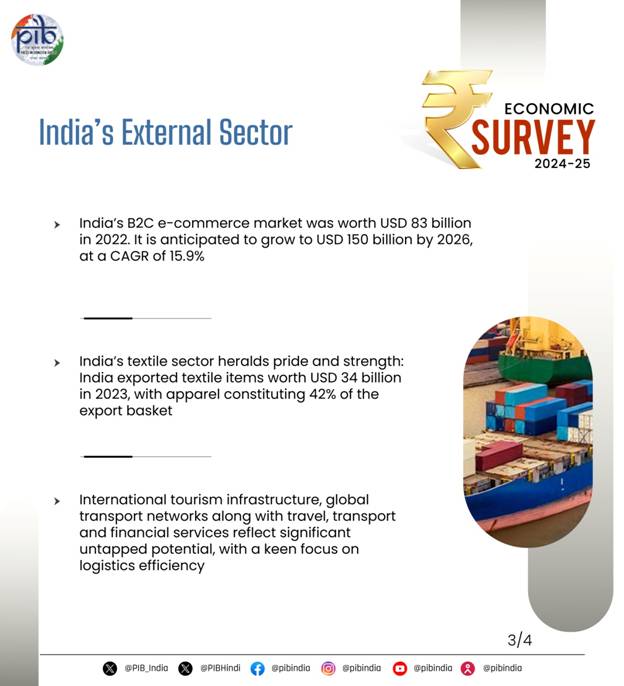
The ‘Other Business Services sector’ also plays a crucial role, with India holding 7.2 per cent of the world share (ranking 3rd largest exporter in the world), driven by its expertise in professional and consulting services. There are opportunities for growth in international tourism and global transport networks. India’s e-commerce export also holds immense potential to grow significantly and become a key contributor to the country’s GDP. It is driven by various elements such as the rise of technology-powered advancements like online payments, localised delivery services, data-driven interactions with customers, and digital marketing.
The development of logistics hubs, investments in infrastructure, and policy reforms to improve supply chain efficiency are measures that will drive Indian exports sector. Directorate General of Foreign Trade (DGFT) has launched ‘Trade Connect e-Platform’, which is a single window initiative enabling exporters to add newer markets. The e-platform aims to transform the international trade landscape for Indian exporters, especially MSMEs. The platform, developed in collaboration with key partners, including the Ministry of MSME, EXIM Bank, Department of Financial Services, and the Ministry of External Affairs, will address information asymmetry by offering exporters comprehensive support, resources and near real-time access to critical trade-related information.
The FDI inflows have shown signs of revival in the first eight months of FY25, though net FDI inflows declined relative to April-November 2023 due to a rise in repatriation/disinvestment. The Economic Survey states that the gross FDI inflows increased from USD 47.2 billion in the first eight months of FY24 to USD 55.6 billion in the same period of FY25, a YoY growth of 17.9 per cent.