Editor’s Note
This article explores the cultural and geological significance of Australia’s national gemstone, the opal, tracing its journey from a sacred Aboriginal “rainbow stone” to a cherished souvenir.
More Than a Souvenir
Sydney · Aborigines call it the “rainbow stone,” and today it is the national gemstone and one of the most popular souvenirs from Australia: the opal. What is so fascinating about this sparkling mineral?
31.05.2023, 12:06 Uhr
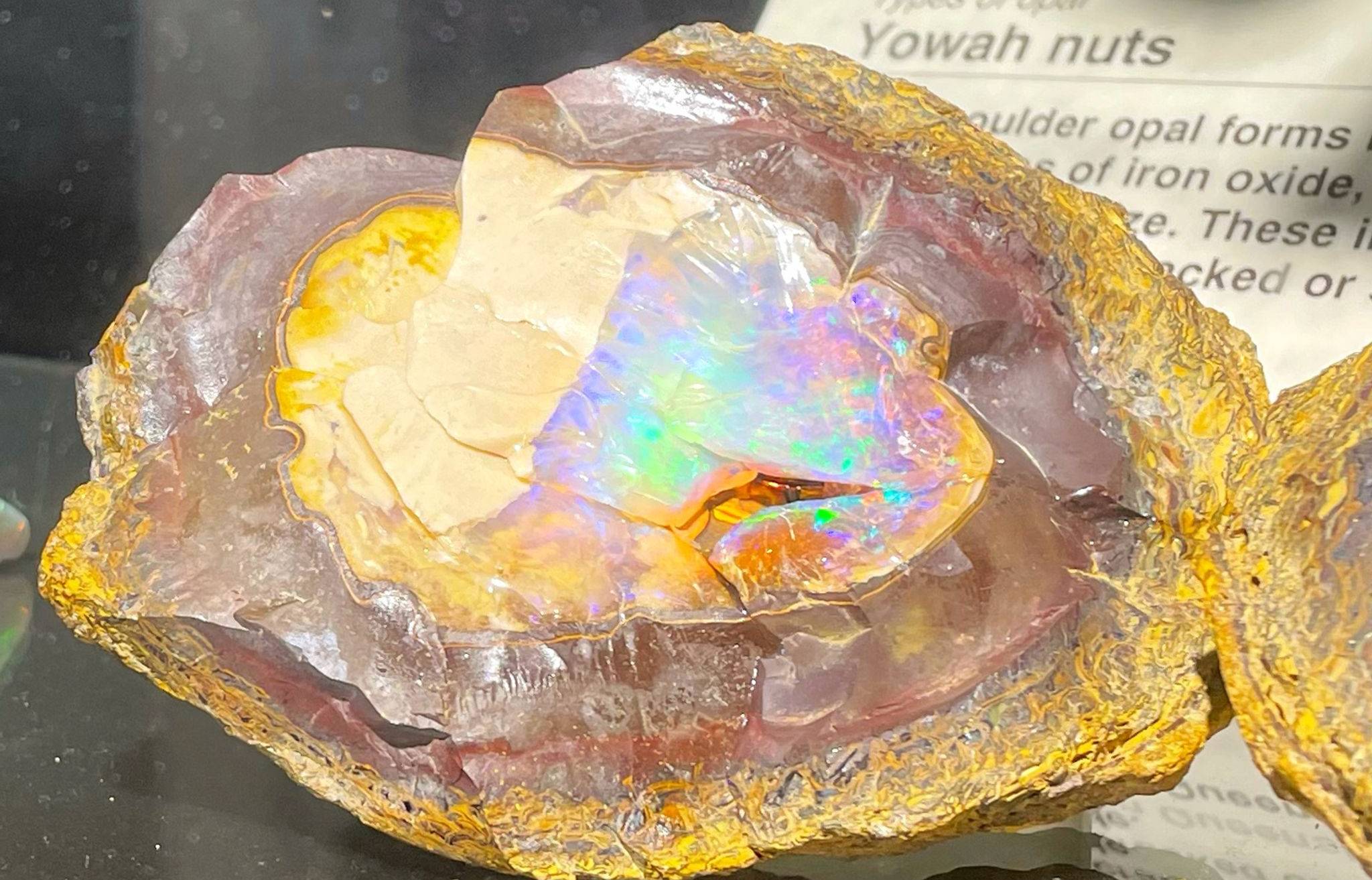
An unprocessed opal, still surrounded by its host rock, stands out as an exhibit at the National Opal Collection.
Photo: Michelle Ostwald/dpa
By Michelle Ostwald, dpa
In the glass display cases of the National Opal Collection in the heart of Sydney, precious opals glitter in valuable necklaces, bracelets, and other jewelry pieces with a magical play of colors. Sometimes they are dark and streaked with red particles, then almost white with green and blue shimmering accents.
This splendor comes at a price: a silver set of necklace, bracelet, and ring, each adorned with a precious opal in bright turquoise tones, costs a proud 200,000 Australian dollars (around 122,000 euros) here.
Rings adorned with opals are also on display at the National Opal Collection.
Photo: Michelle Ostwald/dpa
“In the 1970s, I traded in all kinds of gemstones,” says Maxwell Lane, one of the directors of the collection, to the German Press Agency.

The 81-year-old is among the largest dealers in Down Under. What excites him so much?
His National Opal Collection – half museum, half luxury store – is a homage to the mineral.
Robert Oberdorfer is an opal miner and assistant manager of the National Opal Collection, which also contains a partially opalized skeleton of a pliosaur.
Photo: Michelle Ostwald/dpa
Lane is in good company: William Shakespeare himself described the opal in his comedy “Twelfth Night” as “the queen of all gemstones.” And Napoleon once gave his beloved wife Joséphine the black opal “The Burning of Troy,” a legendary beautiful stone that has been missing since World War II.
Opal miner Robert Oberdorfer polishes a small opal stone at the National Opal Collection.
Photo: Michelle Ostwald/dpa
Almost exactly 30 years ago, Australia declared the opal its national gemstone – and rightly so: about 90 percent of all precious opals come from here, and nowhere else are there larger opal fields. They are mined primarily in the dry Outback, especially in the state of South Australia, but also in Queensland and New South Wales.
The National Opal Collection also includes a jewelry set adorned with shimmering opals, costing about 200,000 Australian dollars (around 122,000 euros).
Photo: Michelle Ostwald/dpa

Opals also play a role in Aboriginal myths. For the indigenous people, they are closely linked to the creation of the world, the so-called “Dreamtime.” According to legend, a creator being traveled to Earth via a rainbow. Everywhere the light touched the ground, it bathed stones and rocks in colorful hues – transforming them into opals. These shimmering rainbow stones are attributed with magical properties.
The most common type of opal, the light or “white opal,” is found in the rock layers of the South Australian Outback. Particularly famous – and popular with tourists – is the 2,000-person town of Coober Pedy, often called the world capital of opals.
In the municipality, there is a free prospecting zone where anyone can try their luck, says Gabrielle Klein from the tourist information office of the small desert town.
Those who want to mine seriously, however, need a license. This is available for about 100 dollars a year.
Austrian-born Robert Oberdorfer is one of those who have been gripped by the opal rush and never let go. He himself spent many years searching for the gemstone in the mines of Coober Pedy and Andamooka, another opal location.
In 1968, the now 75-year-old was involved in a very special excavation:
But the bones did not belong to a dog, but to a pliosaur – an extinct marine reptile that lived about 200 million to 65.5 million years ago. The skeleton, which shimmers colorfully in many places due to opalization, now hangs in the exhibition room of the National Opal Collection.
The fact that an opalized marine dinosaur was found in the Outback goes back to an ancient inland sea, the Eromanga Sea, where the animals lived. Today, most Australian opals are found on the margins of this former sea.
Exactly how the mineral formed is not clearly understood. The prevailing theory is that about 30 million years ago, something changed in the sediment layers. During rain, water collected, seeping through them and absorbing minerals from the sandstone.
In special cases, this became silicic acid, which then settled in cracks and cavities of the rock layers. This created much colorless and worthless opal, so-called “potch,” and in some rare cases, precious opal – the valuable stone that miners tirelessly seek.
