Editor’s Note
Precious metals are rallying, with gold and silver posting significant gains. This surge reflects ongoing market dynamics and investor sentiment. We will continue to monitor these trends and provide updates.
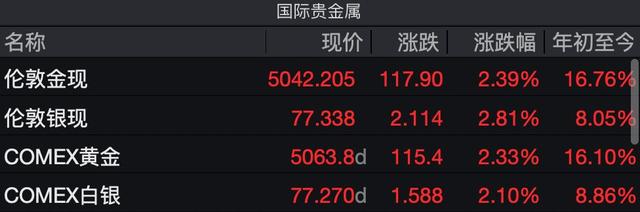
On February 13 local time, spot gold rose 2.39%, reclaiming ground above $5,000 to $5,042.205 per ounce, marking a 16.76% increase year-to-date. Spot silver rose 2.81% to $77.338 per ounce, up 8.05% year-to-date.
International precious metals futures also rose broadly on Friday. Wind data shows COMEX gold futures rose 2.33% to $5,063.80 per ounce, accumulating a 1.51% weekly gain. COMEX silver futures rose 2.10% to $77.27 per ounce, though they declined 0.33% for the week. After experiencing a historic plunge, gold prices have risen for two consecutive weeks, while silver prices continue their downward trend.
On the news front, data released by the U.S. Bureau of Labor Statistics on February 13 showed the U.S. January CPI rose 2.4% year-on-year, lower than expected, while core CPI fell to 2.5%, the lowest level since 2021.
Jonathan Cohn, head of U.S. interest rate strategy at Nomura Securities, stated that the positive reaction to the inflation data was limited by the prospect of continued improvement in the labor market, as this weakens the necessity for the Federal Reserve to further cut rates.
Cohn also noted,
Lindsay Rosner, head of multi-industry fixed income investment at Goldman Sachs Asset Management, said that given the U.S. January CPI data was not as strong as feared, the Fed’s “normalization” path to rate cuts seems clearer. This will depend on whether the labor market continues to show signs of improvement, as the Fed is highly sensitive to any softening in the labor market. The market expects the Fed to cut rates twice this year, with the next cut potentially occurring in June.
Additionally, evolving geopolitical situations have also supported the appeal of precious metal assets. According to CCTV News, on February 13 local time, U.S. President Trump confirmed that the U.S. military will deploy a second aircraft carrier strike group to the Middle East to pressure Iran into reaching an agreement with the United States.
Yinhe Securities pointed out that the rise in precious metal prices is primarily led by the emergence of monetary easing, differing from past cycles where gold price increases typically followed monetary policy easing measures. This round of gold price momentum began in July 2023 and is still within the Fed’s rate hike cycle. The main drivers pushing gold prices come from expectations of dollar de-dollarization, rising global central bank gold purchases, and geopolitical risk premiums.
Despite recent increased volatility in the precious metals market, several Wall Street institutions raised their gold price targets this week.
David Wilson, head of commodity strategy at BNP Paribas, stated this week that influenced by persistent macroeconomic and geopolitical risks, the current gold rally is “reasonable and logical.” He expects gold prices to rise to $6,000 per ounce by year-end, with the gold-to-silver ratio also moving higher.
Wilson noted that while the current gold-to-silver ratio is still below the average level of over 80 times seen in the past two years, it has begun to recover. He stated:
Analyst Edward Lee at UOB wrote in a report this Monday:
The institution expects the gold rally to regain momentum and has raised its year-end 2026 gold price target to the range of $6,100-$6,300 per ounce.
Lee pointed out.