Editor’s Note
This article reports on the signing of key documents between Japanese Prime Minister Sanae Takaichi and U.S. President Donald Trump in October 2025. The agreements focus on implementing a bilateral tariff pact and securing the supply of critical rare earth elements.
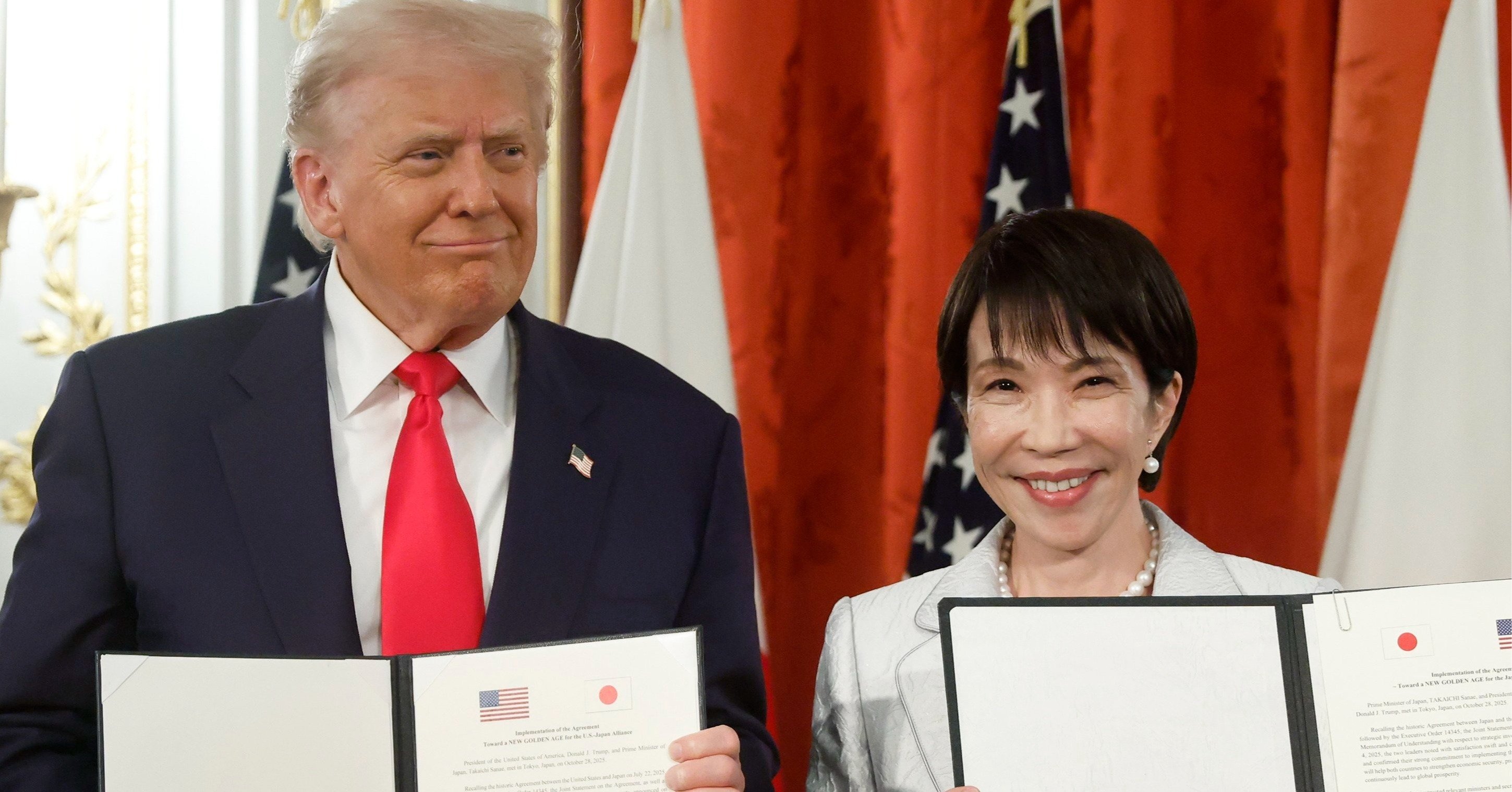
On October 28, 2025, Prime Minister Sanae Takaichi and President Donald Trump signed two documents at the State Guest House in Motoakasaka, Tokyo, concerning the steady implementation of the Japan-U.S. tariff agreement and securing the supply of rare earth elements. (Photo: JIJI)
It is premature to rejoice, thinking “Decoupling from China with Minamitorishima’s rare earths!” While the Japanese government has begun to seriously pursue deep-sea mining as a strategy to reduce dependence on China, there are actually three pitfalls. If things continue as they are, not only could the plan fail, but there is even a risk that Japanese industry could be left high and dry. This article presents the reality that the “dream of domestic rare earths for decoupling from China” is in a tight spot, along with potential solutions. (By Takihiro Suzuki, Chief Economist, Hyakunen Consulting)
Due to my specialization in future forecasting, I make “surprising predictions” around this time every year. The prediction featured in this month’s issue of Nikkei Money was a “plan for a U.S. maritime military base on Minamitorishima.” It is a forecast suggesting that, while the probability is low, such news might emerge this year. I discussed this prediction around November last year, and since then, the development of rare earths around Minamitorishima has become a major topic. The trigger was the cooling of Japan-China relations following remarks by Prime Minister Takaichi.
Rare earths is a collective term for rare earth elements used in all kinds of advanced products like EVs, medical equipment, and high-tech devices. China holds over 90% of the global market share in refining. In retaliation for Takaichi’s remarks, export restrictions on rare earths to Japan began.
For China, rare earths are a strategic resource not only against Japan but also against the U.S. and EU. Reducing dependence on China was an important agenda item at the recent G7 summit. Among Western leaders, President Trump is arguably the politician most keen on changing this dependency situation.
In this context, Minamitorishima has come into the spotlight in Japan. The deep sea near Minamitorishima contains deposits of high-purity rare earth mud, with reserves estimated to be sufficient for hundreds of years of global demand.
However, lifting large quantities of mud from a depth of 6000 meters is not only costly but also technically challenging. Since the announcement of the rare earth discovery in 2013, the project has remained in the investigation phase for a long time.
The recent news is that the Japanese government has expressed its intention to make serious investments in mining. Under the Cabinet Office’s “Strategic Innovation Creation Program,” the plan is to begin trial extraction of rare earth mud from the 6000-meter seabed this year, conduct a demonstration experiment next year with a daily recovery capacity of 350 tons of rare earth mud, and aim to achieve commercial mining around 2030.
Will this Japanese government policy solve the rare earth problem for Western nations? In reality, there are issues that are not easily overcome. As hinted at the beginning with the “surprising prediction,” there are several hurdles to a solution. The reason I combined the prediction of a “U.S. maritime military base” on Minamitorishima in my forecast was to hint at one of these several problems.
What are the difficulties, and why might the U.S. military become involved? This article will explain the geopolitical circumstances underlying this bold prediction.