Editor’s Note
This article reports on a significant policy shift in Rajasthan, where the state government has halted the construction of individual water storage tanks (taankas) under the MGNREGA scheme. The order redirects the program’s focus away from individual-benefit works.
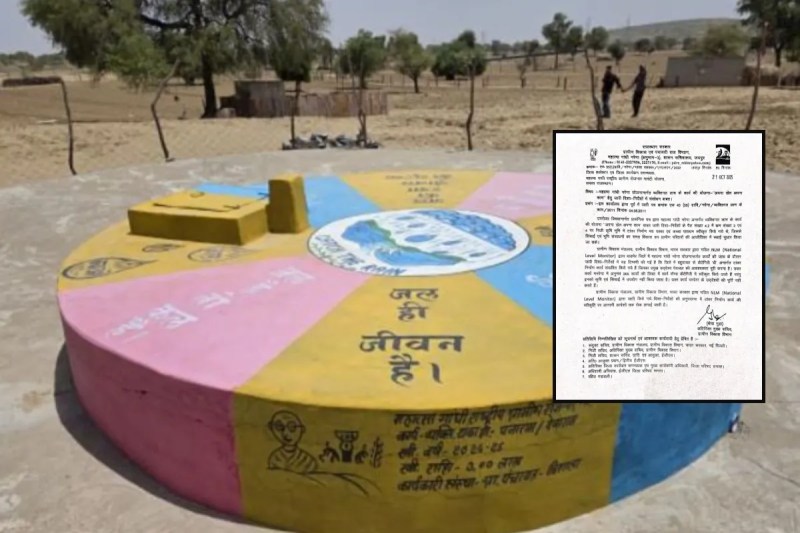
The Rajasthan government has imposed an immediate ban on the construction of water ‘taankas’ (traditional water storage tanks) on farmers’ fields under the Mahatma Gandhi National Rural Employment Guarantee Act (MGNREGA). In an order issued on Tuesday by Additional Chief Secretary (ACS) of the Rural Development Department, Shreya Guha, all district collectors have been instructed that approval for taankas will no longer be granted under MGNREGA for any individual-benefit works.
The department imposed this ban based on a report from the central government’s National Level Monitor. The order states that approval for individual-benefit works under MGNREGA is primarily given for constructing farm ponds for irrigation purposes, while taankas are used for drinking water, which is not in line with the scheme’s core objective.
For centuries, the construction of taankas has been part of the traditional water conservation system in the western part of Rajasthan. These taankas help capture, store, and preserve limited rainwater for extended periods. Experts believe that constructing taankas under MGNREGA provides rural communities with water security, employment, and livelihood. The decision to ban taanka construction could pose a major challenge for areas where groundwater levels are continuously declining and wells/ponds have dried up.
MP Umedaram Beniwal said that this ‘Tughlaqi decree’ issued on Diwali day gives rise to the irony of ‘people will die of thirst, policies will remain on paper’. Making policies sitting in closed AC rooms without ground-level investigation, surveys, and understanding local needs is ignoring the real problems of Thar. It is the water conserved in these very taankas that quenches the thirst of Thar’s residents.
Meanwhile, Baytu MLA Harish Chaudhary said that on the 21st, when the entire country was celebrating Diwali, the government stabbed our desert in the back on that very day. The government issued this order on a holiday.
Youth leader Raghuveer Singh Tamlor said taanka construction is essential for Barmer. There is a water shortage here, especially in border areas. In such a situation, taankas being built under MGNREGA are proving to be a boon. The government should prioritize taanka construction and issue orders for their construction.
Water experts believe that banning taankas will adversely affect the water balance of Thar. The specialty of these taankas is that they help in groundwater recharge while also providing relief from water crisis to thousands of families every year. Instead of a complete ban, the government should set design and usage standards for these structures so they remain aligned with the scheme’s objectives and the tradition of water conservation continues.
In desert districts, especially areas like Barmer and Jaisalmer, water taankas are not just structures but considered the foundation of life. Here, people depend on rainfall for only a few days a year. These taankas built in village after village are the medium through which rainwater is stored and used throughout the year. This water is used for drinking, livestock, and sometimes for irrigation.
Under the ‘Apna Khet, Apna Kaam’ scheme running under MGNREGA, thousands of farmers in the district have had taankas and catchment areas built on their fields in recent years. Villagers say this scheme has not only been a source of employment but has proven to be a permanent solution for areas struggling with water crisis.
– Taankas built in Barmer under various schemes: Approximately 400,000
– Cost of a 13.5 ft x 13.5 ft taanka: Approximately 300,000 rupees
– Water storage capacity of a taanka: Approximately 35,000 liters
– Water collection: A major means of storing rainwater
– Water use: Used for drinking and livestock in villages throughout the year