Editor’s Note
This article highlights Germany’s critical dependency on imported metals, a vulnerability set to intensify with the growing demands of digitalization and the green transition. It underscores the urgent need for strategic supply chain solutions beyond current recycling efforts.
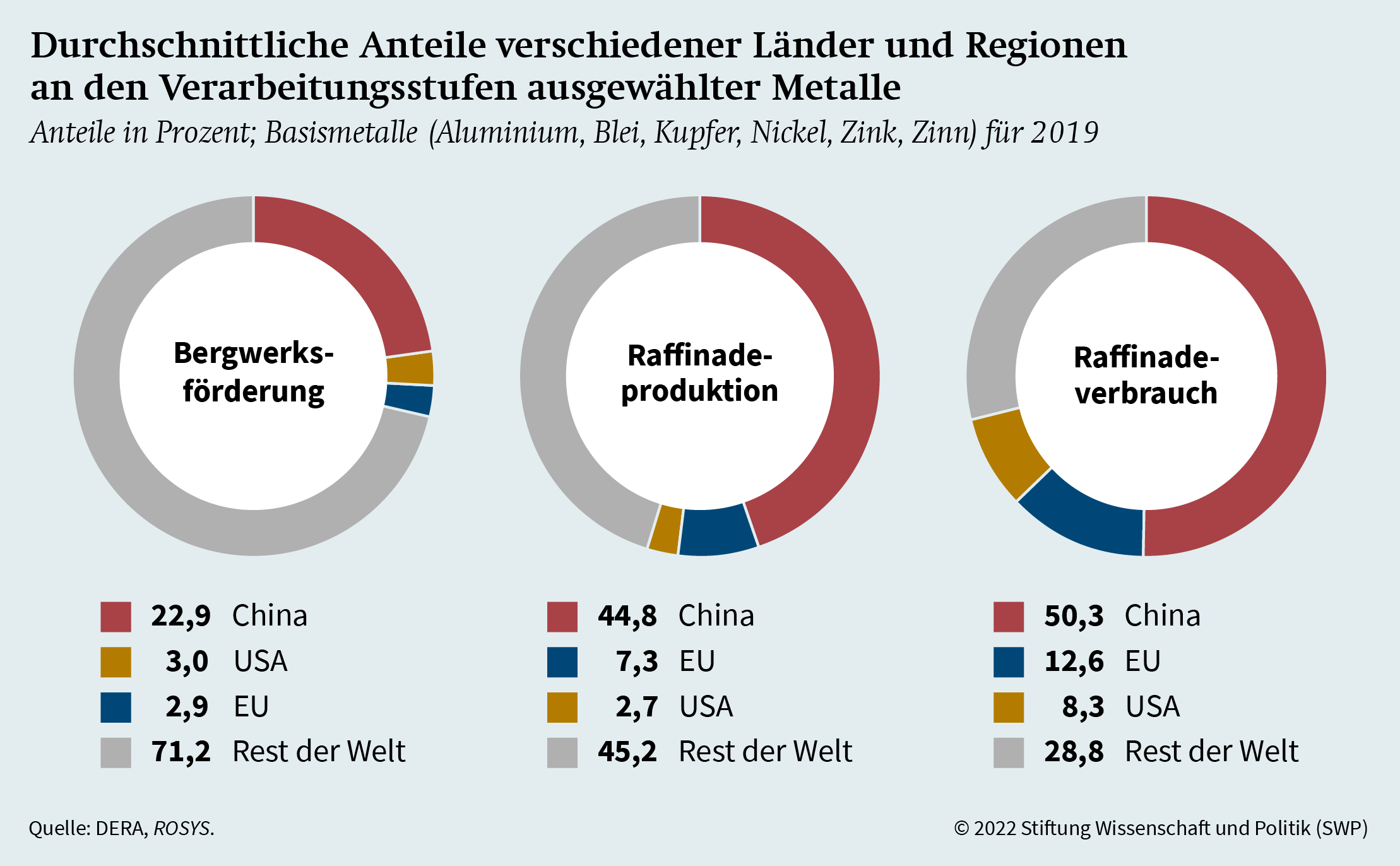
German companies are heavily dependent on imports of metallic raw materials, as Germany itself has limited deposits of such resources and demand can only be partially met through recycling. The demand for metals will increase significantly in the coming years for the expansion of digitalization as well as for the energy and mobility transition. The International Energy Agency (IEA) assumes that by 2040, four times more critical metals will be needed globally for energy transition technologies than today.
The German Federal Ministry for Economic Affairs and Climate Action (BMWK) has formulated key points in recent months to supplement the federal government’s raw materials strategy. These measures can be assigned to three pillars: first, recycling and the circular economy; second, diversification, European and international cooperation; third, implementation of sustainability standards, also in alliance with European partners.
Although Germany covers part of its current demand from its own recycling sector, primary material continues to be imported. The majority of this comes from the world’s largest exporter, South Africa, and is imported in already refined form. The German company Heraeus Precious Metals is the only exception here, as it is involved in further processing with its own refineries at German sites.
Although Germany already has high capacities in copper recycling, it remains dependent on imports of the primary raw material.
To reduce dependencies on certain metals, it makes sense to use raw materials more efficiently, recycle significantly more, and – not least – consume less. The example of copper, however, shows that demand exceeds the amount of scrap currently available for recycling.
Greater diversification must be politically supported and flanked. It is advisable to clearly identify the challenges in the area of metallic raw materials in the German China strategy. Political decision-makers should not only look at extraction, but particularly at smelting and refined production, as China has established itself as the world’s dominant producer here. This also applies to the recycling of metals.
To promote sustainable and effective supply chain governance in the area of metallic raw materials, the federal government must focus on expanding recycling and the circular economy, ensure that German companies diversify their supply chains, and intensify international cooperation. A complete decoupling from China is neither possible in the short term nor politically expedient. Nevertheless, the serious and highly risky dependencies that exist in some metallic raw material supply chains must be urgently reduced.
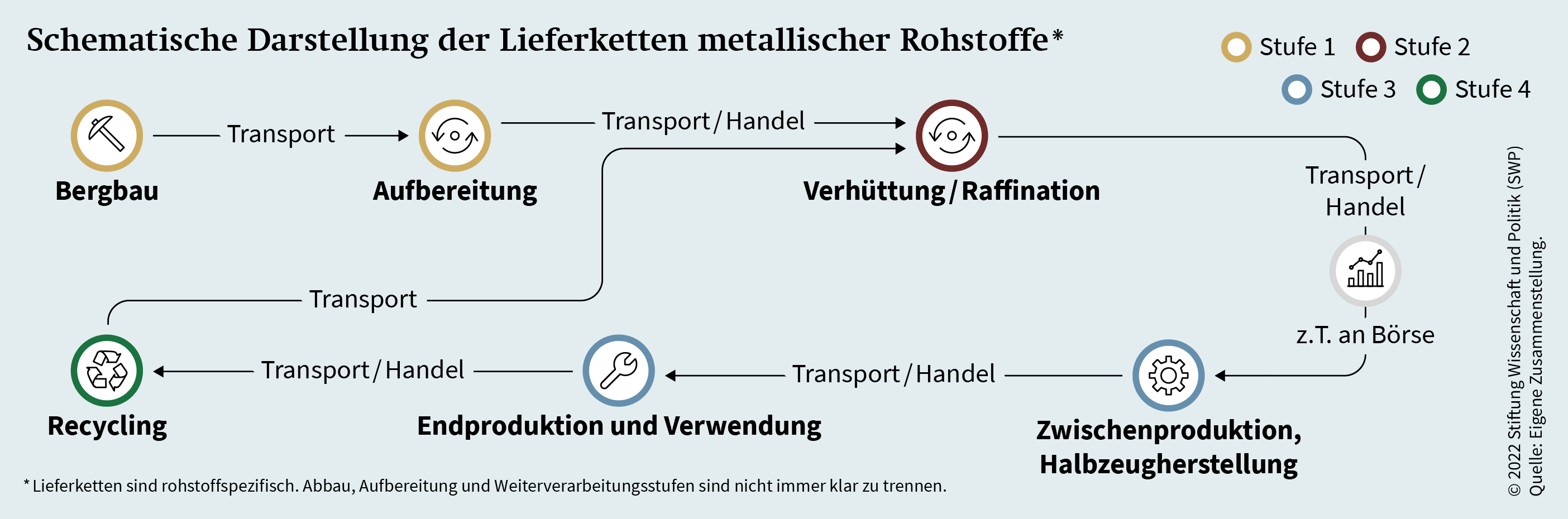
The dependence of German and European companies on metallic raw materials is high. In perspective, the demand for these raw materials will continue to rise, as they are needed for the energy and mobility transition, digitalization, and other future technologies.
Supply security is also influenced by geopolitical developments. China’s central role in raw material supply chains is a factor of uncertainty.
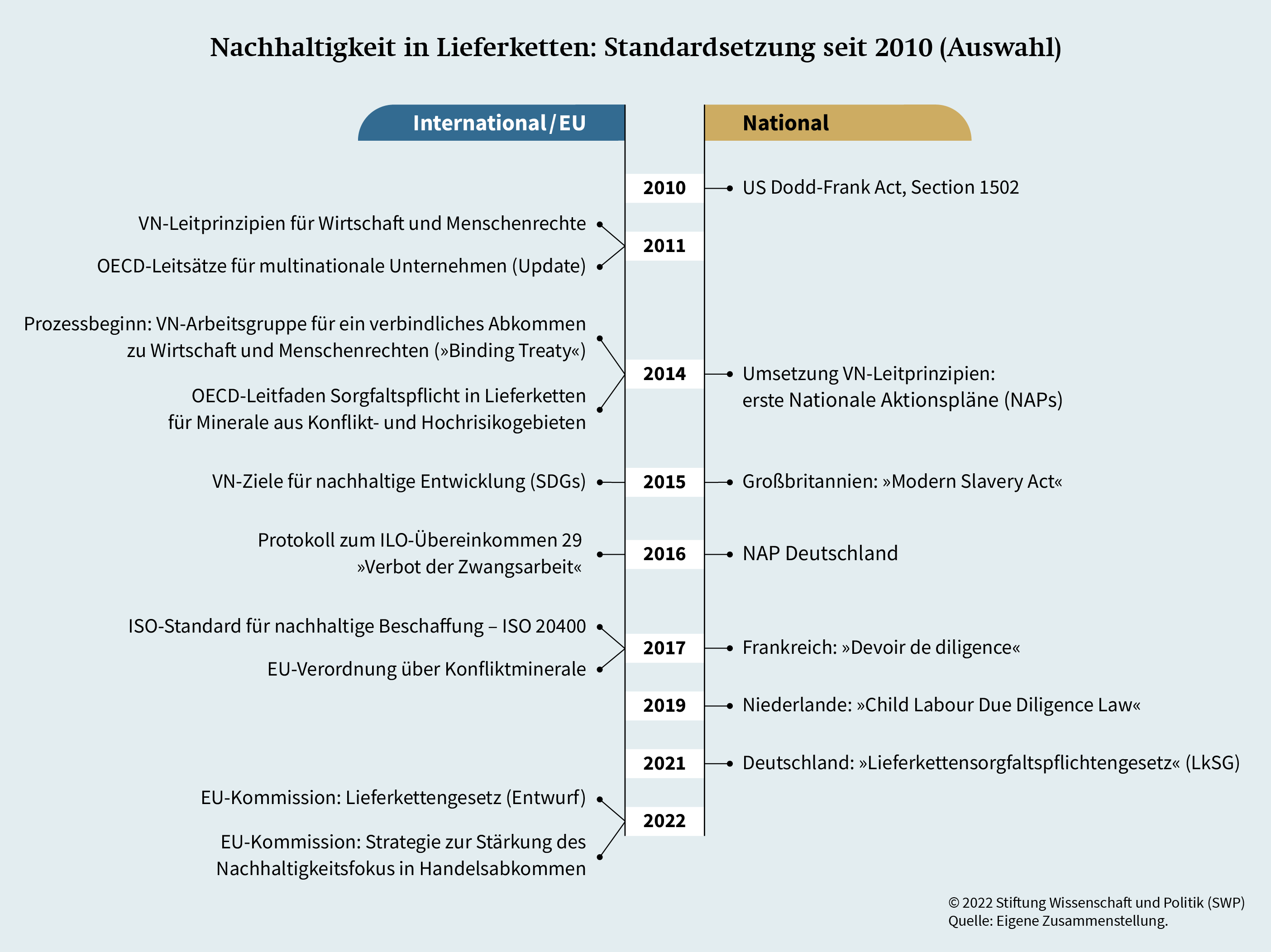
The federal government has set ambitious sustainability goals. Implementing these in complex, multi-stage metallic raw material supply chains is difficult because the environmental and human rights risks in these supply chains are considerable.
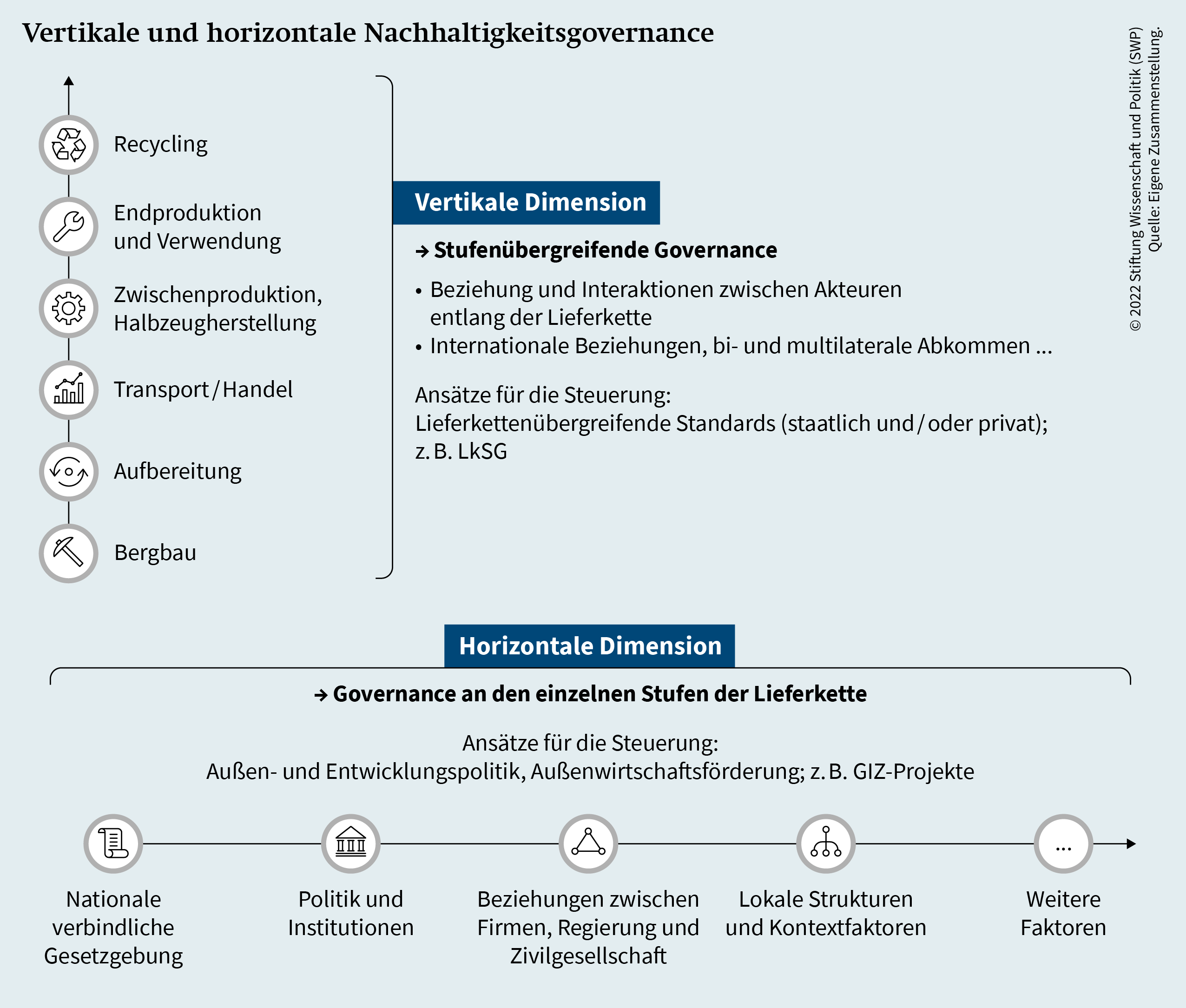
In doing so, it must address the two major challenges in sustainability governance: firstly, the variety of different standards and their incomplete implementation and enforcement; secondly, the lack of transparency and existing power asymmetries along metallic supply chains.
A sustainable resource foreign policy should aim for strategic diversification and, in doing so, strengthen international partnerships with like-minded partners to reduce one-sided dependencies. Decisive elements of this policy are measures to increase transparency and a regulatory “smart mix.”