Editor’s Note
This article highlights a significant step in India’s meteorological capabilities. The development of indigenous, 3D-printed Automatic Weather Stations under ‘Mission Mausam’ represents a key advancement in building climate resilience and supporting critical sectors from agriculture to disaster management.
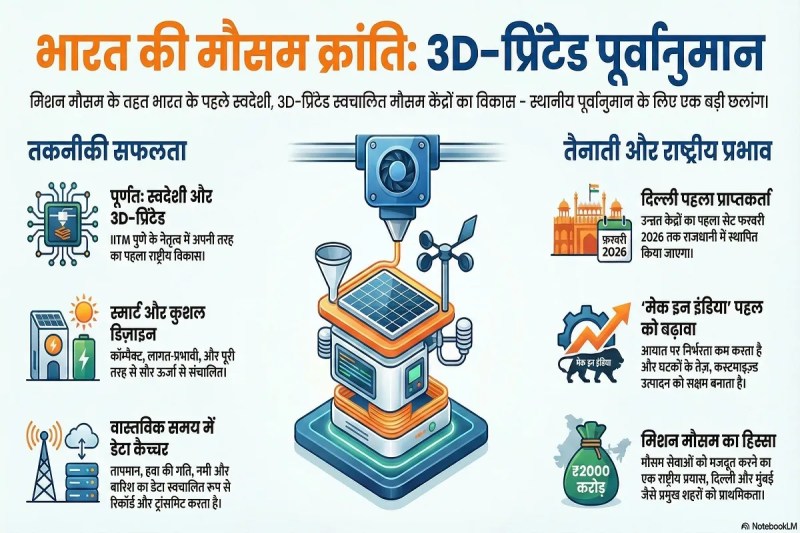
Indian scientists have achieved a significant technological milestone in the field of meteorology. Under the ‘Mission Mausam’, led by the Indian Institute of Tropical Meteorology (IITM), Pune, Automatic Weather Stations (AWS) have been developed using indigenous 3D printing technology. This initiative will prove to be a milestone in making India a weather-ready and climate-smart nation, strengthening disaster management, agriculture, and public life.
These 3D-printed Automatic Weather Stations (AWS) are completely indigenous and represent the first technological development of their kind. They will automatically record parameters such as temperature, wind speed, humidity, and rainfall, and transmit data in real-time. Running on solar energy will reduce operational and maintenance costs. 3D printing has enabled the precise manufacturing of complex components, resulting in faster production, easier customization, and a significant reduction in cost. This will reduce dependence on imports and promote ‘Make in India’.
The ‘Mission Mausam’ program, worth 2000 crore rupees and led by the Ministry of Earth Sciences, aims to strengthen weather observation, forecasting, and climate services. Given the increasing climate risks in urban areas, priority is being given to major cities like Delhi, Mumbai, Chennai, and Kolkata. A dense network will improve short-term and local forecasts.
To ensure data reliability, the new stations will initially be installed alongside manual observatories. Full-scale use will commence after rigorous testing, calibration, and verification. Regular maintenance protocols will also be implemented.
This initiative will prove to be a milestone in making India a weather-ready and climate-smart nation, strengthening disaster management, agriculture, and public life.