Editor’s Note
This article describes a significant downturn in gold prices, highlighting a nearly 9% single-day drop—the steepest since 2013—followed by further declines. It references economist John Maynard Keynes’s famous characterization of gold as a “barbarous relic.”
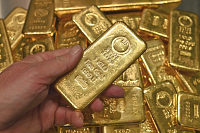
The commodity suffered again on Monday, February 2, continuing the downward movement that began last week. On Friday, gold lost nearly 9%, marking its sharpest single-day decline since 2013.
Gold continues its violent plunge this Monday, February 2. The “barbarous relic,” as economist John Maynard Keynes nicknamed it, shed nearly 5.6% and fell back to $4,619.58 per ounce in early morning trading.
Deutsche Bank notes that on Friday, gold plunged by 8.95%, marking its sharpest single-session drop since 2013. Over two sessions, the precious metal has declined by more than 14%.
Another precious metal, silver, followed a similar trajectory, falling 7.44% this Monday.
The Monday decline can partly be attributed to a decision by CME Group, the Chicago exchange specialized in commodity trading.
On Friday evening, the market operator raised the margin requirements for gold and silver contracts.
For gold, this level was set at 8% of the total contract value, up from 6% previously, while for silver, the percentage increased from 11% to 15%.
In other words, market operators who wish to continue their gold investments will have to provide more cash as collateral, explains Bloomberg.
Alexandre Baradez, an analyst at IG Markets, believes that the increase in these required margins contributed to “position unwinding.”
Since Friday, gold and other precious metals (silver, but also platinum and palladium) have been battered by rumors and then the confirmation of Kevin Warsh’s nomination to head the U.S. Federal Reserve (Fed).
For Deutsche Bank, this was “the real catalyst.” Warsh is known to be more “hawkish” (restrictive) than other candidates regarding the Fed’s balance sheet, meaning he is less inclined than other central bankers to conduct operations (such as securities purchases in the market) aimed at supporting the economy by injecting liquidity.
The German bank explains that Kevin Warsh’s policy direction undermines the “debasement trade” that has supported gold and silver prices.
The “debasement trade” is an investment strategy in the market that is “motivated by the fear that aggressive fiscal and monetary policies will devalue currencies and is currently expressed almost exclusively by a relentless rise in the price of gold,” Citi explained in October.
Deutsche Bank writes, however, that for some time, gold has been rising without necessarily following a real logic. In reality, “it often only takes a small wave to trigger a broader correction,” argues the German bank.
In this sense, Kevin Warsh’s nomination provided the perfect pretext for the market to take profits.
Recall that before the correction suffered over the last two sessions, gold had recorded a mega-rally, gaining 64.6% in 2025 and more than 25% since the beginning of the year.
Jia Zheng, head of operations at Shanghai Soochow Jiuying Investment Management Co., told Bloomberg.
Alexandre Baradez explains that gold and silver were “most crowded trades,” meaning investment bets that everyone rushed into.
Last week, Bank of America dissected the results of its monthly survey of fund managers. The American bank noted that “buying gold” was the most “crowded” market bet, meaning the one everyone is making.
To the question, “which market position is the most ‘crowded’,” 51% of the managers surveyed answered “buying gold,” far ahead of “buying Wall Street’s Magnificent Seven” (27%). The previous month, the rates were 29% for gold and 54% for the Magnificent Seven, respectively.
Is this correction movement set to last? According to various analysts, no.
In a note published this Monday, UBS believes that gold will resume its upward trajectory, reaching $6,200 per ounce by mid-year.
In a special report published this Monday, Deutsche Bank confirmed its target of $6,000 per ounce.
