Editor’s Note
This article highlights the shifting economics of luxury goods, noting the rapidly widening price gap between synthetic and natural diamonds. As alternatives become more affordable, consumer choices and market dynamics continue to evolve.
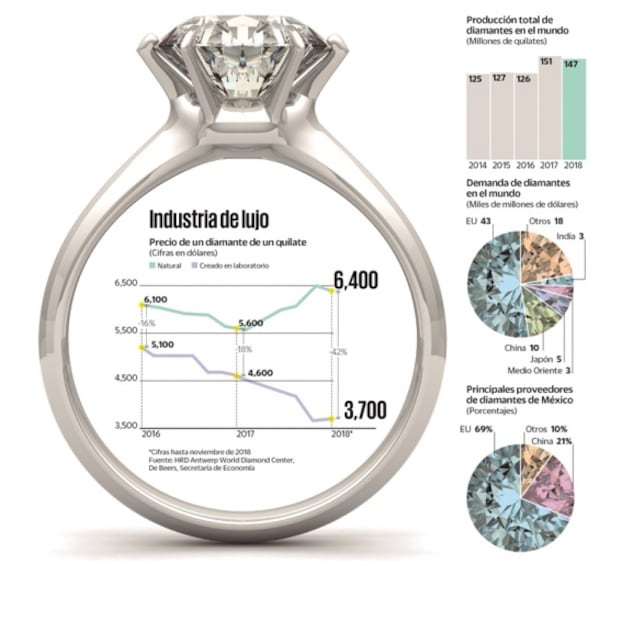
Buying a chain with a diamond can cost 10,000 pesos, and although this is the price for a synthetic precious stone, it is much cheaper than a gold centenario coin, which is priced at around 33,000 pesos. In 2016, the price of a synthetic diamond was 16% cheaper than a natural one, but by December of last year, the difference grew to 42%. This means that if a real one costs one thousand dollars, an artificial one costs 580 dollars.
Scientific discoveries and the development of more and better technology have made it possible to produce diamonds at low cost, explained Marleen Bouman, a researcher at HRD Antwerp World Diamond Center.
Over the last 10 years, the price of the gem has been reduced to almost 10% of the production cost in 2008, which, furthermore, seems to be a trend that will continue and will gradually become more accessible for new segments of the population to acquire the brilliant stone.
One of the strongest firms in synthetic diamond production is Lightbox, from the company De Beers, which holds practically 30% of the artificial stone market and manufactures increasingly cheaper, because it reaches an annual production of half a million carats, said Bouman.
Bouman considered that scientific discoveries and the development of better technology will make diamonds, especially synthetic ones, increasingly within reach of people’s pockets.
According to data from the Antwerp World Diamond Center, headquartered in Antwerp, Belgium, the city considered the main diamond trading hub in the world, the first synthetic diamond was successfully produced in 1954. Since then, technology has been available that lowers production costs.
In Antwerp, rough and polished diamonds have been traded for 50 years, explained the Belgian ambassador to Mexico, Antoine Evrard, ensuring strict control between synthetic and natural ones. Furthermore, pieces are certified so that stones from war-torn countries are not sold.
It is at this site where Antwerp analyzes if diamonds are genuine, grants them a certificate, and engraves a number on them.
According to De Beers, the production of rough diamonds in 2017 was 164 million carats, with Australia, Congo, Botswana, South Africa, and Russia being the main producers of the stone.
In 2015, it was estimated that global synthetic diamond production was 4.38 billion carats, mostly produced in China, where about 4 billion are produced, followed by the US, Russia, and South Africa.
Global sales of these gems in 2017 reached 82 billion dollars, with the main buyers of these precious stones being the United States, China, India, Japan, and Middle Eastern countries.
Mexico imports around 100 million dollars in polished diamonds annually, with the United States being its main supplier, according to Antwerp. Although the entry of unassembled natural or synthetic diamonds, notes the Online Tariff Information System of the Ministry of Economy, was almost 2 million 613 thousand grams in 2018, with its main suppliers being the US, China, Ireland, Korea, and Australia.
According to Mexican statistics, the United States was the supplier of 69% of diamond imports made by Mexico, and China, 21%.
In addition, the jewelry industry is expected to grow in the coming years, which makes Mexico attractive to gem suppliers.
However, the trend is that the greatest demand will remain in the US and China, where the main market is for producers of natural and synthetic diamonds, according to a study by Bain & Company and Antwerp. Although they warned that if the trade war between these two countries continues, it could have a negative effect on market growth in these two countries.
They explain that the current trend is for lab-made brilliants to grow more in presence, especially because the company De Beers, through Lightbox Jewelry, can turn the synthetic diamond, due to its production value, into a mass-produced accessory.