Editor’s Note
This article highlights a notable divergence in the diamond market, where lab-grown diamond stocks surged while natural diamond prices saw a significant cut. The shift underscores changing consumer preferences, particularly among younger buyers, and the evolving competitive dynamics within the industry.
On January 27, the lab-grown diamond sector performed strongly. Huanghe Whirlwind hit the daily limit up, while Sifangda and Huifeng Diamond rose over 8%. Sinomach Precision Industry and Power Diamond gained over 4%, with Wold and Hongjian following suit.
Recently, De Beers, the world’s largest natural diamond producer, significantly reduced prices for diamonds above 0.75 carats. This marks the group’s first clear price cut in over a year. The underlying reason may be that diamonds “grown” by scientists are making a strong push into the jewelry market. This industrial transformation driven by technological development is reshaping the consumer market.
The natural diamond, symbolizing “eternal love,” is facing an “avalanche.” At a recent diamond auction, De Beers announced a significant price reduction for diamonds above 0.75 carats. Although the specific reduction幅度 was not disclosed, the adjustment focused on mid-to-high-end natural diamond categories, drawing industry attention to changes in diamond market supply and demand and shifting consumption trends.
This is already the third consecutive year of proactive price cuts by De Beers: a 40% reduction for mainstream products in 2023, two reductions of 10%–15% in 2024, and a structural adjustment in 2025.
Founded in London in 1888, De Beers’ slogan “A Diamond is Forever” has had a profound market impact. De Beers once controlled 90% of the global diamond supply and still controls about 60% of the world’s rough diamond trade.
The reason behind this is a comprehensive collapse of the price system. The RapNet Diamond Price Index shows that in 2025, the price of 0.5-carat everyday consumer-grade diamonds fell over 20% for the year. A diamond ring worth 18,000 yuan ten years ago now has a回收价 of only 180 yuan, a depreciation rate of 99%. The phenomenon that diamonds “do not retain value” is becoming widely known in the market.
This price adjustment is seen by industry insiders as a direct response to current market environment changes. On one hand, high inflation and macroeconomic uncertainty continue to suppress demand for high-end discretionary消费, with jewelry retail recovery in core markets like the US and China明显分化. On the other hand, the penetration rate of lab-grown diamonds in the mid-range and bridal markets is continuously increasing, creating dual competition with natural diamonds on both price and value. Against this backdrop, inventory turnover for mid-to-high-end natural diamonds is under pressure, challenging the stability of the price system.
However, De Beers did not implement a comprehensive price cut but only targeted adjustments for mid-to-high-end products. This indicates the company’s strategy is not simply trading price for volume but rather attempting to release阶段性 market pressure and restore confidence in the diamond industry while maintaining the long-term value narrative of natural diamonds.
In recent years, with technological and industrial advancements, lab-grown diamonds have achieved mass production.
Among them, the High Pressure High Temperature method is one of the more traditional diamond synthesis methods. Using high-purity graphite as the main raw material, along with catalysts and other materials assembled into a synthesis block, the block is placed into a cubic press. Temperature and pressure are then adjusted, and under high temperature and pressure conditions, the carbon原子 structure of graphite rearranges to form diamond crystals.
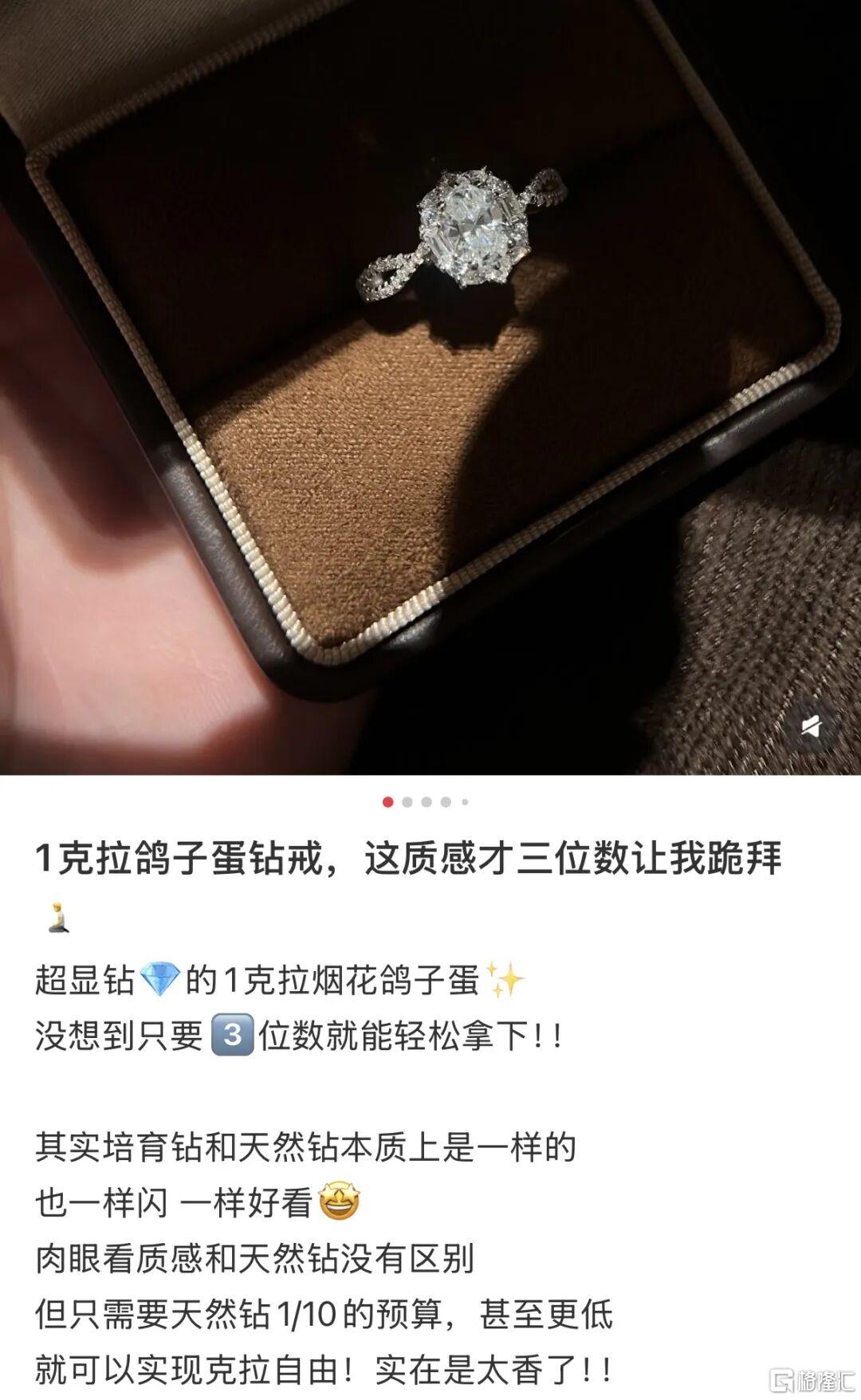
Unlike the growth process of natural diamonds, harvesting a one-carat lab-grown diamond can take as little as one week. Furthermore, lab-grown diamonds are almost identical to natural diamonds in composition, appearance, and other aspects, with prices only about 1/10 of同等品质 natural diamonds.
The affordable price has also made lab-grown diamonds favored by young consumers.
According to the “2025 Lab-Grown Diamond Industry Development Report,” the current market size for lab-grown diamonds in China is about 14 billion yuan,预计 to exceed 102.5 billion yuan by 2030. As of now, global rough lab-grown diamond production capacity is about 40 million carats, with China’s capacity at about 25.2 million carats, accounting for approximately 63%. China is the core production force for lab-grown diamonds globally.
This industrial transformation, driven jointly by technology and消费观念, is reshaping the competitive landscape of the global jewelry industry.