Editor’s Note
This article highlights a day of contrasting economic pressures. While falling fuel prices offer some relief, it underscores how other critical costs, particularly for digital infrastructure like data and algorithms, are moving in the opposite direction, creating a complex landscape for businesses and consumers.
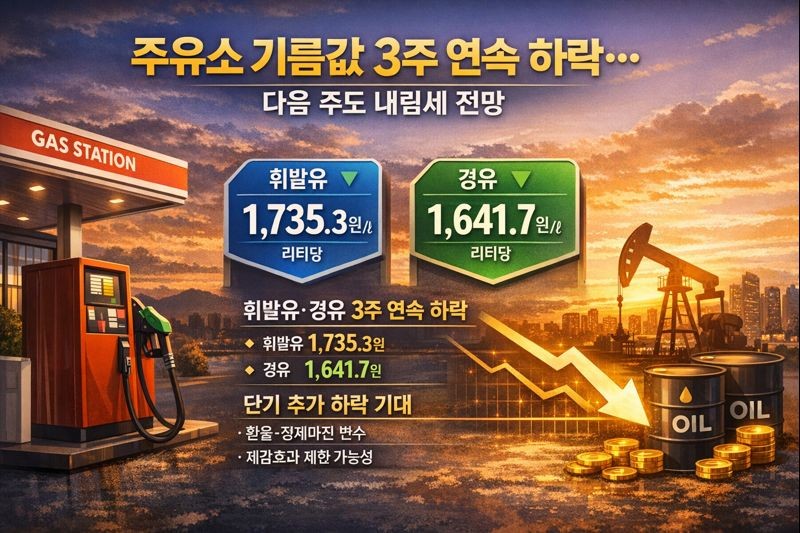
December 27th in the economic field was a day of mixed signals: on one side, pressure on the cost of living eased slightly, while on the other, movements to price uncertainty grew stronger. The news of a third consecutive weekly drop in gas station prices offers a small buffer for drivers and small business owners. However, this decline is not determined solely by international oil price trends. Variables such as exchange rates, refining margins, and distribution competition are intertwined, meaning there is a time lag before a statistical drop translates into perceived price stability. While the phrase ‘a drop is expected next week too’ is welcome, it contains conditions of volatility.
The average selling price of gasoline and diesel at gas stations nationwide fell for the third consecutive week in the fourth week of December. According to Opinet data, gasoline fell to around 1,735.3 won per liter and diesel to 1,641.7 won. As international oil price fluctuations are reflected with a 2-3 week lag, there are expectations for a further short-term decline. However, the perceived effect may be limited if exchange rates and refining margins fluctuate again.
International silver prices have soared to levels surpassing the 1980 ‘Silver Thursday’ peak for the first time in 45 years, confirming a significant cumulative increase this year. This is interpreted as a result of safe-haven demand spreading across precious metals amid expectations of interest rate cuts, a weak dollar, and geopolitical tensions. With volatility potentially expanding in the thin trading period of year-end, risk management for leverage and chasing rallies has become crucial.
Following Coupang’s announcement of ‘self-investigation results’ regarding a personal data leak, its stock price closed up over 6% in the US market. While Coupang explained that there was no evidence of external transmission, the government drew a line, stating it was a one-sided claim not verified by the public-private joint investigation team. This highlights a clash between corporate crisis communication and regulatory verification frameworks, as the ‘official verification process’ can sway market trust more than the conclusion of the incident itself.
The so-called ‘Magnificent 7’ in the US stock market showed mixed performance, with differentiation continuing among individual stocks. While Nvidia rose, Apple and Meta showed weakness, and trading volume and value were observed to be concentrated in specific stocks. With thin liquidity at year-end, short-term volatility can expand based on news and supply-demand dynamics, requiring an approach that emphasizes diversification and clear stop-loss criteria rather than relying solely on index optimism.
Ultimately, today’s five economic news points show that different areas—prices, assets, platforms, and content—are converging on a single question: “Who will bear the cost of uncertainty, and how?”