Editor’s Note
This article examines the dual reality of China’s port system—its unparalleled global scale contrasted with a historically narrow domestic reach. It highlights how strategic investments in inland logistics hubs are rapidly expanding this economic hinterland, reshaping both China’s internal connectivity and its role in global trade networks.
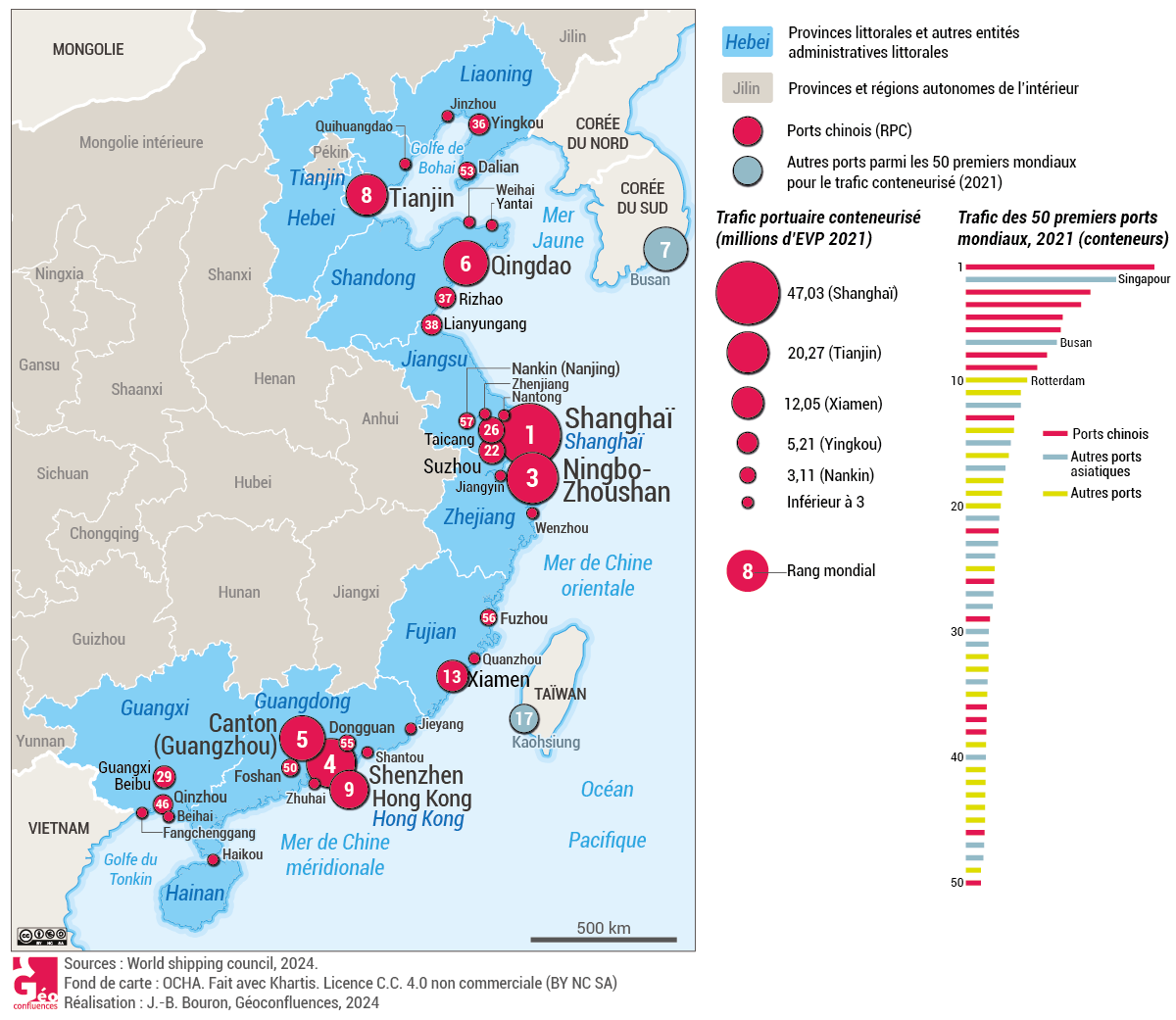
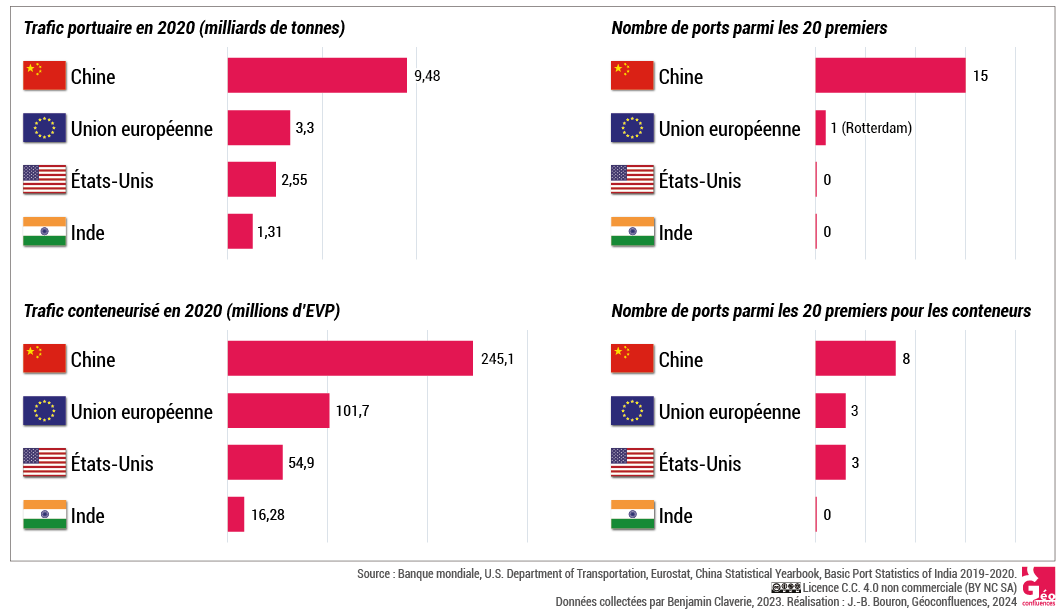
China’s port row is the largest in the world. At the heart of the global maritime exchange system, it is home to 15 of the world’s top 20 ports (and 8 of the top 20 container ports). However, its hinterland is relatively narrow: 95% of exchanges occur within the first 350 kilometers inland. Nevertheless, the development of connections with the hinterlands is rapid, thanks to investments in dry ports such as Xi’an and Chongqing to transform them into major land hubs, as part of the New Silk Roads.
Integration into globalization, within which the sea is a fundamental circulatory space, is even stronger for territories with a port row that is doubly connected to both its forelands and its hinterlands. In recent decades, the global port hierarchy has undergone significant reclassifications, revealing the rebalancing and new geoeconomic lines of force resulting from globalization dynamics. The People’s Republic of China (PRC) currently demonstrates, in terms of ports, its clear superiority over its partners as well as its commercial rivals.
This situation results from the successful bet of the reform and opening-up policy decreed in 1978 and then from joining the World Trade Organization in 2001. Ports then became both the instruments and the beneficiaries of these economic policies that contributed to the opening of mainland China’s coastline.
There are approximately 2,000 maritime and river ports in the People’s Republic of China. Located along a very long coastline (approximately 18,000 kilometers), about a hundred maritime ports participate in international trade, and 34 of them belong to the category of major ports. In their quest to rationalize the maritime sector to limit fragmentation and port overcapacity, Chinese authorities carried out a regional reorganization of the port system in 2006. The Ministry of Transport and Communications then created five major port clusters: the Bohai Bay, the Yangtze River Delta, the Southeast Coast, the Pearl River Delta, and the Southwest Coast.
A clear polarization of port traffic is observed at different geographical scales. At the national level, the five major port clusters account for about 67% of maritime and river port traffic. At the regional level, however, these five port clusters do not carry the same weight in the Chinese row depending on the traffic studied.
Regarding port traffic expressed in millions of tons, two port clusters dominate: the Yangtze River Delta and the Pearl River Delta. The traffic of the Yangtze Delta is 7.5 times greater than that of the Bohai Bay, while the Pearl River Delta achieves traffic 398 million tons greater than that of the Southwest Coast port cluster.