Editor’s Note
This article reports on Russia’s first issuance of digital financial assets (DFAs) linked to the price of a diamond, aiming to lower the barrier for investing in precious stones.
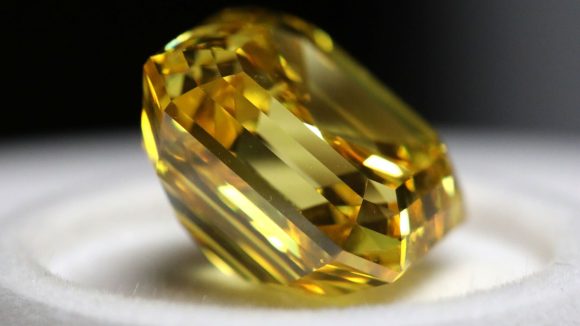
For the first time in Russia, Digital Financial Assets (DFAs) whose value depends on the price of a diamond have been put into circulation. Experts state that the issuance of this type of asset democratizes investment in precious stones, as the current barrier to entry into the market is relatively high.
A total of 5,000 DFAs were issued, each costing 1,975 rubles (21.32 dollars), which is 1/5000 of the price of the diamond, approximately 10 million rubles (107,933 dollars).
Only qualified investors can acquire these DFAs, reports the media outlet Vedomosti, citing representatives of the credit organization and the blockchain platform Masterchain, through which the issuance was conducted.
reports the Russian media RBK, citing stock market expert Valeri Emelianov.
The issuance of digital assets for precious stones comes as Russia, along with African countries, accounted for nearly 90% of the global diamond production market in 2022, according to the Kimberley Process.
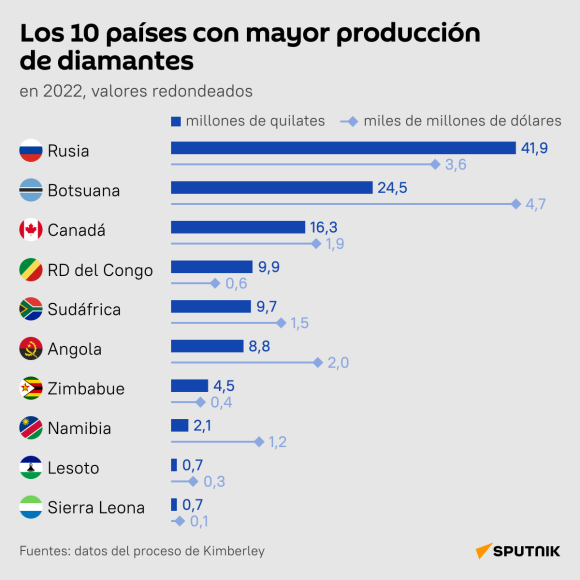
According to 2022 data, global diamond production reached 119.96 million carats. Of these, 41.9 million came from Russia, a record 35% of the market. Previously, from 2004 onwards, Russia’s share in global diamond production was only 22% to 33% annually.
Another 61.6 million carats were produced in African countries. The continent’s largest diamond producers were Botswana (24.5 million carats), the Democratic Republic of the Congo (9.9 million carats), and South Africa (9.7 million carats).
Apart from Africa, Canada (16.3 million carats) and Brazil (158,000 carats) were the leaders in terms of production within the Kimberley Process.
The largest volume of diamonds sold in 2022 corresponded to countries that did not mine this stone at all: the United Arab Emirates, with 27% of global exports (89.4 million carats), and the European Union, with 22.7% (75.2 million carats).
Russia also figured among the nations with the highest volume of supply of these precious stones to the global market, at 11.1% (36.7 million carats).
European Commission President Ursula von der Leyen stated in October that the European Union’s twelfth sanctions package against Russia was being prepared, which should include a ban on imports of Russian diamonds.
On the other hand, the largest representatives of the global market for these precious stones, during a recent private presentation in the USA, did not approve of the restriction mechanism.
In turn, the Russian Ministry of Finance stated that the introduction of restrictive measures against the world’s largest diamond supplier would inevitably lead to large-scale market distortions that would most severely affect the most vulnerable segments of the population.