Editor’s Note
This article examines the often-overlooked environmental cost of electric vehicles: the massive “hidden flows” of waste rock and tailings from mining the necessary minerals. Our analysis provides a new framework to quantify these impacts across the entire supply chain.
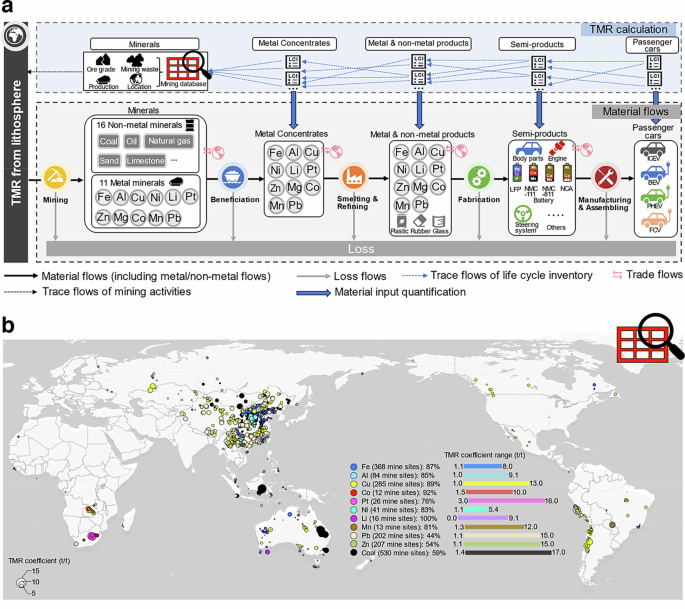
The transition to electric mobility (e-mobility) is vital for reducing greenhouse gas emissions but increases demand for minerals and results in substantial ‘hidden flows’—mined materials that are unused, such as overburden, waste rock, and tailings. These hidden flows remain underexamined compared to battery materials. We developed a global mine-site-specific database and a supply-chain-based framework to quantify the total material requirement (TMR) of the passenger car supply chain, using China—the world’s largest producer and consumer of new energy vehicles (NEVs)—as an example.
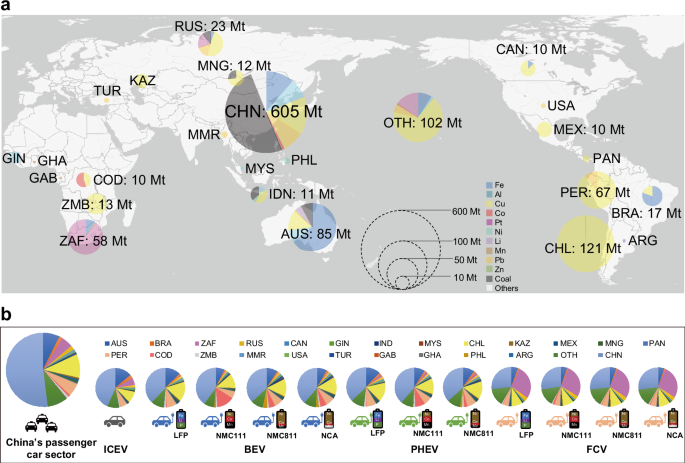
Notably, 48% of these hidden flows occur outside manufacturing countries, highlighting the global environmental burden of China’s e-mobility transition. Our findings provide insights for balancing greenhouse gas emissions reduction with other environmental sustainability issues in the shift to e-mobility.
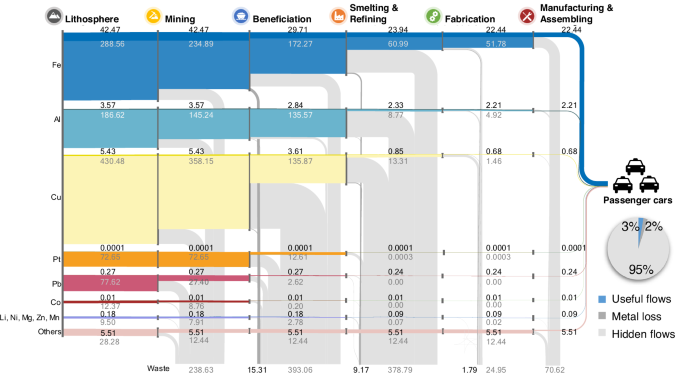
In contrast, the associated mine wastes—known as “hidden flows”—are often overlooked, despite typically exceeding the useful resource by hundreds of times. Generally, hidden flows include topsoil overburden, waste rock, and tailings. Moreover, waste rock and tailings cover about 1 million km² globally. Recent decades have generated enormous amounts of mining waste, leading to severe natural degradation and aggravating existing ecological issues. However, the magnitude, spatial distribution, and effective management of hidden flows remain insufficiently examined. This hinders efforts to develop sustainable mitigation strategies. Therefore, to achieve a fair and sustainable e-mobility transition, quantifying hidden flows is an essential prerequisite.
Quantifying these waste flows along China’s e-mobility supply chain is essential for both resource-supplying and e-mobility manufacturing countries, as it provides crucial insights for developing sustainable resource management strategies and mitigating environmental impacts.
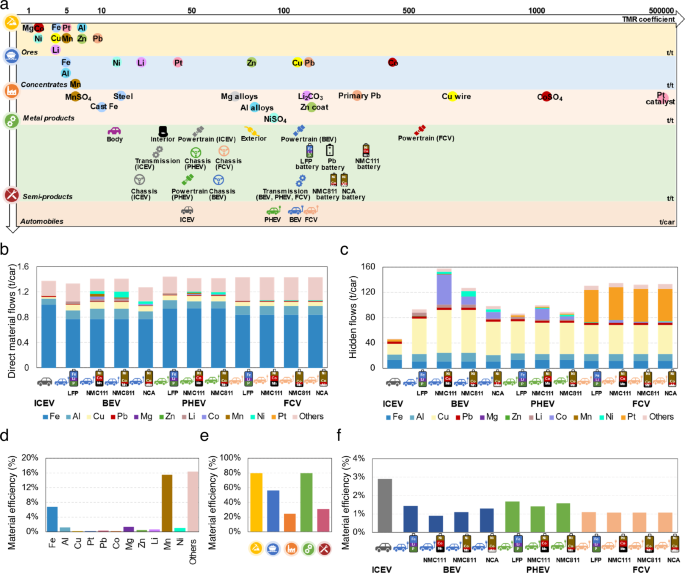
Our life cycle TMR quantification framework traces both useful and waste flows of various materials across multiple regions. In the mining stage, Pb ore has the largest TMR coefficient (9 tonnes per tonne) among the 12 metal minerals, followed by bauxite (7 t/t) and Zn ore (7 t/t) due to significant waste rock generation. The TMR coefficients in the beneficiation, smelting, and refining processes are heavily influenced by ore grade.
Downstream, significant material inputs are required for semi-products: 548 tonnes for 1 tonne of powertrain system for FCVs due to Pt usage, 347 tonnes for 1 tonne of NMC111 battery production due to Co sulfate and Cu anode usage, and 148 tonnes for 1 tonne of transmission system in BEVs, PHEVs, and FCVs due to high Cu usage.
This is primarily due to their low ore grades, ranging from 0.0001 to 0.0007% for Pt, 0.02 to 0.48% for Co, and 0.21 to 4.84% for Cu among all considered mines. Conversely, Mn, Fe, and other materials (plastic, rubber, and glass) have higher material efficiency (15.5%, 6.8%, and 16.3%) due to lower mining waste and higher ore grades of Mn and Fe, or the reliance on nonmetal minerals like silicon for glass. BEVs, particularly those with NMC111 batteries, have the lowest material efficiency (0.9%) among all passenger cars owing to the reliance on Li-ion batteries.