Editor’s Note
**Editor’s Note:** This report provides a comprehensive analysis of the luxury jewelry market, covering material, product, application, distribution channel, and regional trends from 2024 to 2032. It highlights how brands are innovating with designs that merge feminine and masculine aesthetics.
Luxury Jewelry Market report by Material (Gold, Platinum, Diamonds, Gemstones, Pearls, Others), Product (Necklaces, Rings, Earrings, Bracelets, Others), Application (Women, Men, Children), Distribution Channel (Online, Offline), and Region (North America, Europe, Asia-Pacific, Middle East & Africa, Latin America) – Forecasts for 2024–2032.
Brands are introducing innovative designs that blend feminine and masculine patterns and cuts. In 2020, Louis Vuitton launched LV Volt, a unisex jewelry collection featuring the iconic LV initials on rings, bracelets, pendants, and bangles in gold and silver. According to a 2020 study by Taylor & Hart (a custom jewelry brand) published in Jewelry Magazine, demand for gender-neutral jewelry has increased by 228%, and interest in men’s engagement rings has risen by 69% compared to the previous year—a significant shift in purchasing behavior. These factors are expected to further drive market growth.
Sustainable and ethically produced jewelry is gaining increasing importance due to global demand from Millennials and Generation Z. With growing awareness of sustainability, consumers are increasingly seeking products made from recycled materials. Many modern jewelers use recycled gold, while brands like Vieri and Lilian Von Trapp work exclusively with it. Sustainability considerations will increasingly influence the purchase of high-end jewelry in the future, thus leading to rapid growth in the sustainable jewelry segment.
The global luxury jewelry market is segmented by material, product, application, and distribution channel.
The women’s segment is the most significant market participant and is expected to register an annual growth rate of 7.61% during the forecast period. The increasing number of women purchasing jewelry for themselves is a key driver of the luxury jewelry market. The JCK report “State of the Jewelry Industry 2021” underscores the immense importance of these female buyers in this market. According to a survey, 76% of respondents from the jewelry industry reported observing a significant increase in women buying jewelry for themselves. Citing findings from a study by Platinum Guild International, the JCK report adds that based on their data from the last two years, 73% of female jewelry buyers purchased at least one piece of jewelry for themselves. While Generation Z represents the most influential age group for self-purchases, 45% of older generations also indicated they had bought at least one piece of jewelry for themselves. The focus on women buying jewelry for themselves opens up new design possibilities for vendors in this segment.
In Central and South America, fast-fashion trends and inflation are influencing the luxury jewelry market, as product offerings are continuously adapted to price-sensitive consumers. Due to slow economic growth in the region, manufacturers are increasingly offering fashion jewelry made from cheaper materials like silver. Furthermore, key market players are experiencing losses, and to survive and expand their business, some are selling stakes. For example, Vivera, a leading Brazilian jeweler, announced in 2019 that its parent company Tellerina had sold 40% of its shares. Vivera also raised USD 112.9 million and plans to invest it in brand technology.
Jordan will be the face of the first men’s high jewelry collection “The Vault” and the 2024 campaign for the leading American luxury jewelry brand.
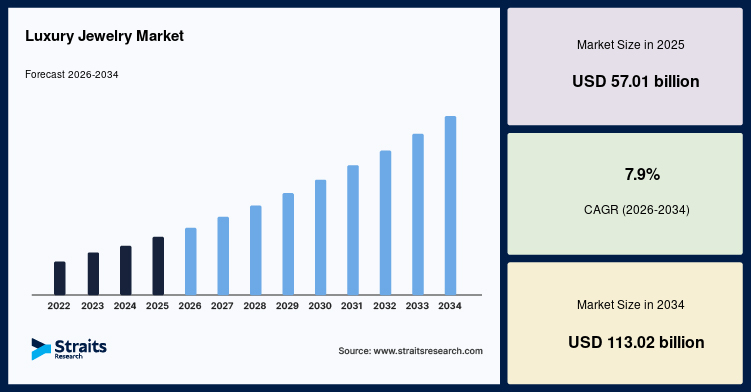
The global luxury jewelry market was valued at USD 57.01 billion in 2025 and is projected to grow from USD 61.52 billion in 2026 to USD 113.02 billion by 2034, registering a compound annual growth rate (CAGR) of 7.9% during the forecast period 2026-2034.
Established luxury brands with a rich tradition and excellent reputation for quality, such as Tiffany & Co., Cartier, and Bulgari, also attract high-net-worth customers. The high brand value and exclusivity of these brands drive demand.
Jewelry expresses a person’s outlook on life. As a luxury good, it connects different income levels. The term “luxury” refers to jewelry of the highest quality. These products are considered more extravagant as they often use precious metals and gemstones that are significantly more expensive than those in other, lower-quality items. Precious metals like gold and diamonds are used to make luxury jewelry.