Editor’s Note
This article highlights a significant geological discovery in Cameroon, estimated to hold diamond reserves equivalent to five years of global production. It begins with an anecdote from a university interview, reminding us that passion for a field can sometimes follow opportunity, a notion relevant to the vast potential this find represents for the region and the industry.
In a lecture hall at the Department of Geological and Environmental Sciences of Chungnam National University, where freshman interviews were underway, a professor’s cheerful response stood out. When an applicant answered, “I’m not particularly interested in geology, but I came because my test scores matched,” other professors expressed disapproval. However, one professor smiled broadly and said, “That’s fine. It’s okay if you come in without knowing. It’s a fascinating field, so come in and work hard.”
That professor is Kim Won-sa. He is an internationally renowned expert in minerals and gems, having developed the world’s first new synthetic compounds of platinum and palladium and discovered deposits of key minerals like titanium both domestically and abroad.
Recently, he achieved a major feat by discovering a diamond deposit in the Republic of Cameroon with an estimated reserve of 736 million carats, equivalent to five years of global production (150 million carats).
Professor Kim’s specialty within geology is mineral synthesis. He has developed five new synthetic compounds, including one containing platinum. His research into mineral synthesis allowed him to understand the environmental conditions and principles behind mineral formation.
His diamond exploration in Cameroon was initiated at the request of the domestic company C&K Mining (CEO Oh Deok-gyun). C&K Mining, a joint venture with the Cameroon Mining Promotion Corporation (CAPAM), had been conducting gold mining operations in Cameroon for three years. As Cameroon recently changed its policy to allow diamond development, C&K Mining, which secured exclusive diamond development rights, sought out mineral exploration experts and contacted Professor Kim.
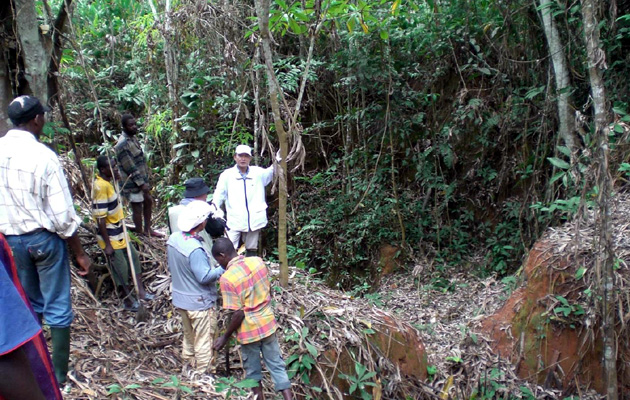
The selected area was the Mobilong region in southeastern Cameroon, adjacent to the Central African Republic. However, Mobilong was a jungle area with thick soil cover, making it impossible to find kimberlite directly. Professor Kim then proposed searching for areas with conglomerate distribution, hypothesizing that diamonds weathered from kimberlite over 1.7-2 billion years might have mixed with gravel of similar specific gravity and accumulated elsewhere.
His modeling proved accurate. Within a year of starting the exploration, early this year, they discovered a diamond deposit in the conglomerate layer of the Mobilong region with estimated reserves of 736 million carats. This exploration was not easy. The jungle terrain was treacherous, with pitfalls covered by leaves, and he suffered various cuts and scrapes.
The biggest hurdle was malaria. Professor Kim contracted tropical malaria last August.
The economic value of the diamond deposit Professor Kim discovered is enormous. Conservatively estimated, it exceeds 60 trillion won, with a mix of gem-quality rough stones (priced at $70-250 per carat) and industrial-quality rough stones ($10-20 per carat). Over a 25-year development period, 20% of the annual production value will be paid to Cameroon, with the entirety being imported to South Korea. Furthermore, only about 14% of the permitted 908 square kilometer development area has been explored, leaving high potential for discovering more deposits.
However, Professor Kim firmly rejects valuation based solely on money, emphasizing greater significance. He first highlights that South Korea will become the first Asian country to develop diamonds.
This means the domestic diamond industry, including processing technology that had been dormant since the 1970s, will be revived as Korea mines, processes, and sells the rough stones itself.
According to Professor Kim, starting in the second half of this year, some of the diamond rough stones produced and imported will be processed at the Gem Processing Center of Wonkwang University, located in the Iksan Jewelry Complex. While the facilities are good, the scale is small, so only a portion will be handled there, with the rest processed in China and India. The center, which had struggled to source rough stones, was reportedly very pleased with Professor Kim’s news.
Another significant achievement is opening channels for exchange with resource-rich Cameroon. Cameroon’s Minister of Industry, Mines, and Technological Development, Badel Ndanga Ndinga, personally visited South Korea, meeting with the Ministry of Knowledge Economy and the Korea Mine Rehabilitation and Mineral Resources Corporation. Discussions were also held with Korea Nuclear Fuel for joint uranium development.
His large-scale diamond deposit development and Cameroon’s support plans have already been widely reported by local state TV (CRTV) and daily newspapers. He is also currently planning to establish a university-affiliated company specializing in gem appraisal at Chungnam National University.
Despite his busy schedule juggling research, teaching, private diplomacy, and company establishment plans, Professor Kim shares one last anecdote about his major choice.