Editor’s Note
After nearly 20 years of negotiations, the EU and India have sealed a major trade agreement, a move both leaders are hailing as historic. The deal signals a strategic effort to strengthen economic ties at a time of global realignment.
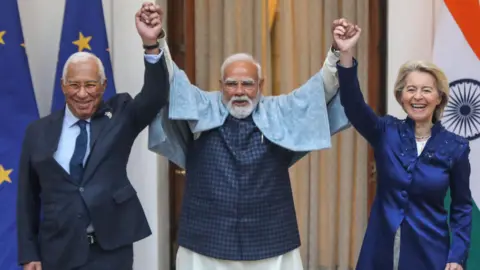
The European Union and India have announced a landmark trade deal after nearly two decades of on-off talks, as both sides aim to deepen ties amid tensions with the US.
European Commission President Ursula von der Leyen said at a media briefing in Delhi. Indian Prime Minister Narendra Modi called the pact “historic”.
It will allow free trade of goods between the bloc of 27 European states and the world’s most populous country, which together make up nearly 25% of global gross domestic product and a market of two billion people.
The deal will see a number of huge tariff cuts across a range of goods and services, and a joint security partnership.
The European Commission said the deal would eliminate tariffs on most exports of chemicals, machinery and electrical equipment, as well as aircraft and spacecraft, following phased reductions. Significantly, duties on motor vehicles, currently as high as 110%, would be cut to 10% under a quota of 250,000 vehicles. That is six times larger than the 37,000-unit quota India granted to the UK in a deal signed last July.
India will also cut tariffs on wine, beer and olive oil from the EU. Brussels said the agreement would support investment flows, improve access to European markets and deepen supply-chain integration.
Delhi said almost all of its exports would get “preferential access” into the EU, with textiles, leather, marine products, handicrafts, gems and jewellery set to see a reduction or elimination of tariffs.
While commodities such as tea, coffee, spices and processed foods will benefit from the agreement, Delhi “has prudently safeguarded sensitive sectors, including dairy, cereals, poultry, soy meal, certain fruits and vegetables, balancing export growth with domestic priorities”, it said.
The trade deal comes as both India and the EU contend with economic and geopolitical pressure from the US.
Delhi is grappling with 50% tariffs imposed by President Donald Trump last year amid talks aimed at securing a trade deal between India and the US that are still dragging on.
That larger geopolitical context was evident in statements made by leaders.
Von der Leyen said on Tuesday.
A day before that, European Council President António Costa had said, without naming the US, that the trade deal would send an “important political message to the world that India and the EU believe more in trade agreements than in tariffs”.
The deal with the European Union may help labour-intensive sectors in India such as shrimp farming, textiles, gems and jewellery, which were hit hard by the US tariffs, experts say.

But some analysts also predict challenges – especially when it comes to compliance with EU regulations and standards.
says economist Mitali Nikore.
She says India’s manufacturing sector “might not be fully prepared” for this and that it is critical that it takes steps to fix this.
she says.
The formal signing is likely to take place only later this year, after the agreement is approved by the European Parliament and member states.
However, the India agreement is regarded as less contentious as it “cuts around sensitives on both sides,” says Andrew Small, Asia director at the European Council on Foreign Relations.
Alongside the trade agreement, India and the European Union are also advancing separate talks on security and defence co-operation, and climate action.