Editor’s Note
This analysis explores how fashion has evolved from a niche historical category into a major driver of auction prices, fueled by cultural recognition and shifts in the luxury market.

Long confined to historical haute couture, fashion has now established itself as a strategic segment for auction houses. This phenomenon is fueled by the cultural recognition of clothing and the evolution of the luxury market. An analysis.
Chanel Lego-style bags offered at the “Icons of Fashion” auction at Sotheby’s, July 2025 in Paris. © Edward Berthelot/Getty Images.
What do the ruby slippers from The Wizard of Oz, Hermès’s first Birkin bag, Marilyn Monroe’s Naked dress, and a Chanel shopping basket bag have in common? They all belong to the small family of iconic fashion pieces that have recorded record sales over the past decade. But why is fashion so captivating in auction rooms?
Articulated rings and nail jewelry by Hedi Slimane for the Dior Homme “Victim of the Crime” collection AW 2004/05. Penelope’s auction in 2025. © Julie Trannoy.
begins Pénélope Blanckaert, the creator of the online auction house Penelope’s, formerly of Artcurial and Sotheby’s.
For nearly twenty years, this fashion enthusiast has established herself as an expert and curator of contemporary fashion, eventually launching her own auction house in 2024.
In less than two years, she has multiplied thematic sales, dedicated to established houses like Chanel or Hermès as well as to bolder territories. This includes children’s fashion, Hedi Slimane’s jewelry for Dior, or Prada and Miu Miu collections.
explains the woman who likes to describe herself as a fashion storyteller.
Cigarette jewelry by Hedi Slimane for the Dior Homme “Luster” collection AW 2003/04. Penelope’s auction in 2025. © Julie Trannoy.
If this notion of risk may seem abstract, it is based on a very concrete economic reality: an auction house earns its revenue by taking a percentage of the hammer price. Consequently, a piece sold at a modest price mechanically generates less income, and in some cases, can even weaken the economic balance of a sale.
It is in this context that new houses have emerged, including Maurice Auction and Joopiter, the auction house created by Pharrell Williams. While each has its specialties, together they reveal the vitality of the market with the arrival of new product typologies, and therefore new buyers.
emphasizes Marie-Laurence Tixier, co-founder of the online auction house alongside Salomé Pirson.
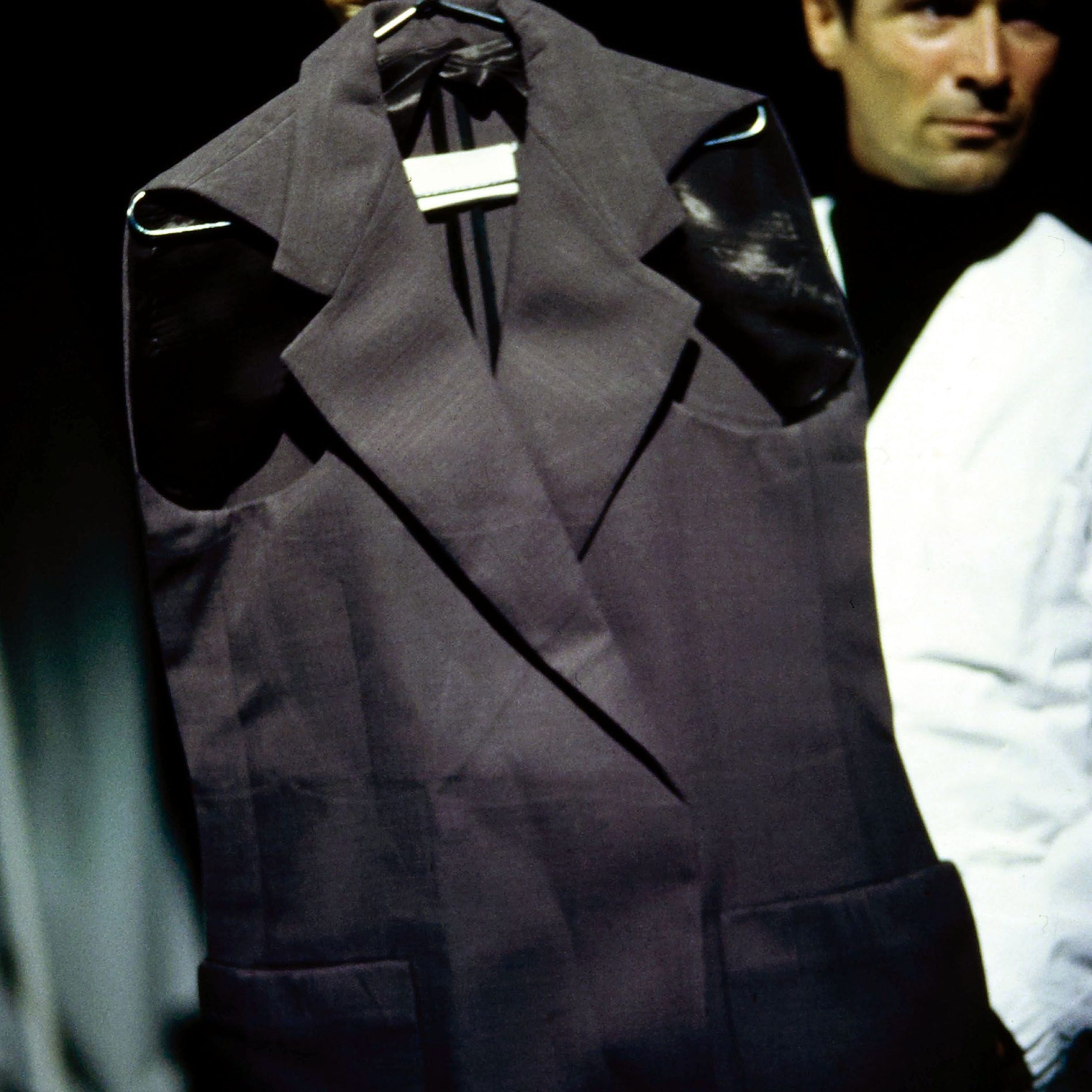
White cotton ensemble with vest by Maison Martin Margiela, spring-summer 1990. Maurice Auction in 2025. © George Mavrikos.

Since their launch in 2022, fashion represents about 50% of their activity, as they are backed by the English auction house Kerry Taylor Auctions, which has become a showcase for them.
continues Salomé Pirson.
It must also be said that the advent of the internet has been a major boost for these new auction houses, allowing them to reach a wider clientele and, through imagery, to engage a younger audience.
analyzes Camille de Foresta, Vice President at Christie’s. This growth takes on its full dimension when examining the historical roots of fashion sales.
Blue-green knitted wool sweater by Maison Martin Margiela, autumn-winter 1990-1991. Maurice Auction in 2025. © George Mavrikos.
Art and fashion have always maintained a close relationship, whether looking at collaborations between artists and designers – such as Schiaparelli and Dalí – or the numerous homages and references that fashion creators have paid to paintings, like Yves Saint Laurent and his Mondrian dress.