Editor’s Note
This article highlights key growth drivers in the gems and jewelry market, including the rise of lab-grown diamonds and digital retail. The data and projections cited are sourced from a third-party research report.
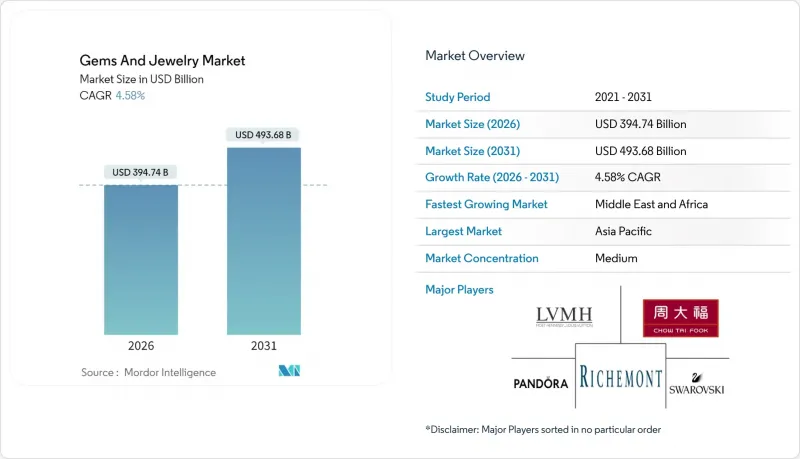
The gems and jewelry market was valued at USD 377.45 billion in 2025 and is projected to reach USD 493.68 billion by 2031, growing from USD 394.74 billion in 2026. The market is expected to register a CAGR of 4.58% during the forecast period (2026-2031).
The expansion of lab-grown diamonds, rapid migration to digital retail platforms, and evolving consumer demographics are driving market growth. While these factors are expanding the customer base, sustainability concerns are significantly transforming supply chains. Regional demand patterns show notable disparities. In terms of revenue, the Asia-Pacific region continues to dominate, while the Middle East & Africa region is witnessing the fastest growth in sales volume, fueled by cultural preferences and a growing affluent population. Consumer preferences are also shifting, with increasing interest in jewelry as everyday fashion, not just within the traditional bridal category. The men’s jewelry segment is emerging as a key area of demand. In terms of competition, the market is moderately competitive, with players focusing on technology investments, ethical sourcing practices, and creating compelling omnichannel experiences to differentiate themselves and acquire customers.
Jewelry is increasingly recognized as a reliable means of asset preservation, particularly during periods of global economic uncertainty and rising inflation. In India, according to the Gem & Jewellery Export Promotion Council (GJEPC), gold remains the dominant investment choice, with gold demand reaching 802.8 tonnes in 2024, a 5% increase year-on-year. Investment demand in Q4 2024 reached 76 tonnes, a 14% increase year-on-year. This growing institutional confidence is boosting retail demand for high-purity, certified jewelry, including rare gems and vintage pieces. Among the affluent, platforms offering secure storage and authenticity verification are gaining popularity for portfolio diversification. According to the World Gold Council (WGC), the Reserve Bank of India (RBI) significantly increased its gold reserves from 16 tonnes in 2023 to 72.6 tonnes in 2024, a strategic move against economic uncertainty and inflation. This action demonstrates strong institutional faith in gold as a stable asset, further bolstering individual investor confidence and driving demand for high-quality investment-grade jewelry.
Driven by rising consumer purchasing power, jewelry is evolving from a luxury for special occasions to a part of everyday self-expression. According to an International Monetary Fund (IMF) report, global GDP per capita is expected to reach USD 14,210 in 2025, indicating increased consumer economic capacity. Social media acts as a catalyst for rapid trend dissemination, with influencers popularizing “must-have” items, making affordable luxury more popular. To keep pace with these fast-changing trends, brands are accelerating their design-to-market strategies and utilizing digital fashion weeks to stay contemporary. For example, Kendra Scott’s 2024 “LoveShackFancy” collection, featuring ribbon necklaces and heart-shaped lockets, demonstrated an approach that appeals to style-conscious younger consumers by combining compelling storytelling and personalization with limited-edition releases. Such approaches foster long-term brand loyalty, and as a result, the jewelry market is increasingly shifting towards fashion-oriented designs, creating unique, experience-focused offerings for consumers.
The rise of counterfeit products is a significant challenge for the gems and jewelry market, as it erodes consumer trust and damages the reputation of reliable brands. For instance, in August 2025, an incident in Chennai revealed a case where two individuals defrauded a bank of over INR 2 crore using counterfeit gold items. Similarly, U.S. Customs and Border Protection seized counterfeit jewelry worth USD 30 million in Louisville in August 2025, highlighting the widespread nature of this issue. To address this, manufacturers are increasingly adopting advanced technologies such as laser engraving, blockchain-based tracking systems, and QR-coded certificates to ensure product authenticity. Regulatory bodies are intensifying crackdowns while also running awareness campaigns to help consumers identify genuine products. These efforts not only protect buyers and maintain brand credibility but also play a crucial role in fostering trust in authentic products, which is essential for the market’s sustainable growth.
In the gems and jewelry market, rings remain the dominant category, holding a significant share of 33.02% in 2025. Their strong demand is primarily attributed to their importance in engagements, weddings, and other special occasions, making them a timeless choice for consumers. The availability of classic, modern, and personalized designs further enhances their appeal. The rise of online shopping has made it easier for customers to explore a wide variety of options, with many seeking unique, high-quality craftsmanship that suits their preferences.
The necklace segment is projected to witness the fastest growth among jewelry categories, with a CAGR of 6.19% forecast from 2026 to 2031. This growth is driven by evolving fashion trends like layering and style mixing, encouraging consumers to purchase multiple necklaces. Social media platforms and influencer campaigns promote innovative and trendy designs, significantly impacting younger buyer demographics. Furthermore, necklaces are in high demand as versatile accessories suitable for everyday wear to formal events, further boosting demand across the global market.
Precious metals led the gems and jewelry market in 2025, accounting for 62.10% of the overall market share. Gold remains popular due to its investment value and cultural significance, while silver attracts consumers with its affordability and versatility. Buyers are increasingly interested in both traditional and contemporary designs, with customization options and high-quality craftsmanship enhancing their appeal. Additionally, a strong physical retail presence and the expanding reach of online shopping have made this segment more accessible to a broad customer base, contributing to its growth.
Among material categories, base metal jewelry is expected to witness the fastest growth, projected to expand at a CAGR of 6.85% through 2031. This growth is supported by technological advancements like tarnish-resistant coatings and hypoallergenic materials, making these products more durable and suitable for daily wear. Social media trends and influencer promotions are driving interest in affordable yet stylish base metal jewelry, particularly among younger consumers. Innovative designs and finishes are contributing to the growing popularity of this category in the global market, offering a cost-effective and fashionable choice for buyers.
The Asia-Pacific region accounted for 38.74% of revenue in 2025. This is driven by strong cultural affinity for gold, rising disposable incomes, and the region’s leading role in gem cutting and polishing. Countries like China are attracting domestic consumers by leveraging tradition-inspired designs, while India benefits from enhanced export competitiveness due to reduced tariffs. Lab-grown diamond production in Surat contributes to the region by reducing costs and improving supply chain efficiency. Urbanization is also boosting bridal jewelry spending, with consumers aspiring to emulate celebrity wedding trends.
The Middle East & Africa region is expected to grow at a CAGR of 6.88%, fueled by high consumption from oil revenues and the cultural significance of jewelry in traditional ceremonies. Gold jewelry in this region serves both as adornment and a savings instrument, ensuring steady demand even during economic downturns. Dubai’s duty-free shopping hubs act as major re-export centers for Africa and Europe, while local mining activities in countries like Kenya and Ghana strengthen the upstream supply chain. A growing youth population and e-commerce penetration are expanding the customer base in this region.
North America and Europe are mature markets focusing on innovation to sustain growth. Consumers in these regions are increasingly interested in sustainable practices, lab-grown diamonds, and personalized shopping experiences. In the United States, tariff policies are encouraging nearshoring and vertical integration, while the European Union’s conflict minerals regulations are driving the adoption of blockchain technology for product origin tracing. Millennials and Gen Z are reshaping the market with their preference for online shopping and self-purchasing, altering traditional retail formats. Ethical sourcing and digital convenience are key to success in these established yet competitive markets.