Editor’s Note
This article highlights a key industrial project aligning with India’s push for sustainable manufacturing. The described facility integrates advanced environmental technologies—from zero liquid discharge to renewable energy—setting a benchmark for green construction and operational standards.
In line with India’s green manufacturing goals, the facility will incorporate zero liquid discharge systems, solar and renewable energy integration, rainwater harvesting, and green landscaping. The use of recycled and sustainable building materials will ensure compliance with the highest environmental and safety standards, including statutory environmental clearances and green factory norms.
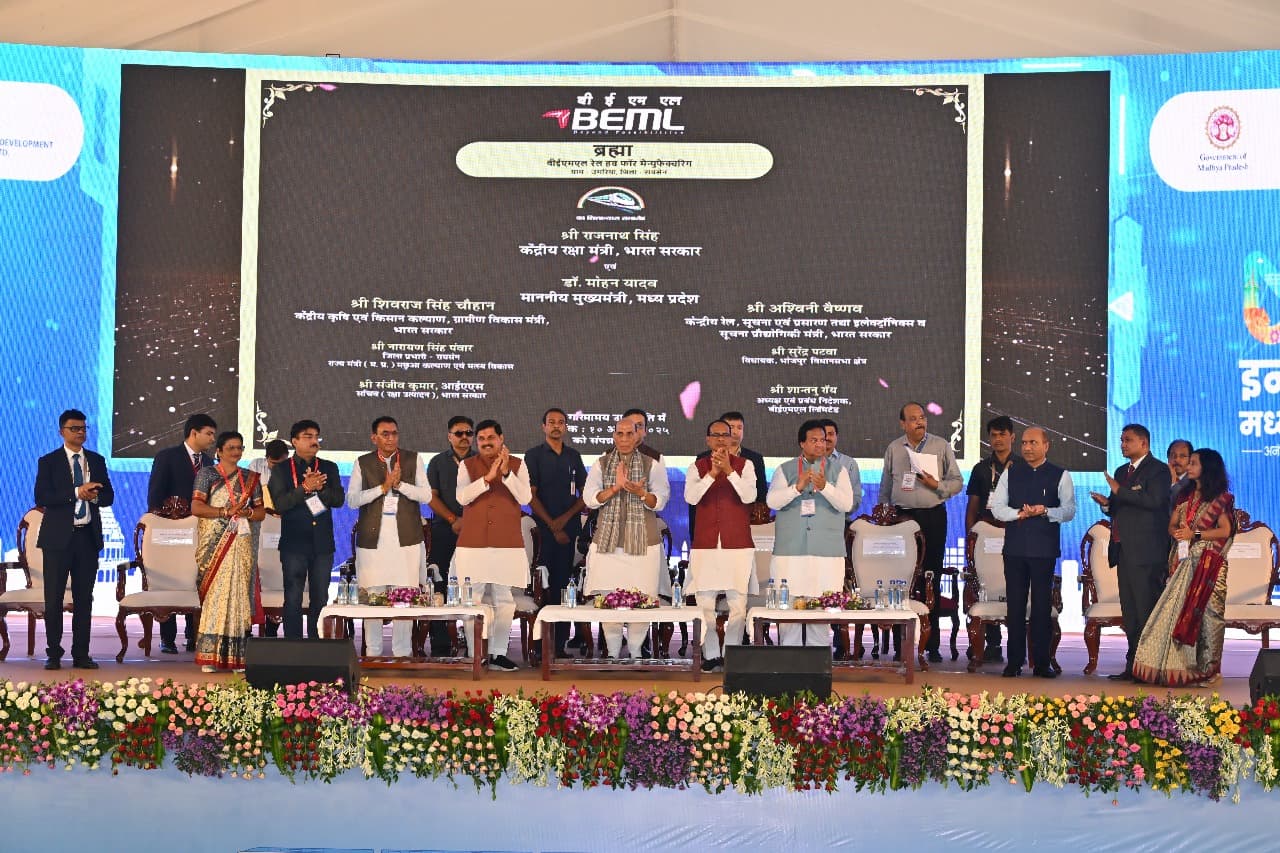
BEML Limited, a Schedule ‘A’ Public Sector Undertaking under the Ministry of Defence, Government of India, laid the foundation stone for its ambitious Greenfield Rail Manufacturing facility – BRAHMA – at Umariya, near Bhopal, Madhya Pradesh.
The foundation stone was laid by the Hon’ble Union Minister of Defence, Shri Rajnath Singh, in the august presence of Hon’ble Union Minister of Agriculture, Farmers Welfare and Rural Development, Shri Shivraj Singh Chouhan; Hon’ble Chief Minister of Madhya Pradesh, Dr. Mohan Yadav; Hon’ble Union Minister for Railways, Information & Broadcasting and Electronics & IT, Shri Ashwini Vaishnaw; Secretary (Defence Production), Shri Sanjeev Kumar, IAS; Joint Secretary, Department of Defence Production, Dr Garima Bhagat; CMD of BEML Ltd., Shri Shantanu Roy; and other senior dignitaries and state officials of Madhya Pradesh.
This state-of-the-art facility, BRAHMA — BEML Rail Hub for Manufacturing — will be developed across 148 acres of land as a world-class manufacturing unit for rolling stock. BEML plans to invest Rs. 1,800 crore in the next few years in a phase-wise manner to fully establish the integrated manufacturing unit. This rail manufacturing unit in Bhopal is poised to significantly boost the regional economy and is projected to generate over 5,000 employment opportunities over the next five years. It is envisioned as a high-tech hub for the design, fabrication, assembly, and testing of a range of railway and metro coaches, including passenger coaches, metro cars, Electrical Multiple Units, Vande Bharat trainsets, and high-speed rail systems. With its cutting-edge infrastructure, the facility will offer innovative, reliable, and sustainable rolling stock solutions for both domestic and export markets.
BRAHMA unit is poised to play a significant role in meeting the growing demand for modern railway infrastructure in India. It will be built on the foundation of sustainability, digitalisation, and automation—integrating the latest technologies in manufacturing, testing, and quality assurance. The plant’s initial capacity will be to produce 125–200 coaches per annum, scalable up to 1,100 coaches annually over the next five years.
The unit is designed to foster an entire ecosystem around manufacturing by catalysing local supply chains and supporting a large number of micro and small-scale industries. It is expected to generate thousands of direct and indirect job opportunities in manufacturing, engineering, logistics, and allied sectors, thereby contributing significantly to the region’s economic development.