Editor’s Note
This article provides an overview of the artificial stone countertop market, defining the product as a composite of natural stone powder and resin. It highlights key attributes like stain resistance and design flexibility, which drive its use in residential and commercial settings. The market is projected to reach significant value, reflecting its growing importance in the construction and interior design sectors.

Artificial stone countertops are surface materials manufactured by mixing and molding natural stone powder and resin, offering uniform texture and high aesthetic appeal. They excel in stain resistance, water resistance, and workability, and are widely used in kitchens, washbasins, and commercial facility interiors. Their high maintainability and design flexibility are highly valued.
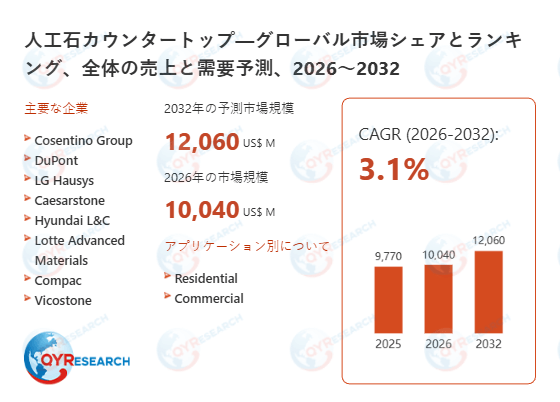
The global artificial stone countertop market is projected to reach approximately USD 12,060 million by 2032. The future growth trajectory is expected to progress at a Compound Annual Growth Rate (CAGR) of 3.1%, with the market size estimated at USD 10,040 million in 2026 and about USD 9,770 million in 2025.
The latest report, “Artificial Stone Countertops – Global Market Share and Ranking, Overall Sales and Demand Forecast, 2026-2032,” provides a detailed analysis focusing on sales scale, sales volume, average price, market share, and rankings of key companies in the global artificial stone countertop market. It also organizes key points of interest for industry stakeholders, including changes in the competitive environment, strategic trends of major companies, new market entrants, and the impact of technological innovation.
The artificial stone countertop market framework consists of four areas: product trends, application structure, corporate strategy, and regional distribution. The report analyzes the main driving factors and risk factors affecting market growth and presents prospects for future market development.
Product Segments: Engineered Quartz Stone, Artificial Marble
The report compares the performance characteristics, adoption rates, price ranges, and technological competitiveness of each product to identify areas contributing to growth. It also organizes sensitivity to demand fluctuations and product lifecycles to assess the long-term market potential of each product.
Application Segments: Residential, Commercial
The report analyzes the background of adoption, usage scenarios, and demand intensity by industry for each application. It maps market penetration by application to clarify areas of accelerated growth and those showing signs of maturity.
Key Companies: Cosentino Group, DuPont, LG Hausys, Caesarstone, Hyundai L&C, Lotte Advanced Materials, Compac, Vicostone, Cambria, Santa Margherita, Quartz Master, SEIEFFE, Quarella, Zhongxun, Sinostone, Baoliya, Qianyun, The Engineered Stone Group, Aristech Acrylics, PengXiang Industry, ChuanQi, New SunShine Stone
The report categorizes the strategies of key players and organizes changes in the competitive structure. It captures corporate trends through multi-faceted analysis of product lines, R&D investment, partnerships/acquisitions, and regional strategies, visualizing competitive advantages.
Target Regions: North America, Asia Pacific, Europe, Latin America, Middle East & Africa
The report analyzes demand characteristics, regulatory trends, supply systems, and economic environments in each region, organizing key factors affecting market growth. Through regional comparisons, it identifies priority and potential markets for players.
The report organizes market expansion factors (technological innovation, industrial demand, cost reduction, policy support, etc.) and analyzes structural factors driving market growth. Simultaneously, it clarifies risk factors affecting corporate decision-making, such as supply chain constraints, regulatory risks, and the rise of alternative technologies, providing a basis for business strategy decisions.
Chapter 1: Global Market Overview and Key Trends (2021-2032)
Chapter 2: Competitiveness Analysis and Ranking of Key Companies (2021-2026)
Chapter 3: Market Trends by Product Category (2021-2032)
Chapter 4: Market Analysis by Application (2021-2032)
Chapter 5: Regional Market Outlook (2021-2032)
Chapter 6: Detailed Country-Specific Market Analysis (2021-2032)
Chapter 7: Profiles of Key Companies (2021-2026)
Chapter 8: Supply Chain and Distribution Structure Analysis
Chapter 9: Market Opportunities and Strategic Recommendations
Chapter 10: Appendix