Editor’s Note
This article details the intensive production process at a major non-ferrous metals facility, highlighting the scale and precision involved in modern industrial manufacturing.
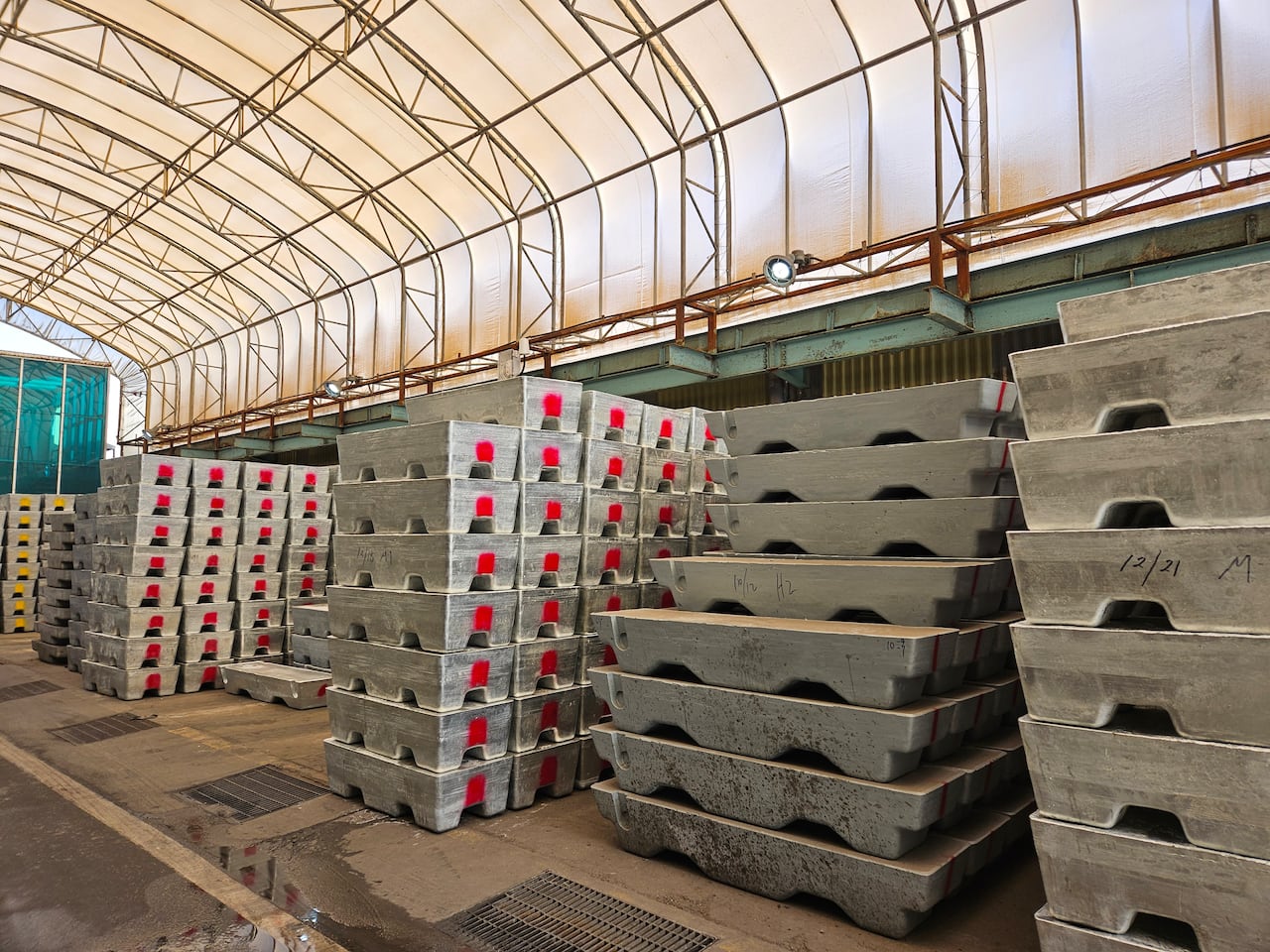
On December 24 last year, at the zinc casting factory of Korea Zinc’s Onsan Smelter in Ulju-gun, Ulsan, hundreds of zinc ingots, shaped in molds heated to about 500 degrees Celsius, were stacked in one corner of the factory filled with the sound of clashing metal and heat. They varied in size and shape, from jumbo zinc ingots weighing over 1 ton to zinc ingots for die-casting (alloy) that looked like stacked small bricks. It takes about 1-2 hours for the ingots to cool completely after leaving the mold, with steam still rising from some surfaces.
Korea Zinc produces approximately 1.2 million tons annually of about 10 types of non-ferrous metals, including zinc, lead, silver, and copper, making it the world’s largest producer. Most are used as basic materials in major industries such as electronics, semiconductors, automobiles, and steel. Among them, zinc (650,000 tons) has the highest production share. Zinc, which forms a thin protective film on its surface upon contact with moisture, is primarily used as a coating agent to prevent corrosion in steel materials like automotive steel plates, steel pipes, wires, and steel structures. It is also used in making items from toy figures to faucets, zippers, buckles, and communication equipment.
The background of Korea Zinc’s global leadership in non-ferrous metal production lies in its differentiated smelting technology (the process of melting ore/scrap in a furnace to separate, extract, and refine metals). While non-ferrous metal smelting is considered a universal technology anyone can perform, Korea Zinc is evaluated as unrivaled in its capability to simultaneously maintain high quality and economic efficiency.
Korea Zinc extracts not only zinc and lead from zinc concentrate (metal ore with primary impurities removed) but also valuable metals like gold, silver, and copper, as well as sulfuric acid. Unlike most smelters that handle only single target metals like zinc or lead, Korea Zinc operates an integrated zinc-lead-copper process. It also possesses proprietary technologies like the Zinc Residue Treatment (TSL) process, which further recovers zinc and valuable metals from by-products remaining after zinc smelting, with the final residue discharged as clean slag used as raw material for cement or asphalt.
On average, zinc concentrate contains 50.6% zinc, with the remainder being 30% sulfuric acid, 16.4% other rare/scarce metals, 3% lead, and 0.006% silver, etc. Lead concentrate is similar. While lead constitutes over half at 56%, 28.7% is other rare/scarce metals, with the rest comprising sulfuric acid (15%), silver (0.311%), copper (0.035%), and gold (0.0003%). From by-products generated during the concentrate smelting process, Korea Zinc obtains about 10 tons of gold, 2,500 tons of silver, and 1.5 million tons of sulfuric acid annually. The market price of 10 tons of gold is approximately 140 billion won.
Despite recent concerns about the smelting industry’s outlook due to surging Chinese demand and cost burdens, Director Kim explained that profitability can be defended by increasing the recovery rates of valuable and rare/scarce metals. Korea Zinc plans to increase the recovery rates of antimony, indium, tellurium, and palladium by more than 20-30% for each item. Antimony and bismuth are strategic mineral resources used in fourth-generation small modular reactors, nuclear submarines, flame retardants, and catalyst raw materials.
Smelting companies receive a treatment charge (TC) from mining companies as payment for smelting concentrate. Recovery rate refers to the proportion of metal extracted from a given amount of concentrate. Although it varies by type, contracts with mining companies are typically around 90%. If more metal is extracted than the promised rate, it becomes the smelter’s share, known in the industry as “free metal.” Korea Zinc has already raised its metal recovery rate to a level close to 100%.
Based on its non-ferrous metal smelting technology, Korea Zinc also plans to establish a presence in the nickel business, a key raw material for secondary battery precursors (substances participating in chemical reactions). The ‘All-in-One Nickel Smelter,’ under construction with a target of commercial production in 2026, is expected to be the starting point. This facility can process various raw materials simultaneously, from nickel concentrate to intermediates like matte (containing 70-75% nickel) and Mixed Hydroxide Precipitate (MHP), and even black powder extracted from waste batteries. MHP is a raw material for secondary battery precursors.
Korea Zinc possesses both pyrometallurgical (causing chemical reactions at high temperatures) and hydrometallurgical (electrolyzing ore dissolved in substances like sulfuric acid) smelting technologies, which is expected to help in flexibly utilizing nickel raw materials. Nickel intermediates become matte through pyrometallurgical processing of raw ore from nickel mines, and MHP through hydrometallurgical processing.
At the All-in-One Nickel Smelter construction site, located about a 5-minute drive from the Onsan Smelter that day, dump trucks and cranes were busily moving about. Korea Zinc, together with its subsidiary Kemco, is investing about 500 billion won in the All-in-One Nickel Smelter, which is expected to produce 43,600 tons of nickel annually from the end of 2026. Combined with Kemco’s existing production, the total will reach 65,000 tons, enough for 1.6 million electric vehicles.
When Korea Zinc begins full-scale supply of domestically produced nickel to precursor plants, the domestic secondary battery supply chain’s dependence on China is expected to decrease somewhat. The precursor is a representative item currently highly dependent on China. Although it is a core material accounting for 70% of cathode material prices, the proportion imported from China exceeds 90%. Korea Zinc has established its own precursor production plant in partnership with LG Chem, and its high-nickel precursor manufacturing technology has also been recognized as a National Core Technology.