Editor’s Note
This article details the remarkable discovery of a gold torc by a water supply operator in Asturias, Spain, and the swift archaeological response that preserved crucial context about its origins.
On the morning of August 29, Sergio Narciandi was working as an operator for the company managing water supply in the Asturian municipality of Peñamellera Baja. While searching for an old water intake at the Cavandi supply point, he came across a spectacular gold torc lying on a path.
After the initial shock, he reported the find to the authorities. That same afternoon, a team of archaeologists inspected the site, located a second fragmented torc, and determined the cause of the pieces’ appearance. It was most likely a deposit of valuable objects—gold ornaments—common in the recent Atlantic Prehistory, possibly dismantled by a small landslide triggered by a fire.
This valuable information would have been irretrievably lost if the object had reached archaeologists as a result of uncontrolled digging. In this case, the exemplary action of the citizen and the swift response of the Archaeological Museum of Asturias have allowed the find to be properly documented, thus learning a bit more about prehistoric gold.
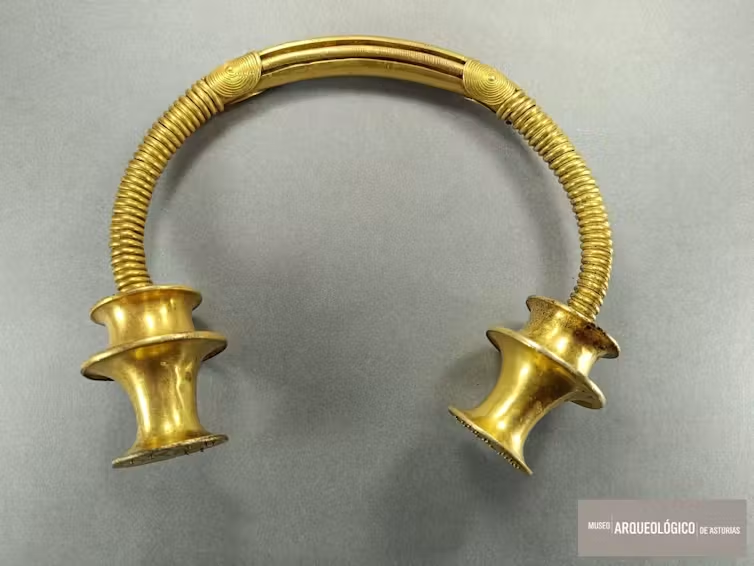
The deposit consisted of two torcs. This term refers to a type of rigid necklace, often made of valuable materials like gold, documented especially during the Iron Age, between the 5th and 1st centuries BC.
A rigid necklace with a gilded surface that can be assimilated into the set of torcs generically called Asturian-Northwestern Galician, characterized by rods with double-scotia terminals and decorations developing geometric ornamental motifs.
Torcs are open, and the ends are generally finished with heads of different morphologies. The rigid part that fits around the neck can have different sections (rounded, rectangular) and sometimes appears decorated with filigrees of geometric motifs.
It is a rigid necklace with a gilded surface and a rectangular-section ring finished with double-scotia section heads.
These pieces reflect the exceptional nature and skill of goldsmith artisans in pre-Roman societies. Their presence in the northwest of the peninsula is relatively frequent in areas such as Burela in Galicia or Cangas de Onís in Asturias. Although it is currently impossible to know whether they were worn by men, women, children, or adults, they undoubtedly indicated the high social status of the person who owned them.
Traditionally they have been associated with warriors, although it is difficult to assert this with reliable scientific basis.
Metals appeared at an advanced stage of Prehistory. The first to be used were copper and gold, with evidence of their use dating back about 8,000 years, although their widespread use did not occur until the 5th and 4th millennia BC.
Later, alloys such as bronze or other metals like silver or iron were used. The development of metallurgy occurred independently in various parts and is the driver of a complex series of ideological, social, economic, and technological changes. One of those places is the south of the Iberian Peninsula, where it began just over 5,000 years ago.
The first pieces made of gold were ornaments, small plates used as body decorations, mostly documented in funerary sites. These objects seem to reflect the social role of individuals, highlighting their relevance within the community.
The Varna Necropolis in Bulgaria is a good example of the role of these gold ornaments and their relationship with burials 6,000 years ago.
It is about 5,000 years ago that weapons began to be systematically made from copper, and later bronze. These include arrowheads, axes, daggers, swords—a whole series of elements reflecting a progressive increase in interpersonal and intergroup violence, and possibly the time when the first wars occurred.
Metallurgical artisans used different metals to create specific objects, although gold continued to be a metal linked to personal adornments and luxury items.
Metal objects, and particularly jewelry, are probably the part of the archaeological record that most attracts public attention.
However, in most cases their scientific utility is limited because we rarely have reliable information about what is truly valuable to archaeologists: the context, the circumstances in which they appeared, and the objects and structures they were associated with. It is this that truly allows us to interpret their meaning and use them to reconstruct the past.
The appearance of treasures in archaeological sites generates great curiosity in society. So much so that many archaeological sites have disappeared due to looters attempting to find metal objects, especially gold pieces.
Uncontrolled searches, with or without metal detectors, are illicit activities currently penalized by law in most countries and cause an irreplaceable loss of historical information.